Hamilton vs Verstappen: Head to Head | Formula Dream
Guides
Hamilton vs Verstappen: The Head to Head, Properly Measured
Hamilton and Verstappen compared on career numbers, the one season they fought for a title, and why team-mate data is the only honest way to rank two drivers who never shared a garage.
On career totals it is not close. Lewis Hamilton has 7 world championships, 106 wins, 104 poles and 207 podiums from 392 races. Max Verstappen has 4 championships, 71 wins, 48 poles and 131 podiums from 245 races.
You can hear both sides of it rather than read about it: every message we hold is collected on Hamilton's team radio page
On rate it is much closer, because Verstappen has done it in 147 fewer races.
And on the only question people actually want answered, who is better, the honest response is that the numbers cannot tell you, for one specific reason: they have never been team-mates. Everything else is a comparison of cars.
Here is what the record shows, what the single season they fought over actually proves, and the one method that does produce a fair answer.
The career numbers, side by side
Career totals. Hamilton leads every raw number; the rate tells a different story.
Lewis Hamilton
World championships: 7 (2008, 2014, 2015, 2017, 2018, 2019, 2020)
Race wins: 106
Pole positions: 104
Podiums: 207
Races entered: 392
2026 team: Ferrari
Max Verstappen
World championships: 4 (2021, 2022, 2023, 2024)
Race wins: 71
Pole positions: 48
Podiums: 131
Races entered: 245
2026 team: Red Bull
Hamilton leads every raw total. Verstappen leads on rate: roughly a win every 3.5 races against Hamilton's every 3.7, and he has been in a championship-winning car for a smaller share of his career.
Both of those framings are true, which is the first clue that the argument is not really about arithmetic.
The one season they actually fought: 2021
They have shared a grid for a decade but competed for a title exactly once, and it went to the last lap of the last race.
Hamilton and Verstappen arrived at the 2021 Abu Dhabi Grand Prix tied on 369.5 points each. Not close. Level.
Hamilton led most of the race after a better start. With five laps to go, Nicholas Latifi crashed at Turn 14 and the safety car came out. Verstappen pitted for fresh soft tyres, Hamilton stayed out on old hards to keep track position, and the race restarted for a single racing lap. Verstappen passed him into Turn 5 and won the title by 2.2 seconds on the road and 8 points in the standings, finishing on 395.5 to Hamilton's 387.5.
Across the whole season Verstappen took 10 wins from 22 races, 18 podiums and 10 poles. Hamilton was right there for all of it.
The reason 2021 settles nothing is that the deciding lap turned on a race control decision about how to resume the race, not on the two drivers. It is the closest they have come to a controlled comparison, and even it was decided by a variable neither of them controlled. The argument over that decision happened live and out loud, and the radio from that race is preserved message by message, both pit walls included.
Every qualifying session they have both entered, counted
Career totals are shaped by machinery. Qualifying is the closest thing to a clean read, because both cars are on low fuel and new tyres at the same moment, so we counted every session both drivers entered from 2018 to the 2026 Italian Grand Prix.
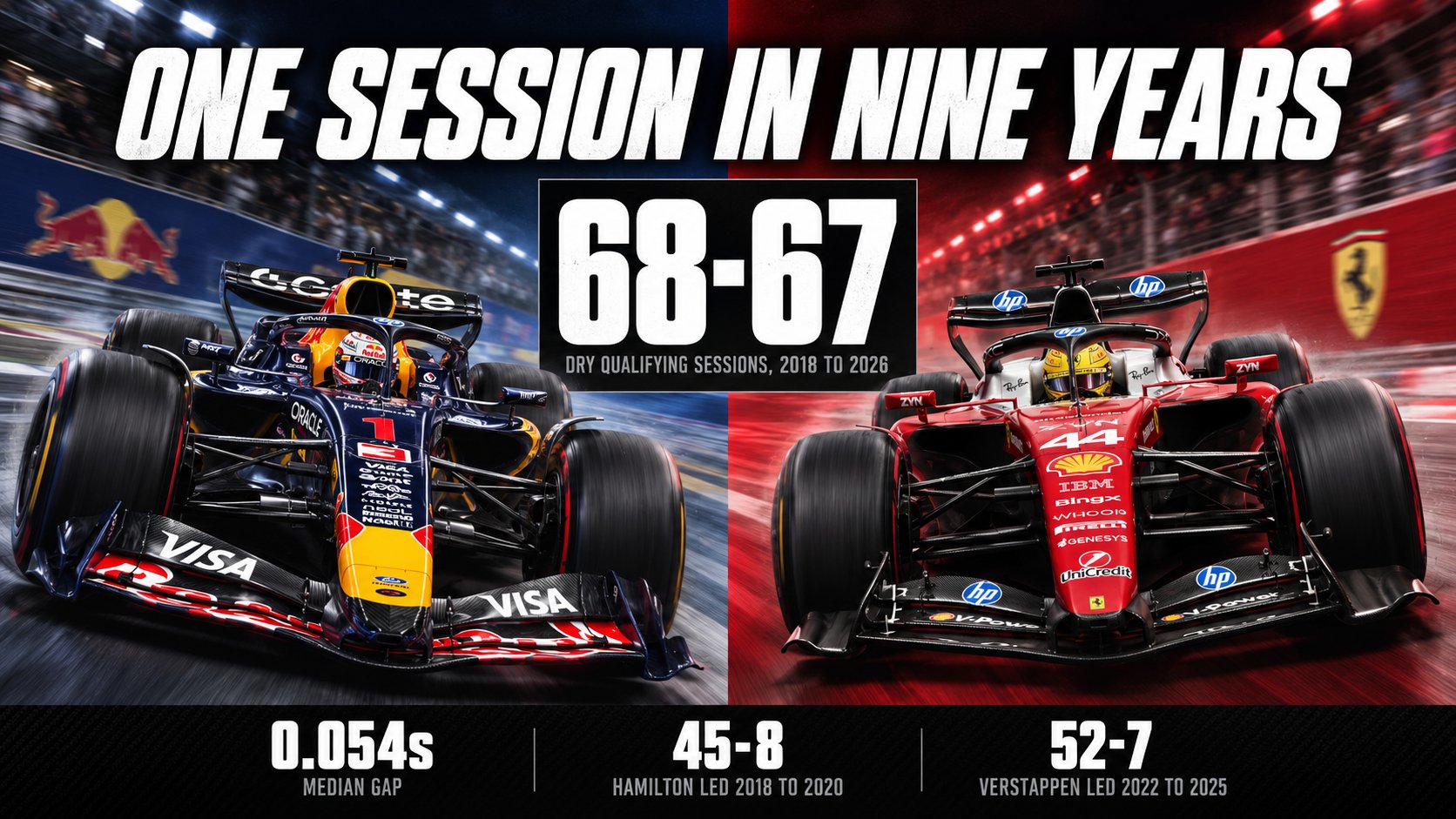
148 sessions. In the 135 that were dry, Verstappen finished ahead 68 times and Hamilton 67. The median gap between their fastest laps is 0.054 seconds.
Season
Sessions
Verstappen
Hamilton
Median gap
2018
18
3
15
Hamilton by 0.683
2019
21
4
17
Hamilton by 0.405
2020
14
1
13
Hamilton by 0.526
2021
10
5
5
Verstappen by 0.095
2022
17
17
0
Verstappen by 0.634
2023
3
3
0
Verstappen by 0.733
2024
21
18
3
Verstappen by 0.531
2025
18
14
4
Verstappen by 0.342
2026
13
3
10
Hamilton by 0.124
Dry qualifying sessions both drivers entered, from F1 timing data. Deleted laps excluded.
One session separates them across nine years, and the total hides everything. Hamilton led 45 to 8 from 2018 to 2020. Verstappen led 52 to 7 from 2022 to 2025. The swings track the machinery almost exactly, which is the point this article is making everywhere else: Mercedes had the quickest car for the first stretch and Red Bull for the second.
2026 has turned again. Hamilton leads 10 sessions to 3 in his second season at Ferrari, by a median of 0.124 seconds.
Two smaller findings worth having. In the 13 wet or part-wet sessions, which we count separately because rain changes the question, Verstappen leads 9 to 4 by a median of 0.676 seconds, more than twelve times his dry margin. And 2023 contributes only three sessions because our timing coverage for that year is incomplete, so those rows carry very little weight.
Why career stats cannot rank two drivers
Three problems make raw totals close to useless for this question.
The car does most of the talking. Hamilton's seven titles came in an era when Mercedes built the dominant car; Verstappen's four came when Red Bull did. Put either of them in a midfield car and the wins stop, regardless of talent. This is not a slight on either driver, it is just how Formula 1 works.
Longevity inflates totals. Hamilton has entered 147 more races. Given enough seasons in a good car, wins accumulate. That measures career length and opportunity as much as speed.
Eras are not comparable. They have raced different tyres, different aerodynamic rules, different points systems and different calendar lengths. A win in a 17-race season is not the same unit as a win in a 24-race one.
Every site publishing a Hamilton versus Verstappen stat table is comparing two drivers plus two cars plus two eras, and reporting the total as if it were about the drivers.
The only fair comparison in F1 is a team-mate
There is one place in the sport where the car is genuinely controlled for: the other side of the same garage. Same machinery, same upgrades, same track, same session. It is the closest thing F1 has to a laboratory.
Qualifying is the cleanest read of all, because it strips out strategy, traffic, safety cars and reliability. One lap, everything on the table.
We measured every team-mate qualifying pairing on the grid. What it shows is how brutal the honest comparison is: Verstappen out-qualified Yuki Tsunoda 20-0 in 2025, and Fernando Alonso beat Lance Stroll 22-0 in the same season. Two clean sweeps. On the other side, Kimi Antonelli lost to George Russell 21-2 as a rookie and now leads him 7-4, the biggest swing on the grid.
Those numbers say something real, because the car is held constant. A career win total does not. The full set is in F1 team-mate qualifying head to head.
We also measured driver consistency the same way, using lap-time variance within a stint. Russell's lap times varied by 0.220 seconds across 2025; Antonelli, in the identical car, varied by 0.453. That is a factor of two, in the same machinery, and it is the sort of difference no championship table will ever show you.
Apply that standard to Hamilton and Verstappen and you get an honest answer: there is no clean data, because they have never shared a car. Anyone who tells you otherwise is selling a conclusion they already had.
Where they stand in 2026
The 2026 grid has moved on from the rivalry.
Hamilton is at Ferrari, still running the number 44 he has carried since his karting days, having turned down the number 1 through every one of his championship years. Verstappen is at Red Bull and has switched to the number 3, using a rule change that only came into effect for 2026 and lets a driver change their permanent number for the first time since 2014. Both stories are in F1 driver numbers explained.
Neither is the reigning champion. Lando Norris is, and he carries the number 1 for 2026.
The comparison you can actually settle
If the point of all this is that team-mates are the only fair test, there is a live example of it on the current grid.
Lando Norris and Oscar Piastri share a McLaren, and we measured them at 0.035% apart over a qualifying lap across 2025, roughly three hundredths of a second, with Norris ahead 13-10. That is what a genuinely close pairing looks like when the car is held constant, and the championship still separated them by 13 points. It is written up in Piastri vs Norris.
For the rivalry that decided the most recent title, by two points, see Norris vs Verstappen.
Follow the head to head yourself
The comparison that matters happens live, session by session, and the team-mate gap is visible in real time if you know where to look.
The Formula Dream app runs a live Dashboard through every session: every car on the circuit map, and a timing tower with lap times, gaps and intervals, tyre compound and age, plus flag and safety car alerts the moment race control calls them. Race Center carries the standings, results and the full weekend timeline. You also get live driver radio as it is broadcast, and every FIA document of the weekend as it is published, which is where the stewards' decisions that settle contested races actually appear.
Free, no subscription, no ads, independent. Not affiliated with Formula 1.
Their current seasons are measured race by race in Lewis Hamilton's 2026 and Max Verstappen's 2026: Hamilton won his first race for Ferrari in Barcelona, and Verstappen is still looking for his first win of the season.
Frequently asked questions
Who has more wins, Hamilton or Verstappen?
Hamilton, with 106 race wins to Verstappen's 71. Hamilton has also entered 147 more races, so Verstappen's win rate per start is marginally higher.
Who is better, Hamilton or Verstappen?
There is no clean answer, because they have never been team-mates and so have never driven the same car. Career totals compare two drivers plus two cars plus two eras. The only comparison in F1 that controls for machinery is a team-mate comparison.
How many championships does each have?
Hamilton has 7 (2008, 2014, 2015, 2017, 2018, 2019, 2020). Verstappen has 4 (2021, 2022, 2023, 2024).
Did Hamilton and Verstappen ever fight for a title?
Once, in 2021. They went into the final race at Abu Dhabi tied on 369.5 points. A late safety car let Verstappen pit for fresh tyres, and he passed Hamilton on the final lap to win the title by 8 points.
What numbers do they use in 2026?
Hamilton runs 44 at Ferrari, the number from his first kart. Verstappen runs 3 at Red Bull, having changed from 33 under a rule that only began allowing number changes in 2026.
Every Miami Grand Prix winner, measured: five races, and pole has won only one of them
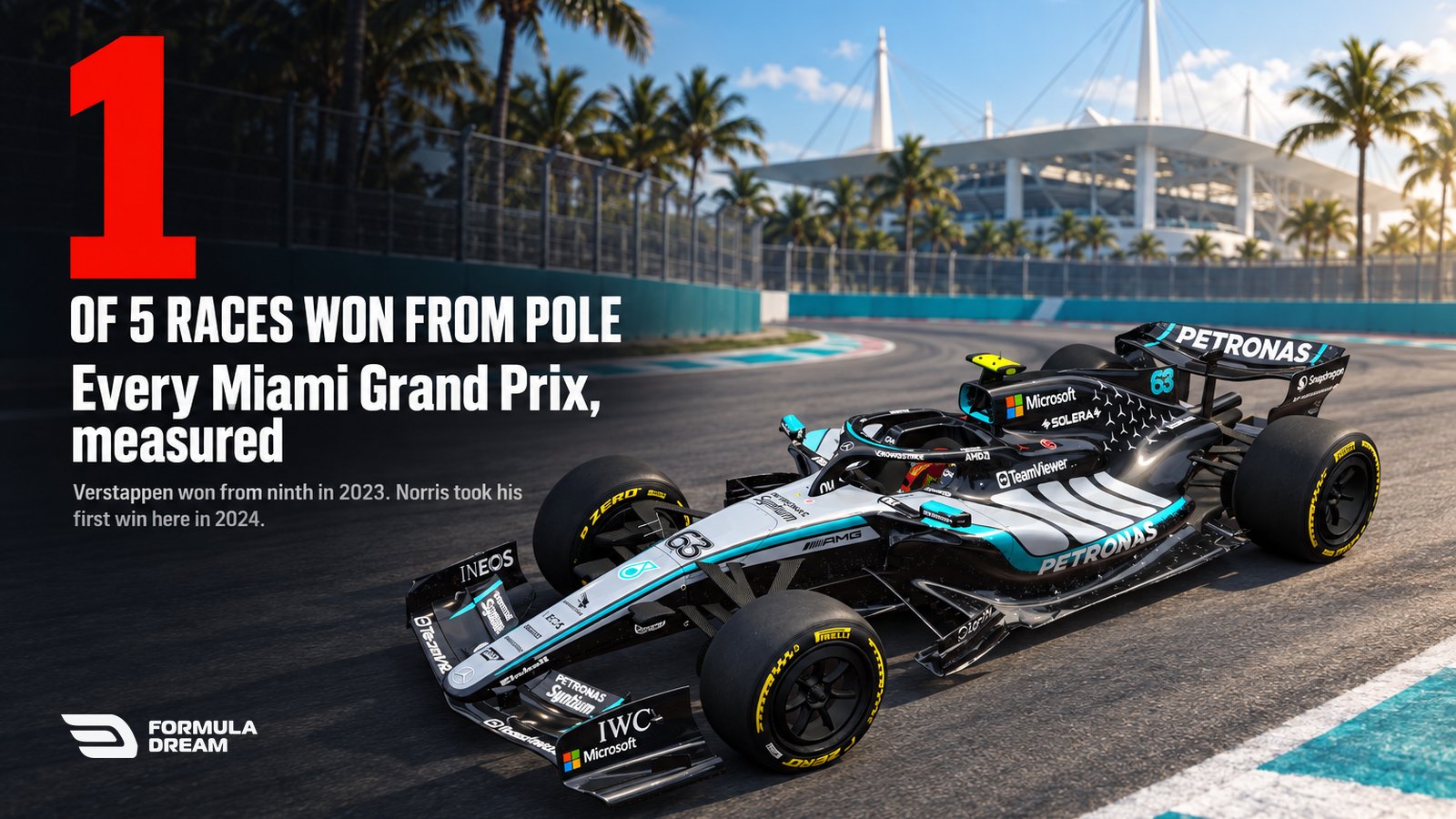
Five Miami Grands Prix have been held since 2022, and only one was won from pole: Kimi Antonelli's in 2026. Max Verstappen won from ninth in 2023, and Lando Norris took his first win there in 2024. Every winner, grid slot and safety car, measured.