F1 Radio Codes Explained: What the Teams Are Actually Saying
Team radio is broadcast to the whole world, including your rivals. That is why so much of it is in code. Here is what box, Plan B, delta, li-co and the rest actually mean.
Everything a Formula 1 team says to its driver is broadcast. Not just to the television audience, but to every rival pit wall on the grid, in real time.
That single fact explains why so much of team radio sounds like a foreign language. The codes exist because the enemy is listening. A team that says "we're pitting this lap for hards" has just told nine other strategists exactly what to do about it. A team that says "Plan B" has not.
Here is what the recurring terms actually mean.
Box, box, box
The most famous one, and the least mysterious. "Box" means come into the pit lane.
It comes from the pit box, the marked area where the car stops. Teams use it instead of "pit" for a practical reason: over a crackling radio, at 300 km/h, inside a helmet, with an engine behind you, "box" is a much harder word to mishear. "Pit" can be lost or confused. "Box" has a hard consonant at each end and cuts through.
It gets repeated two or three times for the same reason. "Box, box, box" is not urgency, it is redundancy. If the driver only catches one of the three, the message still arrived.
Plan A, Plan B, Plan C
This is where the code becomes genuinely secret.
"Plan B" means switch to a different pre-agreed strategy, without saying out loud what that strategy is. The plans are worked out and numbered before the race, so the driver knows that Plan B might mean an extra stop, a different compound order, or a longer first stint. Nobody listening knows which.
Ferrari have used this most visibly over the years, and the point is precisely that you cannot tell from the outside whether "Plan B" means pitting now or staying out ten more laps. The information is worthless to a rival without the codebook.
Some teams number them, some name them after other things entirely. The principle is the same: agree the options in the garage, refer to them by label on the radio.
Delta
Delta means a time difference. It is used two ways and they are easy to confuse.
In normal running, a delta is the gap between two laps or two cars. A negative delta means faster, because the lap time is smaller. A positive delta means slower.
Under a virtual safety car it means something much more specific: a mandatory minimum lap time that every driver has to stay above, displayed on the steering wheel and updating constantly. Fall the wrong side of it and it is a penalty. That version is covered properly in what the VSC delta is.
If you hear "you're two tenths up on the delta" during green flag running, it is a comparison. If you hear it under a caution, it is a rule.
Lift and coast, or "li-co"
Lift off the throttle before the braking zone and let the car roll.
It sounds like giving up free lap time, and it is, deliberately. A driver lifts early, coasts, then brakes later into the corner. Doing that saves three separate things at once: fuel, because the engine is not being fed; brake temperature, because there is less speed to scrub off; and tyres, for the same reason.
Teams shorten it to "li-co" on the radio. When you hear it, the team has decided that finishing the race matters more than the two or three tenths a lap it costs. It is one of the clearest signals that something is being managed rather than raced.
The management vocabulary
A cluster of terms all mean some version of "go slower on purpose, in a specific way":
"Manage the tyres" or "we need these tyres to the end": the stint has been extended, usually because the strategy changed.
"Fuel save" or a target number: the car will not finish at the current consumption. Often paired with lift and coast.
"Engine mode" changes: turning the power unit up or down, usually described by a number or a name rather than what it does.
"Target plus two": run two tenths slower than the reference lap time.
None of these are casual. Each one is an instruction with a number behind it.
Multi 21
The most famous coded message in the sport, and a useful lesson in what codes cost.
At the 2013 Malaysian Grand Prix, Red Bull told Sebastian Vettel "Multi 21": car 2 finishes ahead of car 1, meaning Vettel was to hold position behind Mark Webber. It was a clean, deniable instruction that meant nothing to anyone outside the team.
Vettel ignored it and passed Webber for the win. The code worked perfectly. The driver did not. It remains the best-known example of a team radio phrase that was designed to be opaque and then became permanently famous, which is roughly the opposite of the intention. It sits alongside the other great ones in famous F1 team radio messages.
Multi 21 is also the reason people assume team orders are always coded. We counted the language across 37,359 broadcast messages and found the opposite: "let him past" is used more than every coded alternative combined. The numbers are in F1 team orders, measured.
Why teams bother
Radio is the one channel where a team has to tell its driver the truth in real time, and it cannot be encrypted. So the vocabulary evolved instead: say the thing, but say it in a way that only costs your rivals effort to decode.
The result is a language where the most important messages are often the shortest and flattest sounding. A calm "Plan B, Plan B" can be a bigger moment in a race than any amount of shouting, and the mechanics of how the system works are worth understanding alongside the vocabulary.
Hear the codes as they are used
Reading what "Plan B" means is one thing. Hearing it land mid-race, and watching what happens to the timing screen thirty seconds later, is where it becomes obvious.
The Formula Dream app carries live driver radio as it is broadcast, alongside a live Dashboard with every car on the circuit map and a timing tower showing lap times, gaps, intervals, tyre compound and age, so you can watch a coded instruction turn into a pit stop in real time. You also get every FIA document of the weekend as it is published.
Free, no subscription, no ads, independent. Not affiliated with Formula 1.
If you want to go back through old messages rather than listen live, our Team Radio Archive on the website holds more than 39,000 of them from 2018 onwards, searchable by driver, team and session, with the audio and a colour-coded transcript. That is a website tool rather than part of the app.
Frequently asked questions
What does box box box mean in F1?
Come into the pit lane. It comes from the pit box, the marked area where the car stops, and is used instead of "pit" because it is much harder to mishear over the radio. Repeating it is redundancy, not urgency.
What does Plan B mean in F1?
A switch to a different pre-agreed strategy, without naming it. The alternatives are worked out before the race and referred to by label, so rival teams listening cannot tell what has changed.
What does delta mean in F1?
A time difference. In normal running it is the gap between two laps or two cars, where negative means faster. Under a virtual safety car it means a mandatory minimum lap time that carries a penalty if a driver goes below it.
What is lift and coast in F1?
Lifting off the throttle before the braking zone and letting the car roll. It costs lap time and saves fuel, brake temperature and tyre wear at the same time. Teams shorten it to "li-co".
Why do F1 teams use code on the radio?
Because team radio is broadcast publicly and in real time, so every rival pit wall hears it. Codes let a team give a clear instruction to its driver without handing its strategy to the competition.
Every Miami Grand Prix winner, measured: five races, and pole has won only one of them
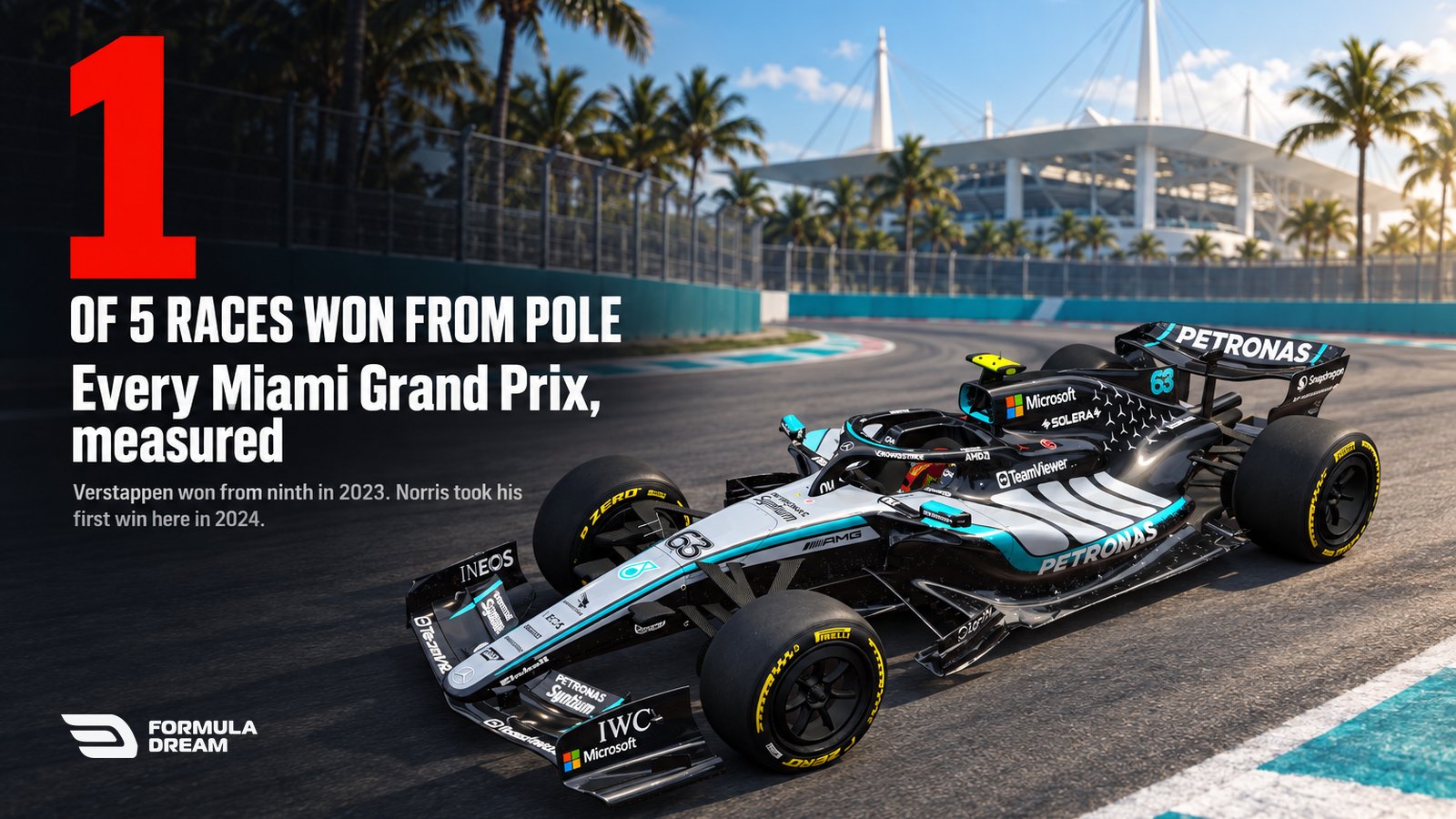
Five Miami Grands Prix have been held since 2022, and only one was won from pole: Kimi Antonelli's in 2026. Max Verstappen won from ninth in 2023, and Lando Norris took his first win there in 2024. Every winner, grid slot and safety car, measured.