How Do F1 Teams Make Money? The Real Numbers | Formula Dream
Guides
How F1 Teams Make Money: Inside the $4 Billion Money Machine
How F1 teams make money, the prize money split by the Concorde Agreement, why even finishing last pays $60 million, the sponsorship that now dwarfs it, and how F1 became a $4 billion business.
Formula 1 teams spend hundreds of millions of dollars a year chasing performance. So where does all that money come from, and do the teams actually make any? F1 is now a business worth close to $4 billion a year, and the way that money flows to the teams is one of the most interesting and least understood parts of the sport. Here is how F1 teams actually get paid.
Broadly, an F1 team has three sources of income: prize money from the sport's central pot, sponsorship from the brands on the car, and investment from the team's owner. For most teams, the first two are the ones that keep the lights on.
Prize money: the Concorde Agreement
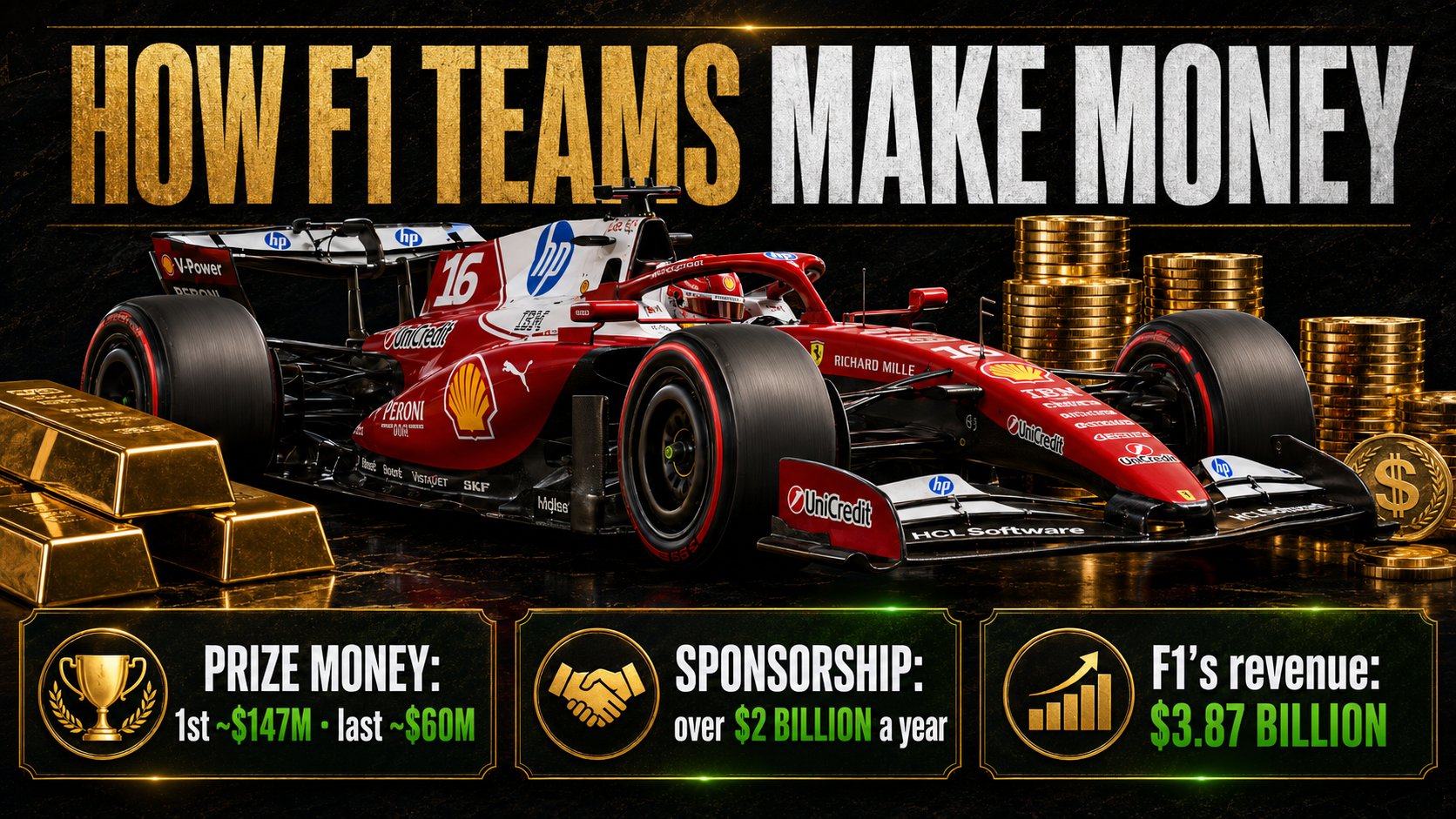
The commercial rules of F1 are set by a document called the Concorde Agreement, signed between the teams, the FIA and F1's owner. Its most important job is dividing up the money. Under it, the teams are paid a share of the sport's revenue. Liberty Media's results put that at $1.4 billion in 2025, up from $1.27 billion in 2024: about 36% of all Formula 1 revenue, and about 45% of its primary revenue from race hosting, media rights and sponsorship.
Crucially, this money is not split equally. About half of the pot is handed out based on where a team finished in the previous year's constructors' championship, so success on track directly turns into cash. The exact shares are not published, and the estimates in circulation disagree with each other, which we unpick in how F1 prize money is split. What the total does tell you is the average: $1.4 billion across ten teams is $140 million a team in 2025. Even the team at the bottom receives tens of millions, which is a big reason an entry is so fiercely valuable.
Sponsorship: the bigger prize now
For the top teams, prize money is no longer even the biggest earner. Sponsorship has overtaken it. Across the grid, Formula 1 sponsorship was reported to have passed $2 billion in 2024, because a winning F1 car is one of the most valuable advertising spaces in the world, seen by hundreds of millions of people across a global season.
The biggest deals are enormous. McLaren's title partnership with Mastercard, which renamed the team from 2026, is reported to be worth around $100 million a season, the largest title deal on the grid, against a reported $60 million to $70 million a season for Ferrari's with HP and Red Bull's with Oracle. Every logo you see on a car, on the sidepods, the rear wing, the halo, the driver's overalls, is a sponsorship slot sold for real money, and the better a team performs, the more that space is worth.
The owners, and the "trophy asset"
Behind the prize money and sponsorship sit the owners. Some teams are backed by giant car manufacturers, Ferrari, Mercedes, Audi, who treat F1 as the ultimate marketing platform. Others are owned by billionaires or investment groups. Their published UK accounts show how uneven the business is. In 2024 Mercedes made a profit of £120.3 million on revenue of £636 million, and McLaren £54.2 million on £530.3 million, while Red Bull Racing, constructors' champions in 2022 and 2023, made just £1.68 million on £314.4 million. Williams has lost a combined £211 million since 2020.
The owners keep investing anyway, because an F1 team has become a "trophy asset". Sportico valued the ten 2025 teams at an average of $3.42 billion each, up 48% in a year, so even a team that barely breaks even can be a spectacular investment as its value climbs.
Where the sport itself makes its billions
The money the teams share has to come from somewhere, and that is F1 itself, run commercially by Liberty Media, which took over in 2017 and transformed the sport into a record-breaking business with $3.87 billion of revenue in 2025. F1's own income comes mainly from broadcasting rights (TV deals around the world), race-hosting fees (circuits pay large sums for the privilege of holding a Grand Prix), its own sponsorship, and premium hospitality. F1 keeps its share and distributes the rest to the teams, and the whole machine has been growing at record pace.
Why finishing higher pays twice
Put it all together and you see why every position in the championship matters so much financially. Finishing higher in the constructors' standings brings a bigger slice of the prize money, and it makes a team more attractive to sponsors, who pay more to be on a winning car. Success compounds: win more, earn more, spend more (within the cost cap), win more again. It is the financial engine that drives the entire sport.
What changed in 2026: an eleventh team
The money now splits eleven ways instead of ten.
Cadillac joined the grid for 2026 as Formula 1's eleventh team, and every existing team's share of the prize pot got smaller as a result. That dilution was anticipated in the 2021 Concorde Agreement, which set an anti-dilution fee a new entrant must pay to the existing teams as compensation.
The fee had been fixed at $200 million, but the teams argued it was far too low against their current valuations, and the figure Cadillac paid came in at $450 million, split ten ways for $45 million each.
The arithmetic behind the argument is worth understanding, because it explains why the existing teams resisted a new entry so hard. A one-off $45 million is a good year's compensation. But the dilution is not a one-off: it continues every season, for as long as there are eleven teams. Within a few years the lost revenue overtakes the payment, and after that the teams are simply earning less, permanently. What they were really negotiating was how many years of grace they got.
Follow the championship the money depends on
Every position in the constructors' championship is worth millions, which is why teams fight over eighth place in a race nobody is watching closely.
The Formula Dream app runs a live Dashboard through every session: all the cars on the circuit map, a timing tower with lap times, gaps, intervals, tyre compound and age, and flag or safety car alerts as race control calls them, plus standings and results in Race Center. You also get live driver radio as it is broadcast, and every FIA document of the weekend as it is published, which is where the penalties that move championship positions appear.
Free, no subscription, no ads, independent. Not affiliated with Formula 1.
Mainly through three streams: prize money from F1's central pot (shared via the Concorde Agreement), sponsorship from the brands on the car, and investment from the team's owner. For top teams, sponsorship is now the largest.
How is F1 prize money split?
F1 paid its teams $1.4 billion in 2025. The exact split is secret, but broadly one part is shared equally and a similar part by constructors' championship position, so the champions earn far more than the backmarkers.
How much does the last-place F1 team earn?
The figure is not published. Estimates circulate, but they come from leaks and reports rather than from Formula 1. The confirmed number is the total: $1.4 billion across the grid in 2025, an average of $140 million a team.
Do F1 teams make a profit?
Some do. In their 2024 UK accounts Mercedes reported a £120.3 million profit and McLaren £54.2 million, while Red Bull Racing's profit was £1.68 million and Williams has lost £211 million since 2020. Owners accept thin or negative years because team values have soared.
How much is Formula 1 worth?
F1's commercial business generated a record $3.87 billion in revenue in 2025, and it distributes around $1.4 billion of that to the teams.
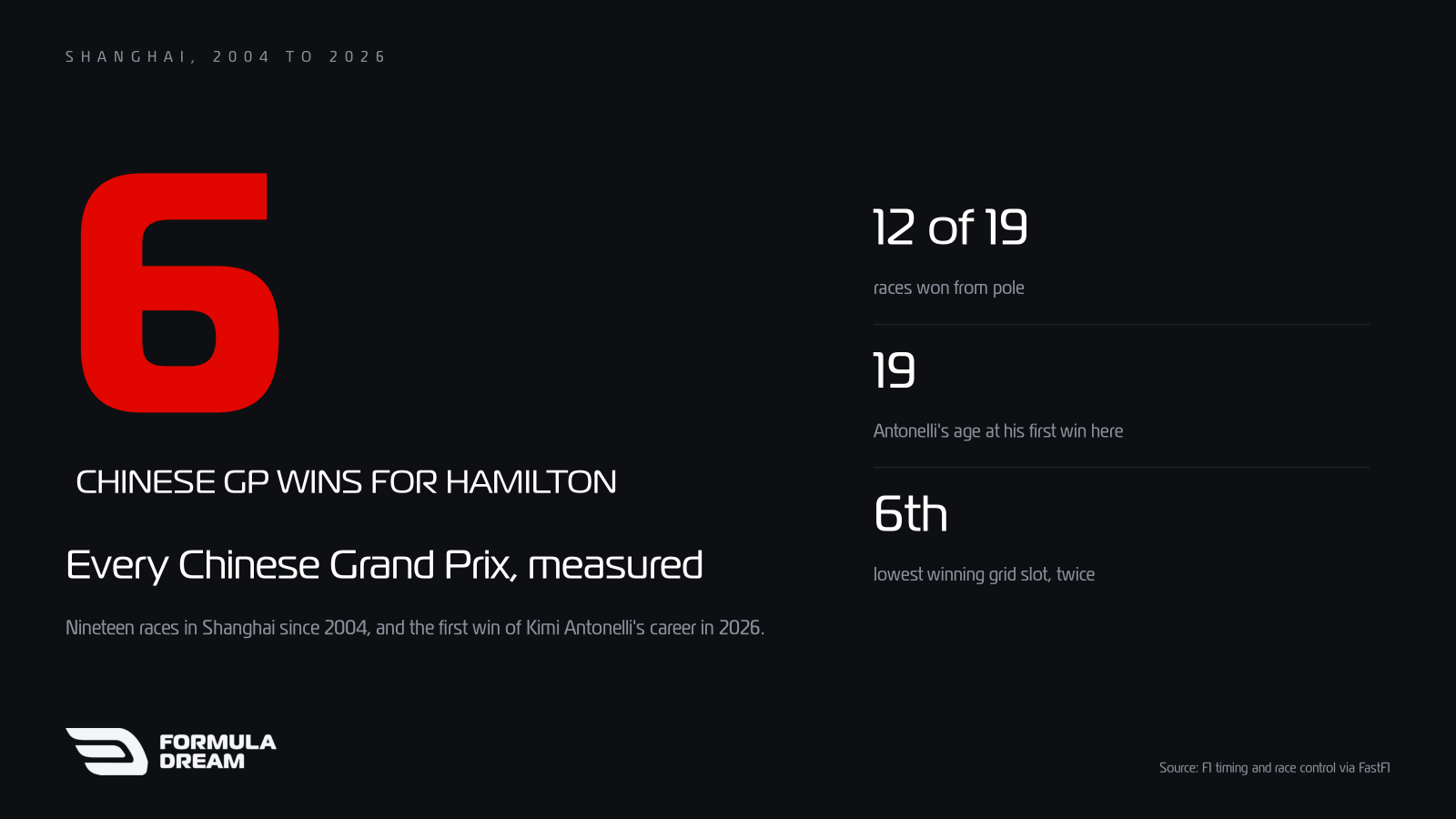
Nineteen Chinese Grands Prix have been held in Shanghai since 2004. Lewis Hamilton won six, pole won twelve, and in 2026 Kimi Antonelli took the first win of his career there, at 19, with Hamilton on the podium for Ferrari for the first time. Every winner, grid slot and safety car, measured.