F1 Points System 2026: How Scoring Works | Formula Dream
Guides
F1 Points System Explained: How Formula 1 Scoring Works
The F1 points system explained, how many points a win is worth, the full top-10 breakdown, sprint points, why the fastest-lap point is gone, and how the two championships are decided.
In 2008, Lewis Hamilton won his first World Championship by a single point. He clinched it at the last corner of the last lap of the last race of the season in Brazil, passing Timo Glock to grab the fifth place he needed while Felipe Massa crossed the line ahead, believing for a few seconds he was champion. Final tally: Hamilton 98, Massa 97. That is the F1 points system at its most brutal, a whole year decided by one point.
Points are awarded at every Grand Prix, the driver and team with the most at the end of the year are champions, and the system is simpler than it looks. Here is exactly how the scoring works.
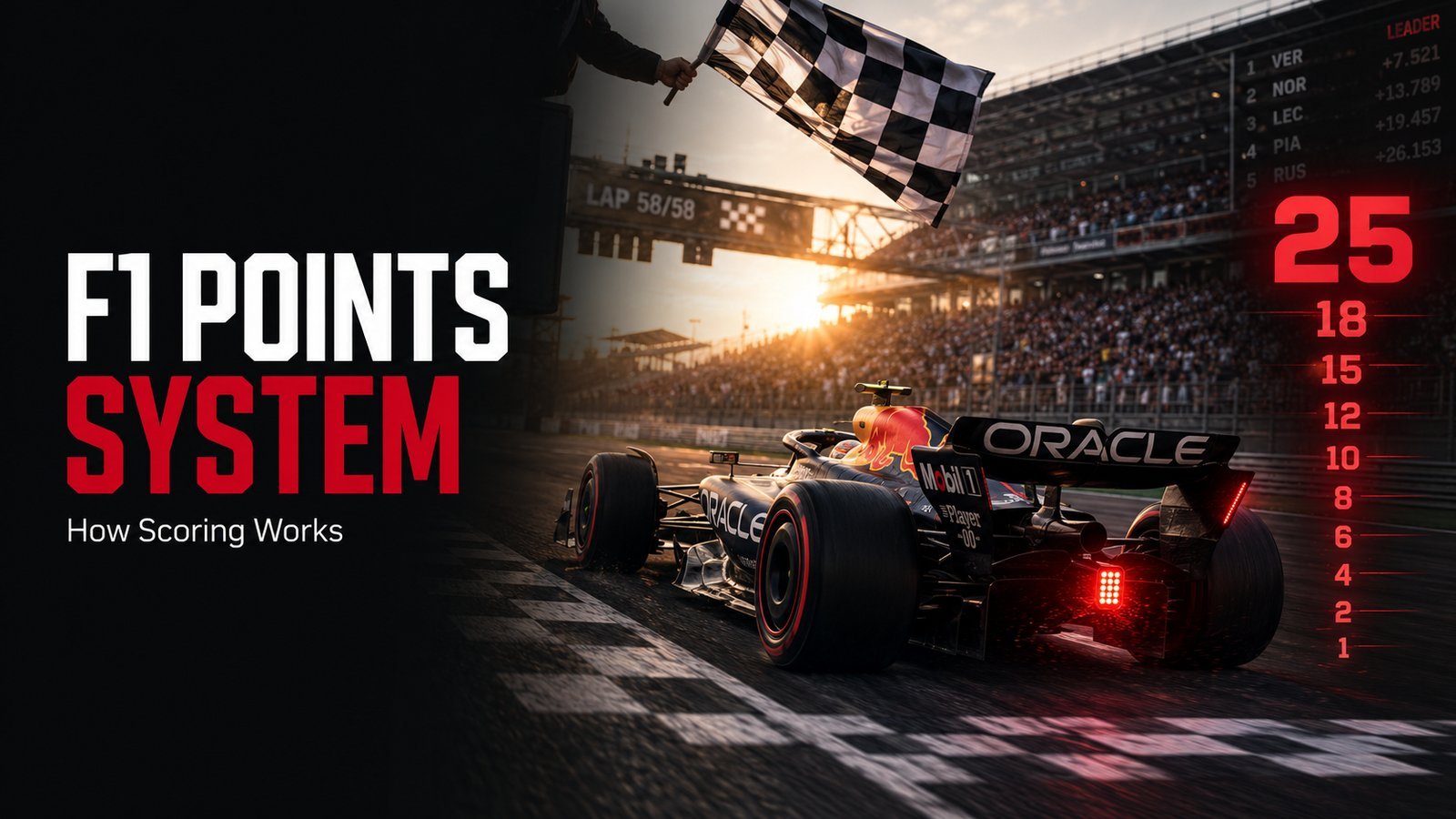
At a normal Grand Prix, the top ten finishers score points on this scale:
Position
Points
1st
25
2nd
18
3rd
15
4th
12
5th
10
6th
8
7th
6
8th
4
9th
2
10th
1
F1 race points, 2026. Positions 11 and below score nothing.
Finish 11th or lower and you score nothing. That is why the fight for the final points-paying places is often as fierce as the battle for the win.
The full 2026 scoring: 25 points for a Grand Prix win down to 1 for tenth, and a separate 8-to-1 scale for the Sprint.
The fastest-lap point is gone
For years there was a bonus point for setting the fastest lap of the race, provided you finished in the top ten. That point, awarded since 2019, was abolished from 2025 after the FIA's World Motor Sport Council approved the change in October 2024. It had been criticised for encouraging teams to make a late "free" pit stop for fresh tyres purely to grab, or deny a rival, the extra point, sometimes at the cost of race position. So today the finishing order is the only thing that scores.
Sprint points
On the six sprint weekends in 2026, in China, Miami, Canada, Britain, the Netherlands and Singapore, the short Saturday Sprint race awards its own points to the top eight:
Position
Points
1st
8
2nd
7
3rd
6
4th
5
5th
4
6th
3
7th
2
8th
1
F1 sprint points, 2026. Only the top eight score.
These are added straight onto a driver's and team's totals, so a strong sprint weekend can be worth a useful extra haul.
Two championships from the same points
Every point a driver scores counts twice, toward two separate titles:
The Drivers' Championship is the sum of each individual driver's points.
The Constructors' Championship is the sum of both of a team's cars. This is the one that decides prize money and pecking order, and it is why teams care about their second driver scoring, not just their star.
Shortened races
If a race has to be stopped early and cannot be restarted, reduced points are awarded depending on how far the leader got. No points are awarded at all unless the leader has completed two laps without the safety car or virtual safety car.
Distance completed by the leader
Points for 1st to 10th
Two laps to under 25%
6, 4, 3, 2, 1 (top five only)
25% to under 50%
13, 10, 8, 6, 5, 4, 3, 2, 1 (top nine)
50% to under 75%
19, 14, 12, 9, 8, 6, 5, 3, 2, 1
75% or more
Full points
Points for a shortened Grand Prix, introduced for 2022
This scale was introduced after the 2021 Belgian Grand Prix, where the cars only ran behind the safety car and half points were still awarded. What happens when a race is stopped is in F1 red flag rules.
What two points looks like
The scale sounds abstract until a championship lands on it.
The 2025 title was decided by two points. Lando Norris finished on 423, Max Verstappen on 421 and Oscar Piastri on 410, after 24 rounds. At the Abu Dhabi finale Verstappen won the race from pole and Piastri finished second, and it did not matter: Norris needed a podium, took third, and the championship was his by the margin of a single seventh place.
That is the system working exactly as intended. A points scale that awards 25 for a win and 18 for second is deliberately shallow at the top, so a season is not settled by one result. Nine points separated first from third across an entire year.
Why the gap from first to second is seven points
The steps are not even, and the unevenness is the design.
The drop from 25 to 18 is the largest on the scale. After that the gaps narrow: 18 to 15, then 15 to 12, and by the lower reaches a place is worth one or two points. Winning is protected as clearly more valuable than finishing second, while the difference between eighth and ninth is small enough that a driver has little incentive to take a reckless risk over it.
It also means consistency beats occasional brilliance over a season. A driver finishing third every race scores 360 points across 24 rounds. A driver alternating wins and retirements scores 300. The scale rewards the person who is always there.
Why the constructors' championship is the harder one
Both cars score, and that changes everything about how a team is judged.
A team with one quick driver and one struggling driver can look strong on Sunday afternoons and still lose the constructors' title to a team with two solid drivers. Because the money follows the constructors' standings rather than the drivers', this is the championship that actually decides a team's budget for the following year, as covered in how F1 prize money works.
It is also why the second seat matters so much more than casual coverage suggests, and why the team-mate comparison is watched so closely inside a team. A driver who is half a second off is not just losing their own race, they are removing points the team has already paid for.
Points start on Saturday
The other thing the points table hides is how much of it is decided before the race.
We measured every race from 2021 onwards: pole position won 56.0% of the time, the front row won 77.6%, and the top three grid slots won 87.2%. The all-time figure for pole converting to a win is roughly 43.6%, so the modern rate is far higher.
Points are awarded on Sunday. They are largely allocated on Saturday, which is why teams treat qualifying as seriously as the race itself. The measurements are in how often pole position wins.
How the F1 points system has changed
The 25-point win is younger than most fans assume. Formula 1 has changed its scale several times since 1950:
Seasons
Points from 1st down
Notes
1950-1959
8, 6, 4, 3, 2
Plus 1 for fastest lap; only a driver's best results counted
1960
8, 6, 4, 3, 2, 1
Only the best six results counted
1961-1990
9, 6, 4, 3, 2, 1
Dropped-result rules varied by year
1991-2002
10, 6, 4, 3, 2, 1
Every result counted
2003-2009
10, 8, 6, 5, 4, 3, 2, 1
Points extended to eighth
2010-2018
25, 18, 15, 12, 10, 8, 6, 4, 2, 1
Points extended to tenth
2014 only
Double points at the final race
Abu Dhabi paid 50 for a win, then the idea was dropped
2019-2024
25, 18, 15, 12, 10, 8, 6, 4, 2, 1
Plus 1 for fastest lap, if finishing in the top ten
2025 onwards
25, 18, 15, 12, 10, 8, 6, 4, 2, 1
No fastest lap point
Formula 1 World Championship points systems for a Grand Prix, 1950 to 2026
The biggest single change was 2010. Moving from 10 to 25 points for a win made victories far more valuable relative to second place, and extending points to tenth gave the midfield something to fight for every weekend.
Follow the standings live
Points only matter as a running total, and that total moves during the race.
The Formula Dream app carries the standings, results and full weekend timeline in Race Center, so the championship picture stays current without hunting for it. During a session it runs a live Dashboard with every car on the circuit map, a timing tower carrying lap times, gaps, intervals, tyre compound and age, live driver radio as it is broadcast, and every FIA document of the weekend as it is published.
Free, no subscription, no ads, independent. Not affiliated with Formula 1.
F1 Fantasy uses a different scoring system entirely, with its own points for qualifying, overtakes and finishing position. We explained it in how F1 Fantasy scoring works.
Frequently asked questions
How many points is an F1 win worth?
A Grand Prix win is worth 25 points. The rest of the top ten score 18, 15, 12, 10, 8, 6, 4, 2 and 1.
Is there still a point for fastest lap in F1?
No. The bonus point for the fastest lap was removed from the 2025 season. The finishing order is now the only way to score.
How do sprint race points work?
The Sprint awards points to the top eight finishers: 8 for the win down to 1 for eighth. They are added to the normal championship totals.
What is the difference between the drivers' and constructors' championships?
The Drivers' title goes to the individual with the most points. The Constructors' title combines both of a team's cars, so a team needs both drivers scoring to win it.
What happens if two drivers finish level on points?
The tie is broken by countback: whoever has more wins takes it, and if that is level too, more second places, then third places, and so on. It nearly mattered in 2021, when Hamilton and Verstappen went into the finale level on points, meaning the title would have gone to Verstappen on his greater number of wins even if they had finished the race dead level.
When did F1 change to 25 points for a win?
In 2010. Before that a win was worth 10 points, from 1991 to 2009, and 9 points for most of the 1960s, 1970s and 1980s.
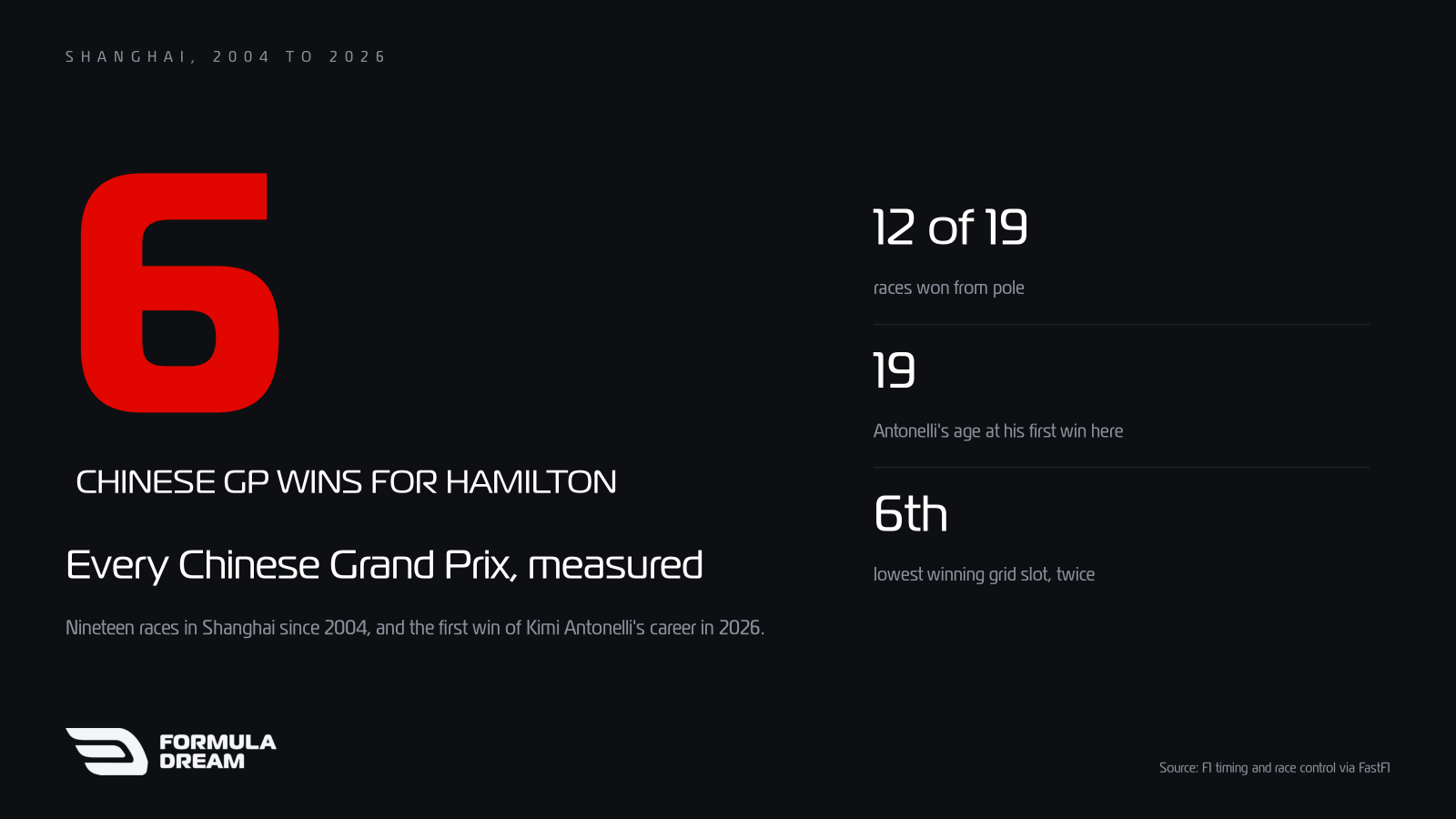
Nineteen Chinese Grands Prix have been held in Shanghai since 2004. Lewis Hamilton won six, pole won twelve, and in 2026 Kimi Antonelli took the first win of his career there, at 19, with Hamilton on the podium for Ferrari for the first time. Every winner, grid slot and safety car, measured.