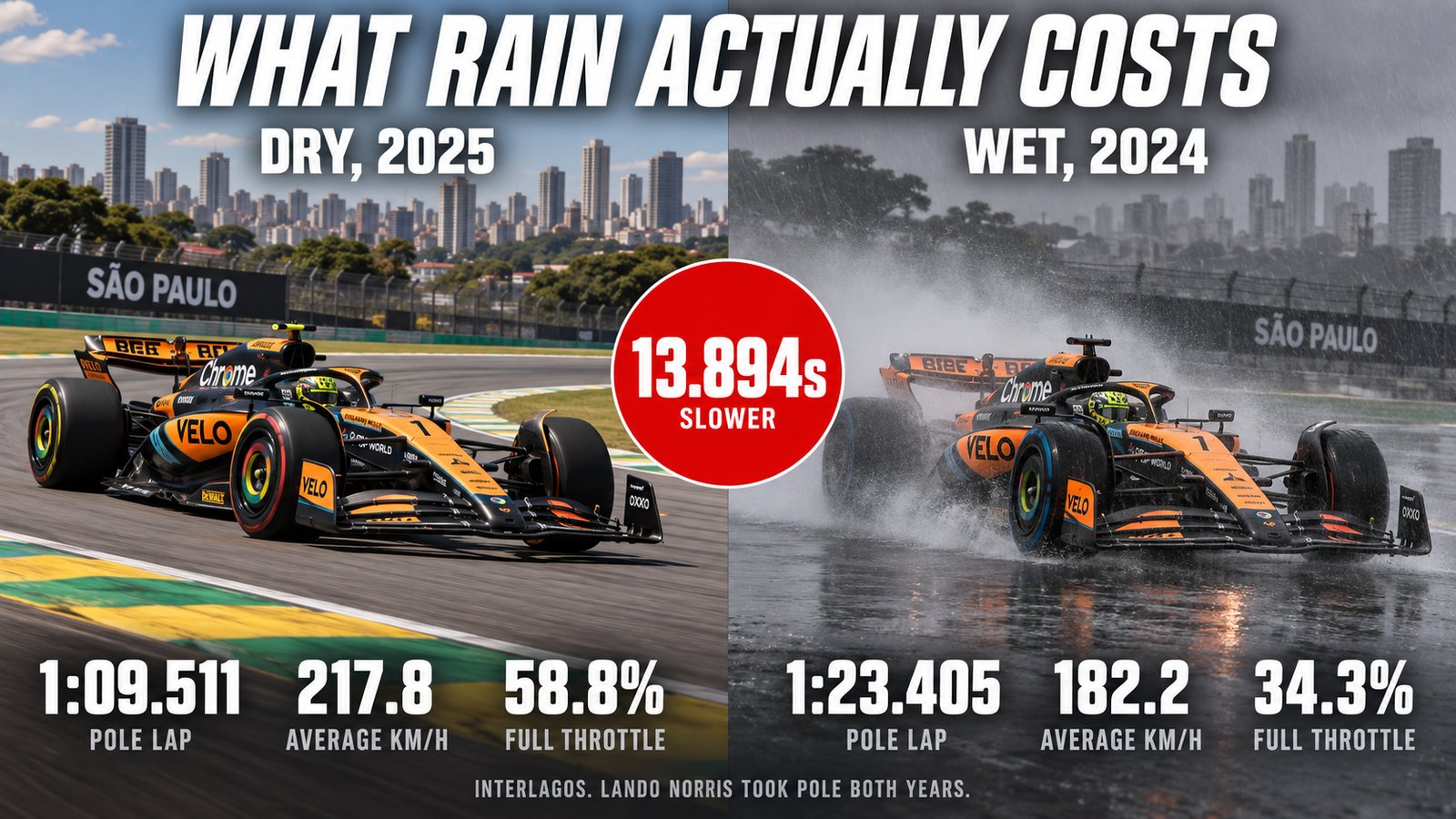
Lando Norris took pole at Interlagos in 2024 in the wet, and again in 2025 in the dry. The gap between those two laps is 13.894 seconds.
That is a rare thing in Formula 1: a genuine like-for-like measurement of what rain costs. Same driver, same circuit, one year apart. We pulled both laps from the car telemetry.
Interlagos pole laps, both set by Lando Norris. Measured from car telemetry.
Interlagos, drawn from the car rather than traced: the path of Lando Norris's 2025 pole lap, 336 km/h at its fastest and 85 km/h at its slowest.
What the drivers said on this circuit is in our São Paulo Grand Prix 2025 race radio, every broadcast message with the audio and a transcript coloured by who is speaking.
Rain cost 35.6 km/h of average speed and cut full throttle from 58.8% to 34.3%. In the wet, Norris was on the power for barely a third of the lap. In the dry, nearly six tenths of it.
The tyre row is there to make the comparison honest. The 2024 session was fully wet, with 263 laps on full wets and 159 on intermediates and not a single slick run. It was not a damp track that dried out; it was a wet session from start to finish.
That is why we do not use the 2024 number anywhere else on this site as Interlagos's speed. The circuit's real figure is the 2025 one: 217.8 km/h.
Where Interlagos sits when it is dry
At 217.8 km/h it is quicker than most people assume. Our measurements across the calendar:
Spa 238.8 km/h
Melbourne 238.1
Interlagos 217.8
COTA 211.4
Baku 211.3
Mexico 201.4
Singapore 197.0
Monaco 163.0
It clears COTA and Baku despite being one of the shortest laps in Formula 1 at 4.205 km. The full ranking is in the fastest F1 circuits.
The reason is the layout. Interlagos has only six braking events, fewer than any other circuit we have measured, against ten at Singapore and COTA. It is a short lap that keeps flowing, with a long climb from the final corner all the way through the start line and into Turn 1.
It is the two-stop race on this list
Every other circuit in this series is a one-stop. Interlagos is not.
Year
Laps
Mean stops per driver
Most common
Safety cars
2025
71
1.90
2
2
2024
69
2.00
2
3
São Paulo Grand Prix race data, from F1 timing data.
Two stops is the most common strategy in both years, and both races produced multiple safety cars, three of them in the wet 2024 edition. Against a 2026 season average of 2.05 stops per driver, Interlagos runs right at the top rather than at the bottom.
That combination, a short lap that flows, plus safety cars, plus a genuine two-stop, is why Brazil so often produces the best race of the season. Our season-wide numbers are in how many pit stops in an F1 race.
Why the weather keeps deciding it
Sao Paulo in November sits at the start of the wet season, and the circuit is on a hill with its own microclimate. Rain arriving mid-session is not unusual here, it is close to expected.
The measurement at the top of this page is what makes that matter. A wet Interlagos is not slightly slower, it is 13.894 seconds a lap slower, and it changes which parts of the car matter. When full throttle drops from 58.8% to 34.3%, engine performance stops deciding the lap and traction and driver confidence take over. That is why wet races at Interlagos produce results that dry ones do not.
What 2026 changes
The current cars carry roughly 30% less downforce than the ones that set the laps above, measured in are F1 cars getting faster.
At a circuit with only six braking events and a lot of sustained cornering load, that should cost more than it does at a stop-start track. And in the wet, where downforce matters most and grip is scarcest, the gap between a confident driver and a cautious one should widen further.
The Interlagos circuit hub pulls together everything we hold for this venue in one place: every qualifying gap drawn as real distance, the track domination maps where we have them, and the team radio from previous races here.
What the drivers said here
The radio is the part of a weekend that does not make the highlights. We hold every message Formula 1 broadcast from Interlagos in 2025, 56 of them across the whole weekend, transcribed with the original audio and the driver and engineer colour coded, on the Interlagos 2025 team radio page.
It is worth a scroll before a race here, because the complaints repeat. Drivers tend to raise the same two or three things about a circuit every year, and reading last season back is the quickest way to know what to listen for in this one.
The Formula Dream app runs a live Dashboard through every session: every car on the circuit map, and a timing tower with lap times, gaps and intervals, tyre compound and age, plus flag and safety car alerts as race control calls them. At the one circuit on this list that reliably produces two stops and multiple safety cars, tyre compound and age is the column that tells you what is about to happen. You also get live driver radio as it is broadcast, which in Brazil is where the rain calls get made, and every FIA document of the weekend as it is published.
Free, no subscription, no ads, independent. Not affiliated with Formula 1.
At Interlagos, 13.894 seconds a lap. Lando Norris took pole in the wet in 2024 with a 1:23.405 and in the dry in 2025 with a 1:09.511, at the same circuit. Average speed fell from 217.8 km/h to 182.2, and full throttle from 58.8% to 34.3%.
How long is the Interlagos circuit?
4.205 km on the racing line, measured from telemetry on the 2025 pole lap. It is one of the shortest circuits in Formula 1, and the race is 71 laps.
Is Interlagos a fast circuit?
Yes, more than its reputation suggests. The 2025 pole lap averaged 217.8 km/h, quicker than COTA at 211.4 and Baku at 211.3, because it has only six braking events, fewer than any other circuit we have measured.
How many pit stops at the São Paulo Grand Prix?
Two. It is the only circuit in our measured series where two stops is the most common strategy, with a mean of 1.90 per driver in 2025 and 2.00 in 2024.
Why is the Brazilian Grand Prix so often chaotic?
A short flowing lap, a hillside microclimate at the start of the wet season, and a two-stop strategy. Both of the last two races produced multiple safety cars, three of them in the wet 2024 edition.
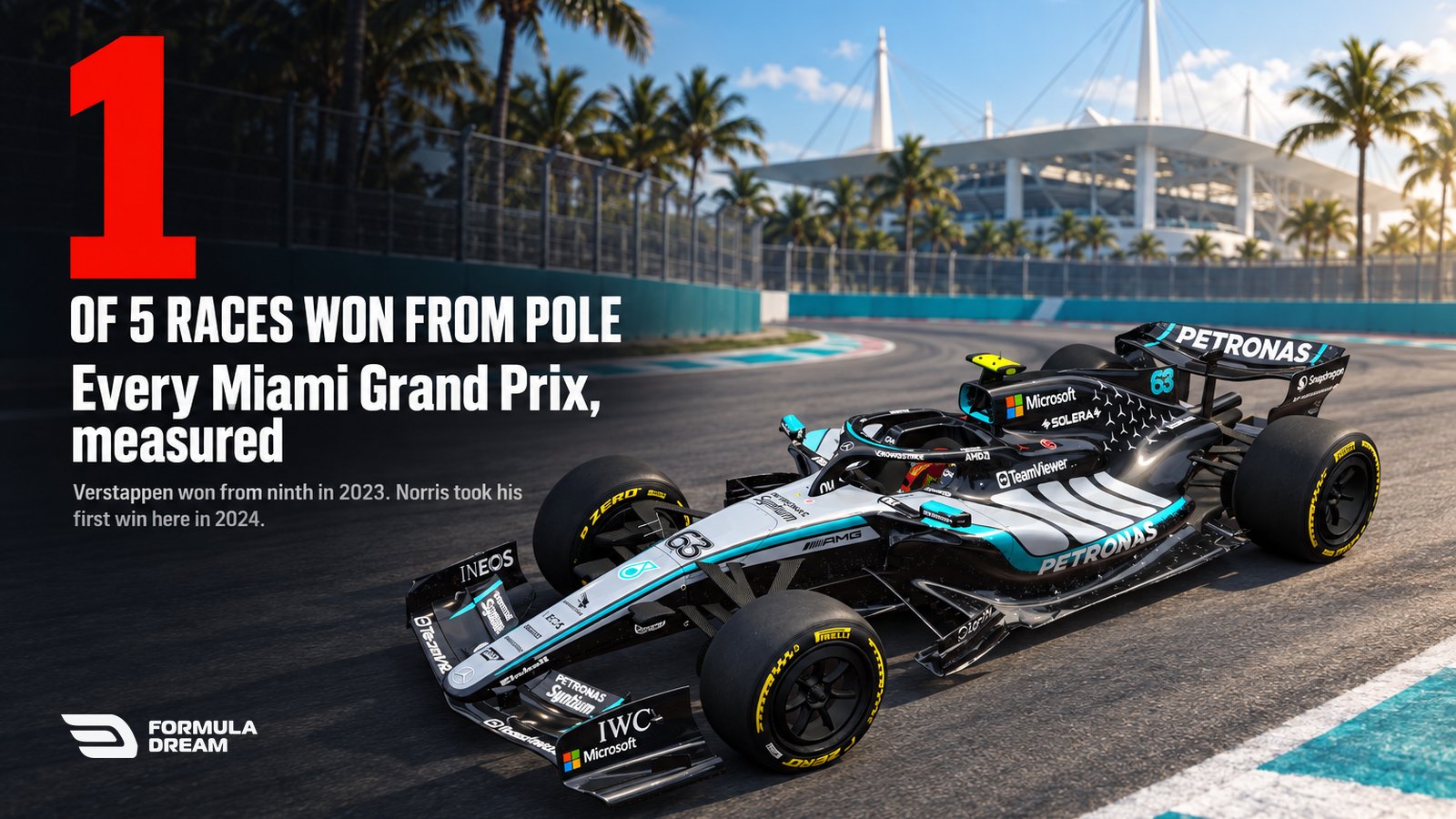
Every Miami Grand Prix winner, measured: five races, and pole has won only one of them
Five Miami Grands Prix have been held since 2022, and only one was won from pole: Kimi Antonelli's in 2026. Max Verstappen won from ninth in 2023, and Lando Norris took his first win there in 2024. Every winner, grid slot and safety car, measured.