Why Mexico Has F1's Highest Top Speed and a Slow Lap
Guides
Why Mexico Has F1's Highest Top Speed and a Slow Lap
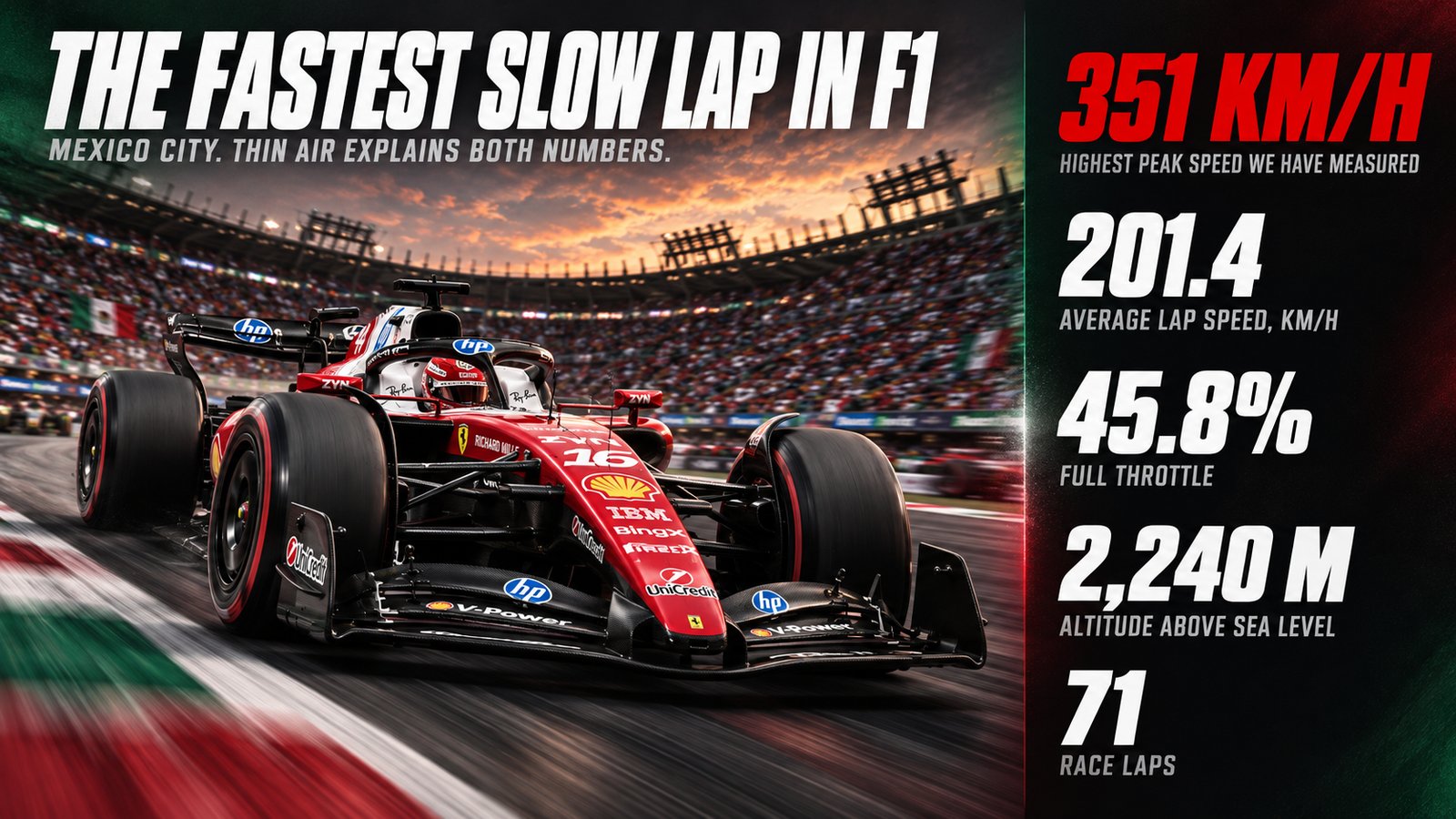
We measured it: Mexico produces the highest peak speed of any circuit we have measured, 351 km/h, while spending less than half the lap at full throttle.
Autodromo Hermanos Rodriguez, fastest qualifying lap measured from car telemetry.
Mexico City, drawn from the car rather than traced: the path of Lando Norris's 2025 pole lap, 351 km/h at its fastest and 68 km/h at its slowest.
What the drivers said on this circuit is in our Mexico City Grand Prix 2025 race radio, every broadcast message with the audio and a transcript coloured by who is speaking.
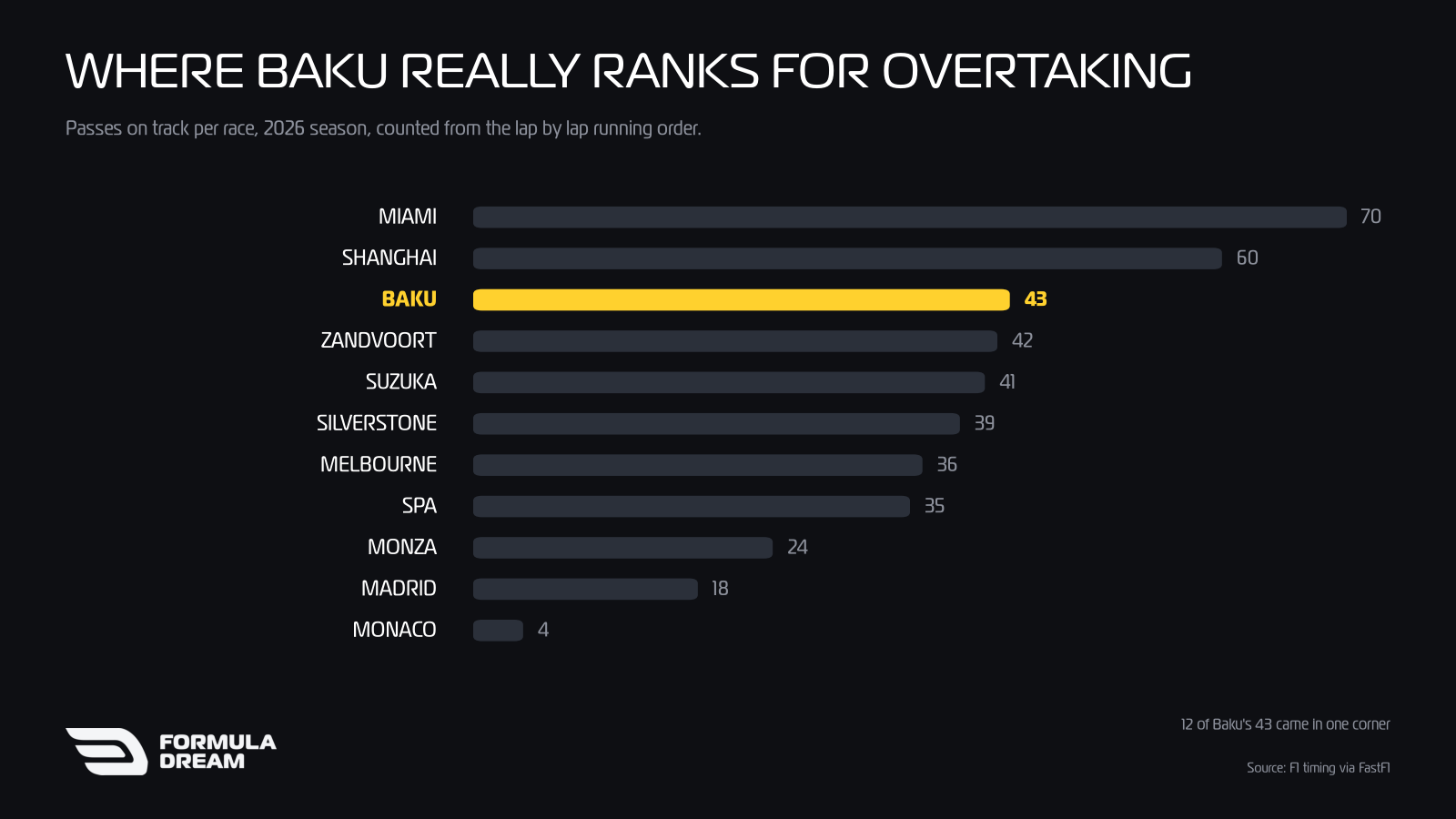
Set that against everything else we have measured this season. Barcelona produced the highest speed-trap reading of 2026 at 358 km/h. Mexico, on a two-year-old car, reached 351 on the lap itself. Meanwhile its average lap speed of 201.4 km/h sits below Baku's 211.3 and COTA's 211.4, and its 45.8% full throttle is lower than everything except Monaco.
The highest top speed in Formula 1 belongs to one of its slower circuits.
Thin air explains both numbers
At 2,240 metres, the air in Mexico City is around 20% less dense than at sea level. That single fact drives everything about this circuit.
Less air means less drag. A car pushes through thinner air more easily, so it keeps accelerating for longer down the main straight. That is why the peak speed is so high, and why the outright Formula 1 speed record of 372.5 km/h was set here in 2016.
Less air also means less downforce. The same thin air that stops resisting the car also stops pressing it down. Teams respond by fitting the highest-downforce wings they own, often the same specification they would use at Monaco, and even then the car has less grip than it would at sea level with a low-drag setup.
So the car is simultaneously the fastest it will be all year in a straight line and among the least planted it will be in a corner. Hence 351 km/h and 45.8% full throttle on the same lap.
Less air also cools less. Radiators, brakes and the power unit all have less air mass to work with, which is why Mexico is one of the hardest weekends of the year for cooling and why teams run their most open bodywork.
The stadium section is where the lap slows
The lap has eight braking events and a slowest point of 68 km/h, and most of the time loss is concentrated in one place.
After the long run down the main straight, the circuit turns into a slow, tight sequence through the old baseball stadium, taken between second and third gear with grandstands close on both sides. It is spectacular and it is slow, and it is the reason a circuit with a 351 km/h peak averages only 201.4.
The longest continuous full-throttle run is 863 metres in 2025, less than half of Baku's 1.842 km. Mexico is a drag strip attached to a go-kart track.
Race day
Year
Laps
Mean stops per driver
Most common
Safety cars
2025
71
1.50
1
1
2024
71
1.10
1
1
Mexico City Grand Prix race data, from F1 timing data.
Both races produced exactly one safety car deployment and a most-common strategy of one stop, though 2025 was messier, with a mean of 1.50 stops per driver. At 71 laps it is one of the longer races on the calendar by lap count, because the lap itself is short.
The current cars carry roughly 30% less downforce than the ones that set the laps above, which we measured in are F1 cars getting faster.
Mexico is the circuit where that should matter least in a straight line and most everywhere else. A car already short of downforce because of the altitude, now given less by regulation, will be even harder to drive through the stadium section. Expect the top speed to hold up and the lap time to suffer.
Whether Mexico beats Barcelona's 358 km/h and takes the 2026 top-speed record is one of the more interesting open questions of the season. The full ranking is in F1 car top speed.
The Mexico City circuit hub pulls together everything we hold for this venue in one place: every qualifying gap drawn as real distance, the track domination maps where we have them, and the team radio from previous races here.
What the drivers said here
The radio is the part of a weekend that does not make the highlights. We hold every message Formula 1 broadcast from Mexico City in 2025, 51 of them across the whole weekend, transcribed with the original audio and the driver and engineer colour coded, on the Mexico City 2025 team radio page.
It is worth a scroll before a race here, because the complaints repeat. Drivers tend to raise the same two or three things about a circuit every year, and reading last season back is the quickest way to know what to listen for in this one.
The Formula Dream app runs a live Dashboard through every session: every car on the circuit map, and a timing tower with lap times, gaps and intervals, tyre compound and age, plus flag and safety car alerts as race control calls them. Mexico is the weekend where the speed trap column is worth watching on its own, because this is where the biggest numbers of the year appear. You also get live driver radio as it is broadcast, which at altitude is full of cooling and brake temperature talk, and every FIA document of the weekend as it is published.
Free, no subscription, no ads, independent. Not affiliated with Formula 1.
Because Mexico City sits 2,240 metres above sea level, where the air is around 20% less dense. Less air means less drag, so the car keeps accelerating for longer. We measured a peak of 351 km/h on the fastest 2025 qualifying lap.
Is Mexico a fast circuit?
Not on average. Despite the highest peak speed we have measured, the lap averages only 201.4 km/h, below Baku at 211.3 and COTA at 211.4, because the stadium section is slow and the car is at full throttle for just 45.8% of the lap.
Why do F1 teams use high downforce wings in Mexico?
Because thin air produces less downforce as well as less drag. Teams fit their highest-downforce wings, often close to Monaco specification, and the car still has less grip than it would at sea level.
How long is the Mexico City F1 circuit?
The Autodromo Hermanos Rodriguez measured 4.229 km on the racing line from telemetry on the fastest 2025 qualifying lap. The race is 71 laps.
How many pit stops at the Mexico City Grand Prix?
One is the most common. The mean was 1.50 stops per driver in 2025 and 1.10 in 2024, and both races had one safety car deployment.
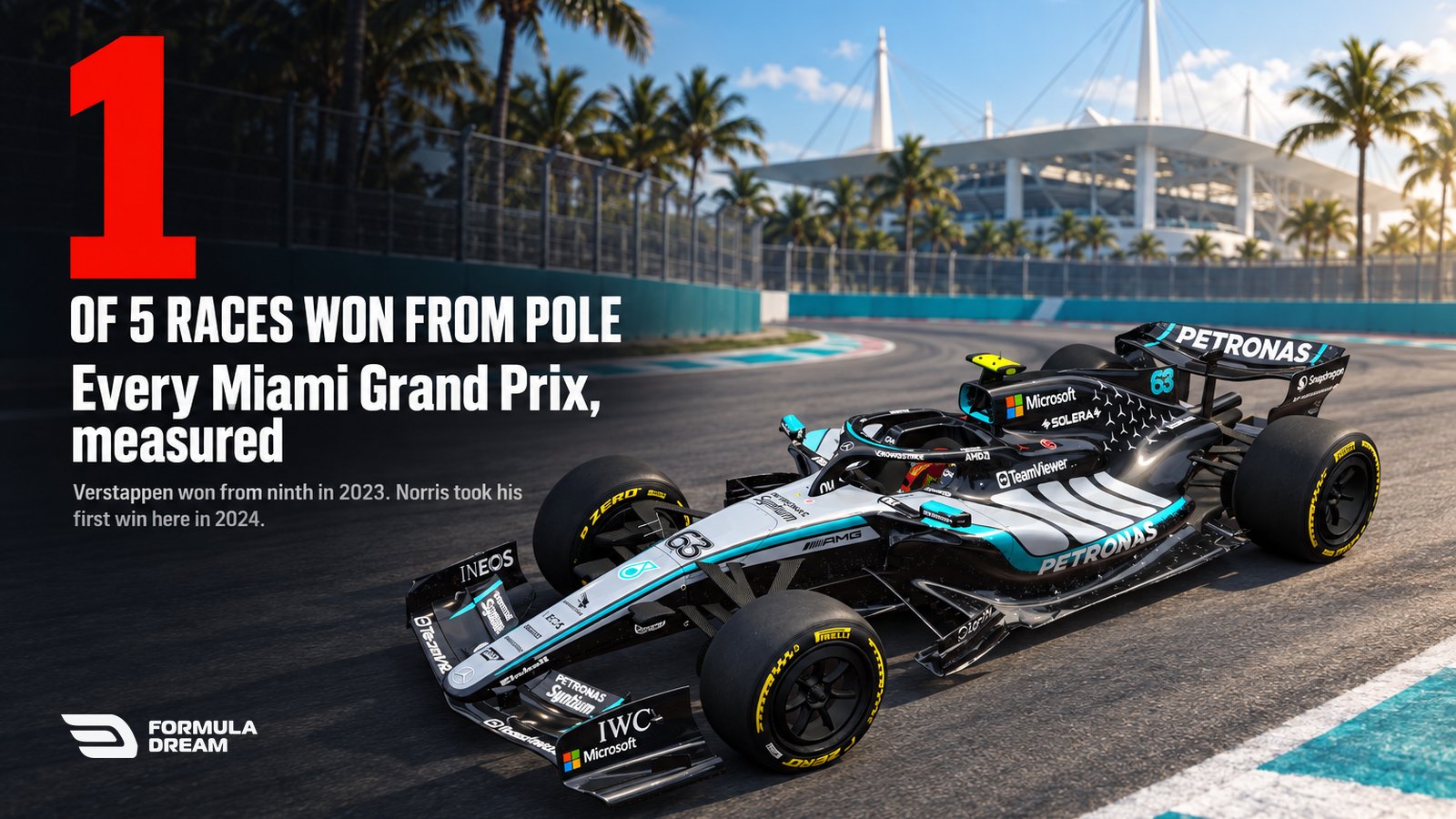
Every Miami Grand Prix winner, measured: five races, and pole has won only one of them
Five Miami Grands Prix have been held since 2022, and only one was won from pole: Kimi Antonelli's in 2026. Max Verstappen won from ninth in 2023, and Lando Norris took his first win there in 2024. Every winner, grid slot and safety car, measured.