Marina Bay Circuit: Why Singapore Is F1's Hardest Race
Guides
Marina Bay Circuit: Why Singapore Is F1's Hardest Race
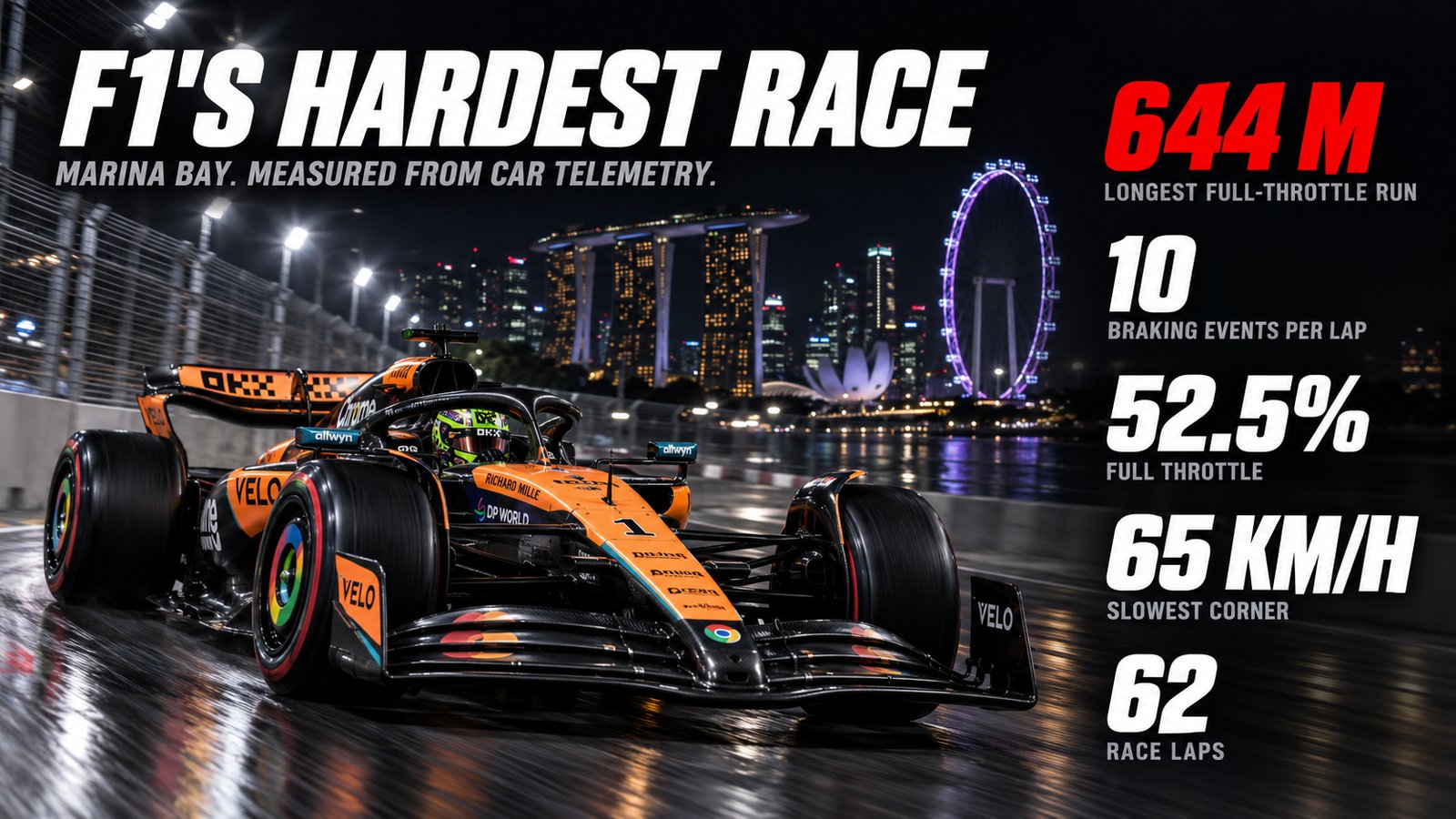
We measured the Singapore lap. Ten braking events, 52% full throttle, and the longest flat-out run is just 644 metres. It is the least restful lap in Formula 1.
The longest a Formula 1 driver goes without lifting at Singapore is 644 metres.
That single number explains why Marina Bay is considered the hardest race on the calendar, and it is the sort of thing you only find by going into the telemetry rather than the record books. We measured the fastest qualifying lap at the last two Singapore Grands Prix, corner by corner.
Marina Bay Street Circuit, fastest qualifying lap measured from car telemetry.
Marina Bay, drawn from the car rather than traced: the path of George Russell's 2025 pole lap, 316 km/h at its fastest and 65 km/h at its slowest.
What the drivers said on this circuit is in our Singapore Grand Prix 2025 race radio, every broadcast message with the audio and a transcript coloured by who is speaking.
Ten braking events a lap, and the driver is off the throttle for nearly half of it.
Put that beside the rest of the calendar and the picture is stark. We measured Spa at 238.8 km/h average with 68% full throttle, and Baku, another street circuit, at 211.3 km/h with 61.5%. Singapore manages 197.0 km/h and 52.5%. Only Monaco, at 163.0 km/h and 37%, asks less of the engine and more of the driver.
Why 644 metres matters
On most circuits a driver gets a genuine rest. Baku hands them 1.842 km of uninterrupted full throttle, long enough to breathe, check the mirrors and think about the next sequence. Monza gives them most of a lap at full load.
Singapore gives them 644 metres, which at around 300 km/h is roughly eight seconds.
Everything else is corner, brake, corner. Ten braking events in 4.879 km means one roughly every 490 metres, and the walls are close enough that none of them can be taken casually. Sustain that for 62 laps in tropical heat and humidity, at night, and you have the reason drivers describe Singapore as physically harder than anywhere else they go.
It is not a chaotic race, though
The reputation says Singapore is a safety car lottery. The last two races say otherwise.
Year
Laps
Mean stops per driver
Most common
Safety cars
2025
62
1.15
1
0
2024
62
1.25
1
0
Singapore Grand Prix race data, from F1 timing data.
Zero safety car deployments in either race, and a clear one-stop both times. In 2025 light rain fell before the start, but every lap of the race was run on slick tyres and it still produced none. That is worth knowing before Sunday, because the strategic assumption people carry into Singapore is often the opposite.
Across the whole 2026 season we measured an average of 2.05 pit stops per driver per race, so Singapore at 1.15 is at the low end. The full numbers are in how many pit stops in an F1 race.
What actually decides it
If the safety car is not the variable, three others are.
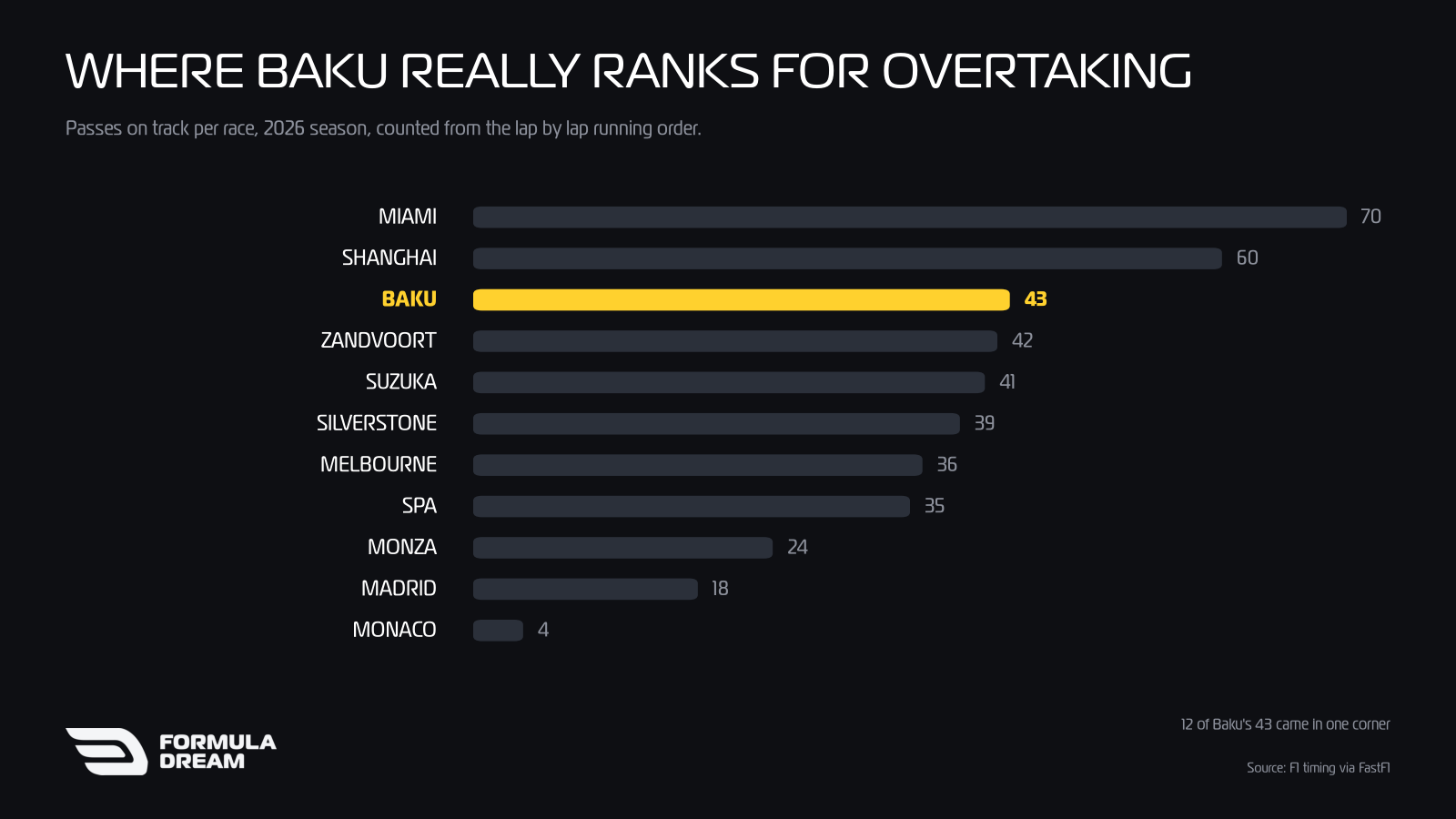
Track position. A 4.879 km lap with ten braking events and walls throughout is one of the hardest places in Formula 1 to overtake. Qualifying matters more here than almost anywhere.
Driver condition. Sixty-two laps of near-continuous work in that climate is the closest modern Formula 1 comes to an endurance event. Mistakes late in the race are usually fatigue rather than machinery.
Brakes. Ten braking events a lap, 62 times, with limited straight-line airflow to cool them. Brake temperature management is a genuine engineering problem here rather than a talking point.
How 2026 changes it
The 2026 cars carry roughly 30% less downforce than the generation before, and pole laps this season are running about 3% slower at circuits raced in both years. Our measurement is in are F1 cars getting faster.
Singapore should feel that more than most. A circuit made almost entirely of corners loses more to a downforce cut than one made of straights, so expect the lap times above to look optimistic when the 2026 cars run here in October. Our forecast for this year's pole, from the rates measured at every circuit raced in both seasons, is 1:31.8 to 1:32.1, with session times for the first Singapore sprint weekend, in the Singapore GP 2026 race preview.
There is one more change worth watching. DRS no longer exists, replaced by active aerodynamics and a driver-triggered deployment the FIA calls Overtake. On a circuit where overtaking was already the hardest problem, that is a real unknown. We verified the change from the car data itself in what is DRS in F1.
The Marina Bay circuit hub pulls together everything we hold for this venue in one place: every qualifying gap drawn as real distance, the track domination maps where we have them, and the team radio from previous races here.
What the drivers said here
The radio is the part of a weekend that does not make the highlights. We hold every message Formula 1 broadcast from Marina Bay in 2025, 54 of them across the whole weekend, transcribed with the original audio and the driver and engineer colour coded, on the Marina Bay 2025 team radio page.
It is worth a scroll before a race here, because the complaints repeat. Drivers tend to raise the same two or three things about a circuit every year, and reading last season back is the quickest way to know what to listen for in this one.
Watch the hardest race with the data on screen
Singapore is round 17 of the 2026 season, on 11 October.
The Formula Dream app runs a live Dashboard through every session: every car on the circuit map, and a timing tower with lap times, gaps and intervals, tyre compound and age, plus flag and safety car alerts as race control calls them. On a circuit where track position decides the race, the gap column is the whole story, and tyre age tells you when it is about to change. You also get live driver radio as it is broadcast, which at Singapore is where the fatigue shows, and every FIA document of the weekend as it is published.
Free, no subscription, no ads, independent. Not affiliated with Formula 1.
The Marina Bay Street Circuit measures 4.879 km on the racing line, recorded from car telemetry on the fastest 2025 qualifying lap. The race is 62 laps.
Why is Singapore the hardest race in F1?
Because there is almost no rest. The fastest lap contains ten braking events and only 52.5% full throttle, and the longest continuous flat-out run is 644 metres, around eight seconds. That is sustained for 62 laps in tropical heat and humidity.
How many pit stops at the Singapore Grand Prix?
One, in both of the last two races. The mean was 1.15 stops per driver in 2025 and 1.25 in 2024, against a 2026 season average of 2.05.
Does the Singapore Grand Prix always have a safety car?
No, despite the reputation. There were zero safety car deployments in either the 2024 or 2025 race. Light rain fell before the 2025 start, but the whole race was run on slick tyres.
What is the top speed at Singapore?
316 km/h on the fastest 2025 qualifying lap. That is low by Formula 1 standards, because the circuit's longest straight is short and the car is never able to build speed for long.
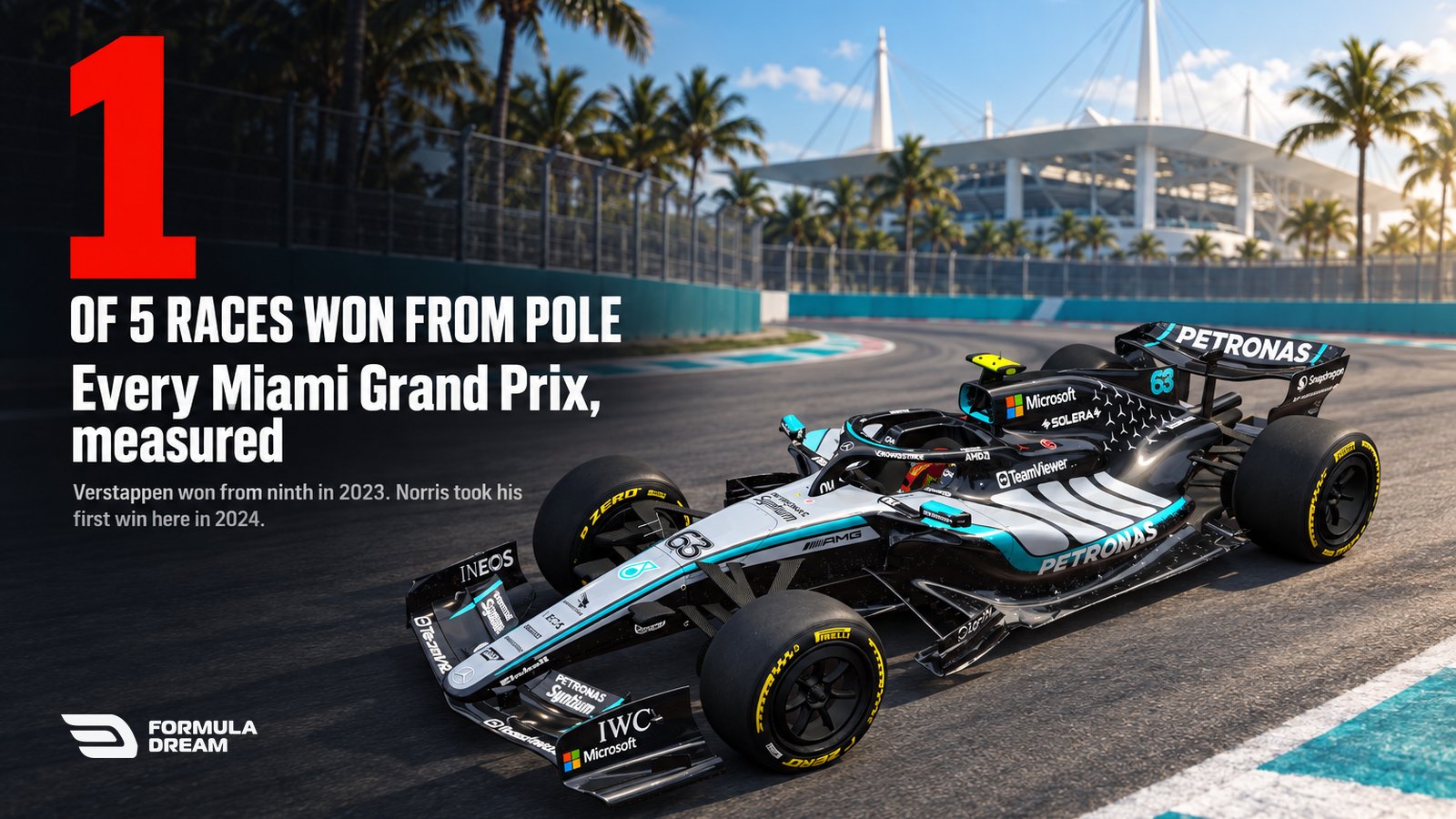
Every Miami Grand Prix winner, measured: five races, and pole has won only one of them
Five Miami Grands Prix have been held since 2022, and only one was won from pole: Kimi Antonelli's in 2026. Max Verstappen won from ninth in 2023, and Lando Norris took his first win there in 2024. Every winner, grid slot and safety car, measured.