Understeer vs Oversteer Explained: Why an F1 Car Won't Turn
Understeer vs oversteer explained, which end of the car loses grip, why understeer is slow and oversteer is fast but dangerous, how teams tune the balance, and why Verstappen and Hamilton want opposite things.
Listen to any F1 driver on the radio for a full race and you will hear the same two complaints over and over: the car is "pushing", or the car is "loose". Those are the two ways a car runs out of grip, understeer and oversteer, and the balance between them is the single thing a driver and their engineers chase all weekend. Get it right and you have a fast, planted car. Get it wrong and you are either ploughing off the road or spinning off it. Here is the difference, and why the best drivers in the world disagree about which one they want.
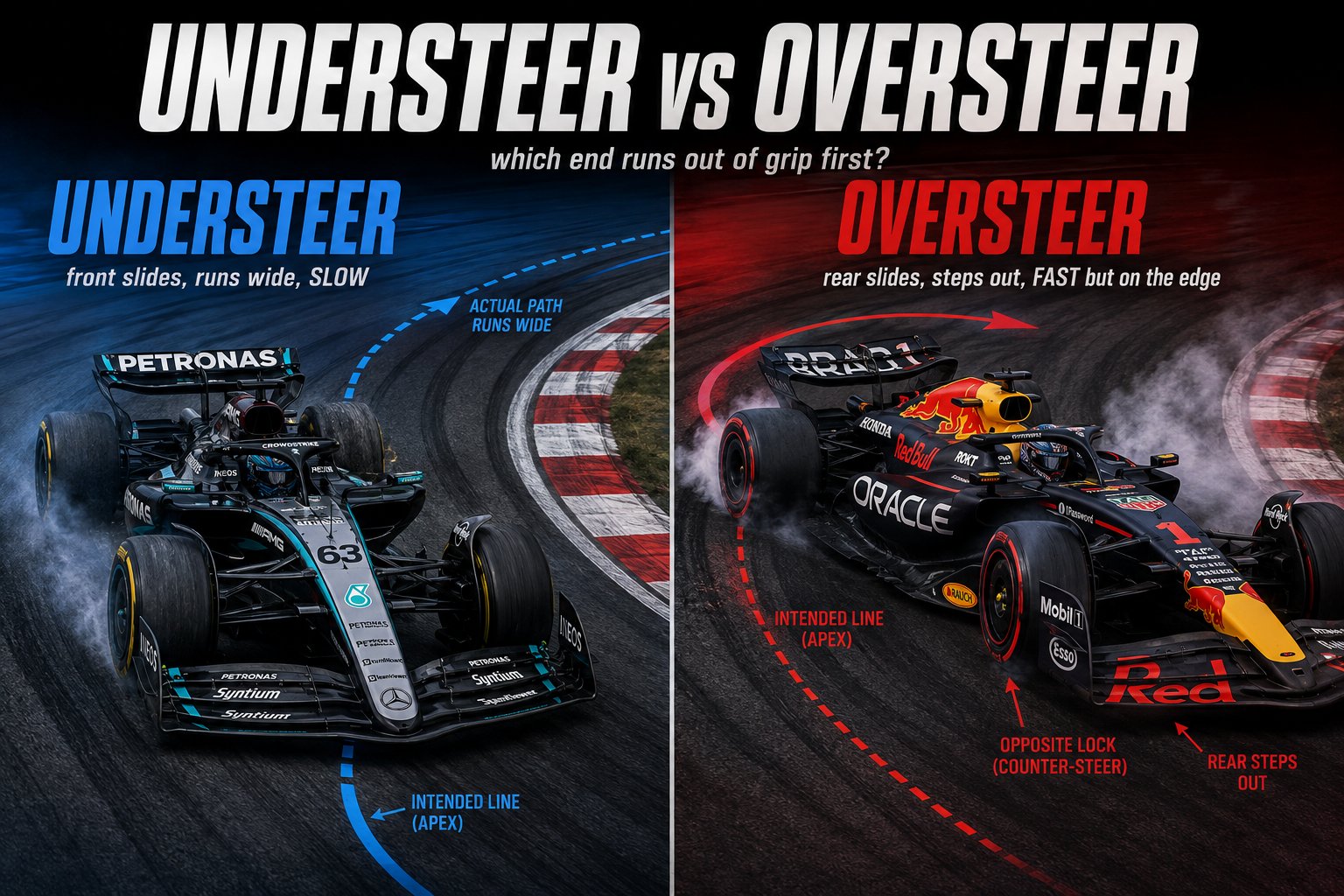
Every corner is a battle for grip between the front tyres and the rear tyres. Whichever end runs out of grip first decides how the car misbehaves:
Understeer is when the front tyres lose grip first. You turn the wheel, but the car keeps running wide, it will not point where you are aiming. Drivers call it "pushing" or "washing out".
Oversteer is when the rear tyres lose grip first. The back of the car steps out and it rotates more than you asked for, threatening to spin. Drivers call it "loose", "snappy" or "a pointy car".
Every lap is spent balancing on the knife-edge between the two, keeping all four tyres as close to their grip limit as possible without tipping over it.
What causes understeer
Understeer comes from asking the front tyres for more than they can give: carrying too much speed into a corner, or turning the wheel more sharply than the available grip allows. The front tyres slide instead of biting, and the car ploughs on toward the outside of the corner. Cold tyres or a wet track make it worse, because there is less front grip to begin with. It is the safer of the two, because it is gradual and predictable, which is exactly why it is also slow: a car that will not turn forces the driver to lift off and wait.
What causes oversteer
Oversteer comes from unsettling the rear. Squeeze the throttle too hard on the way out of a corner and the rear tyres can spin up and let go. Lift off the throttle or brake in the middle of a corner and the car's weight pitches forward, unloading the rear tyres, and the back can snap out, this is "lift-off oversteer", and it is how a lot of spins happen. Controlled, it is fast and thrilling, letting the driver rotate the car into the corner. Uncontrolled, it is a fraction of a second from a spin.
Which is faster, and why the great drivers disagree
Here is where it gets interesting, because there is no single "right" balance, it comes down to what a driver can handle. Max Verstappen is famous for wanting a car with a sharp, pointy front end and a rear that is right on the edge of letting go. His philosophy is blunt: "Understeer is slow. Whatever you do, it doesn't matter. If you want a fast car, it has to come through the nose." He tolerates a nervous, oversteering rear that would frighten most drivers, and his ability to catch and control it is one of the great strengths of his driving.
Not everyone wants that. Lewis Hamilton and many others prefer a more stable car that leans slightly toward understeer, because a predictable rear lets them lean on the car with total confidence, especially through high-speed corners. Neither is wrong. A pointy car is faster if you can control it, and a stable car is faster if the alternative is spinning. The balance a driver asks for is a fingerprint of their style.
How teams tune the balance
Getting the car to the driver's preferred balance is most of what setup work is about. Engineers have a whole toolkit: the front wing angle (more front wing adds front grip and moves the car toward oversteer), the mechanical suspension settings, tyre pressures, and the differential, which drivers can even adjust from the steering wheel to change how the car behaves on corner entry and exit. Move the car's aerodynamic balance forward and it gets more pointy; move it back and it gets more stable. A driver will spend all of practice reporting exactly where and how the car pushes or slides so the team can dial the balance in.
Why it shifts during a race
The balance is never fixed. When a car follows another closely, it drives into dirty air, which starves the front wing and causes understeer exactly when the driver is trying to stay tight enough to attack. And as the tyres degrade through a stint, the balance drifts too, which is why a driver's complaints often change from understeer early in a stint to oversteer late, or the other way round. Managing that shifting balance, lap after lap, is a huge and invisible part of racecraft, and it all feeds into finding the right line through every corner.
Hear the balance complaints live
Understeer and oversteer are the two things drivers talk about most on the radio.
The Formula Dream app carries live driver radio as it is broadcast, which is where this shows up in a driver's own words rather than in a summary. Alongside it, a live Dashboard puts every car on the circuit map with a timing tower carrying lap times, gaps, intervals, tyre compound and age, plus flag and safety car alerts as race control calls them, and every FIA document of the weekend as it is published.
Free, no subscription, no ads, independent. Not affiliated with Formula 1.
What is the difference between understeer and oversteer?
Understeer is when the front tyres lose grip and the car runs wide and won't turn in. Oversteer is when the rear tyres lose grip and the back steps out, rotating the car too much.
Which is faster, understeer or oversteer?
A little oversteer is generally faster, because it helps the car rotate into a corner, which is why Max Verstappen says "understeer is slow". But too much oversteer risks a spin, so many drivers prefer a slightly stable, understeering car they can rely on.
What causes oversteer in a corner?
Usually too much throttle on exit spinning up the rears, or lifting off or braking mid-corner, which shifts weight forward and unloads the rear tyres, known as lift-off oversteer.
How do F1 teams fix understeer or oversteer?
By tuning the balance: front wing angle, suspension settings, tyre pressures, the differential, and the car's aerodynamic balance. More front grip moves the car toward oversteer; more rear stability moves it toward understeer.
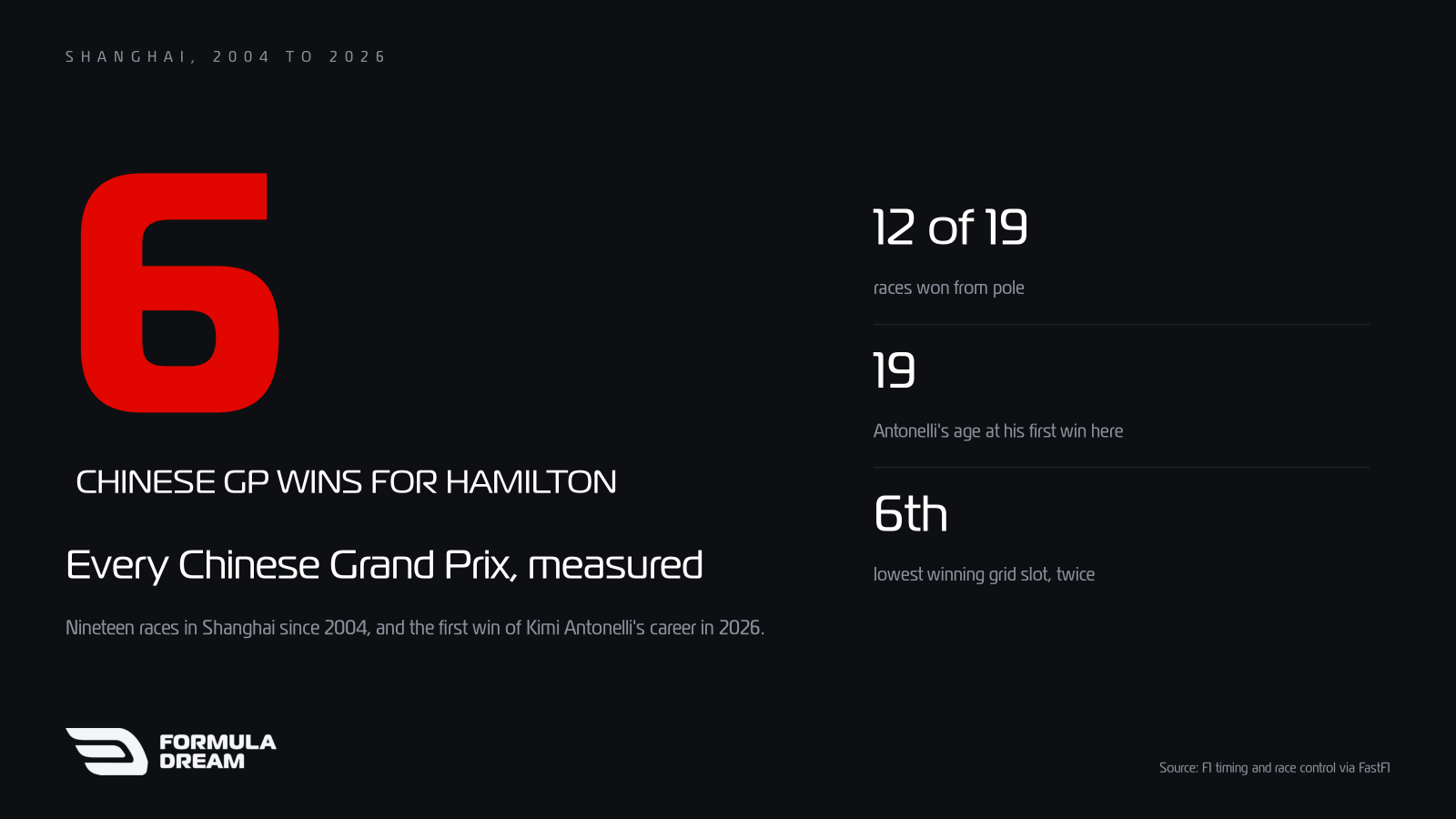
Nineteen Chinese Grands Prix have been held in Shanghai since 2004. Lewis Hamilton won six, pole won twelve, and in 2026 Kimi Antonelli took the first win of his career there, at 19, with Hamilton on the podium for Ferrari for the first time. Every winner, grid slot and safety car, measured.