The F1 Helmet Explained: The Toughest 1.5kg on the Grid
The F1 helmet explained, how a 1.5kg carbon shell withstands a 55-tonne crush and an 800 degree fire, the Zylon strip added after Felipe Massa's injury, and why it is the driver's last line of defence.
To a fan, an F1 helmet is a piece of art: a canvas for a driver's colours, their personality, the one part of the car that is unmistakably theirs. To an engineer, it is one of the most extreme pieces of protective equipment ever made, a shell weighing barely more than a bag of sugar that can survive being crushed by a tank and sitting in an inferno. It is the last line of defence for the most precious and exposed part of the driver. Here is how it is built, and what it can take.
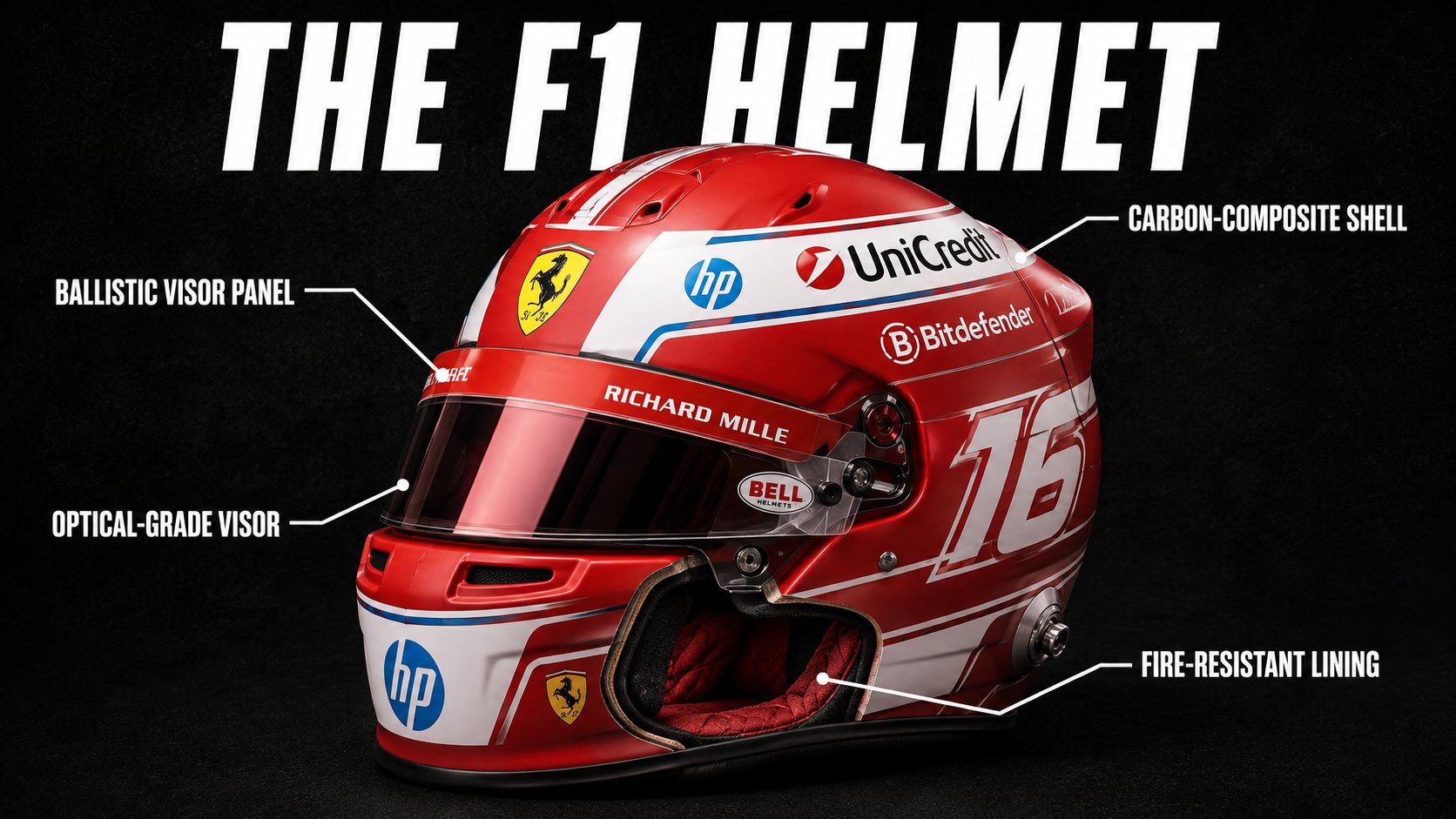
An F1 helmet is a layered composite, and every layer has a job:
A carbon-fibre outer shell, weighing only around 1.2 kilograms, that provides the hard, impact-spreading surface.
A Lexan polycarbonate visor, the same tough transparent material used in bulletproof windows.
A Nomex fireproof lining, the same flame-resistant fabric as the driver's overalls.
Layers of energy-absorbing foam to cushion the head in an impact.
A Zylon reinforcement strip across the front, above the visor, made from one of the strongest fibres in existence.
The complete helmet weighs only around 1.3 to 1.8 kilograms, because every extra gram on the head makes the g-forces harder for the neck to handle.
What it can withstand
The numbers are almost hard to believe. That 1,200-gram carbon shell can take the crushing force of a 55-tonne object without deforming. It can sit in an 800 degree Celsius fire for 45 seconds while its interior stays below 70 degrees, protecting the driver's head from the heat of a fire long enough to escape. And it is fired at with projectiles in testing to make sure nothing can penetrate the visor. To be used in F1, a helmet must pass the FIA's 8860 standard, one of the most demanding helmet homologations anywhere.
The Zylon strip, and Felipe Massa
That reinforcement strip above the visor has a specific, frightening origin. At the 2009 Hungarian Grand Prix, Felipe Massa was struck on the helmet by a suspension spring that had fallen off the car ahead, travelling at enormous speed. It hit him just above the eye, fracturing his skull and nearly costing him his sight and his life. The visor area, the one part of the helmet that has to be open enough to see through, was the weak point. In response, from 2011 a strip of Zylon, an ultra-high-strength fibre, was woven across the front of every F1 helmet to reinforce exactly that area. It is a perfect example of how F1 safety works: a near-tragedy exposes a weakness, and the whole sport is made safer.
Hand-made, and personal
Despite all that technology, an F1 helmet is still hand-made, built up from layers of carbon composite by a handful of skilled specialists, often in small workshops, with a single helmet taking two or three people a full day to construct. A certified F1 helmet costs somewhere around $4,500 to $7,000, and a driver will get through several over a season, including special one-off designs for their home race or a milestone.
That is the other side of the helmet: it is the one place in a tightly-controlled sport where a driver's identity shines through. Under the paint, though, is deadly serious engineering, and it works alongside the HANS device and the halo as one layer of the system that keeps a driver's head safe.
The helmet is part of the car's weight
An easy thing to miss: the helmet is not treated as clothing, it is treated as mass.
The 2026 minimum weight of 768kg includes the car, the driver, their seat and their kit, excluding fuel. So a helmet is roughly 1.5kg of a figure the team has to hit exactly, and every gram of safety equipment is a gram of ballast the team cannot place where it wants.
That is the quiet engineering tension in helmet design. Making it stronger usually means making it heavier, and heavier is both slower and harder on the driver's neck. A 6.5kg head and helmet pulls on the neck like about 40kg at six g, on every fast corner of every lap. The weight rules are in how much an F1 car weighs, and the forces in how many g's F1 drivers experience.
Why it never works alone
A helmet is one layer of a system, and the reason drivers survive modern accidents is that the layers do different jobs at the same moment.
In Romain Grosjean's 2020 Bahrain crash, the FIA measured a peak impact of 67g after his car hit the barrier at 192 km/h and caught fire. The helmet handled the fire and the direct impact. The halo held the barrier away from his head. The HANS device stopped his neck taking the deceleration. The survival cell kept its shape around him.
Remove any one of those and the outcome changes. The helmet is the layer people can see, which is why it gets the attention, but it is the combination that turned a fatal accident into burned hands.
Follow the drivers wearing them
The helmet matters most in the moments you only hear about afterwards.
The Formula Dream app collects every FIA document of the weekend as it is released, which is where the decision behind a penalty actually appears, usually before the commentary catches up. It also runs a live Dashboard through every session with all the cars on the circuit map, a timing tower carrying lap times, gaps, intervals, tyre compound and age, flag and safety car alerts the moment race control calls them, and live driver radio as it is broadcast.
Free, no subscription, no ads, independent. Not affiliated with Formula 1.
A carbon-fibre outer shell, a Lexan polycarbonate visor, a Nomex fireproof lining, energy-absorbing foam, and a Zylon reinforcement strip above the visor. It weighs only around 1.3 to 1.8 kilograms.
How strong is an F1 helmet?
Extremely. The carbon shell can withstand a 55-tonne crushing force without deforming and survive an 800 degree Celsius fire for 45 seconds while staying cool inside. It must pass the FIA's 8860 standard.
Why do F1 helmets have a strip above the visor?
It is a Zylon reinforcement strip, added from 2011 after Felipe Massa was struck on the helmet by a suspension spring at the 2009 Hungarian Grand Prix, fracturing his skull. It strengthens the vulnerable area around the visor.
How much does an F1 helmet cost?
A certified F1 helmet costs roughly $4,500 to $7,000, and each one is hand-made from carbon composite by skilled specialists over about a day.
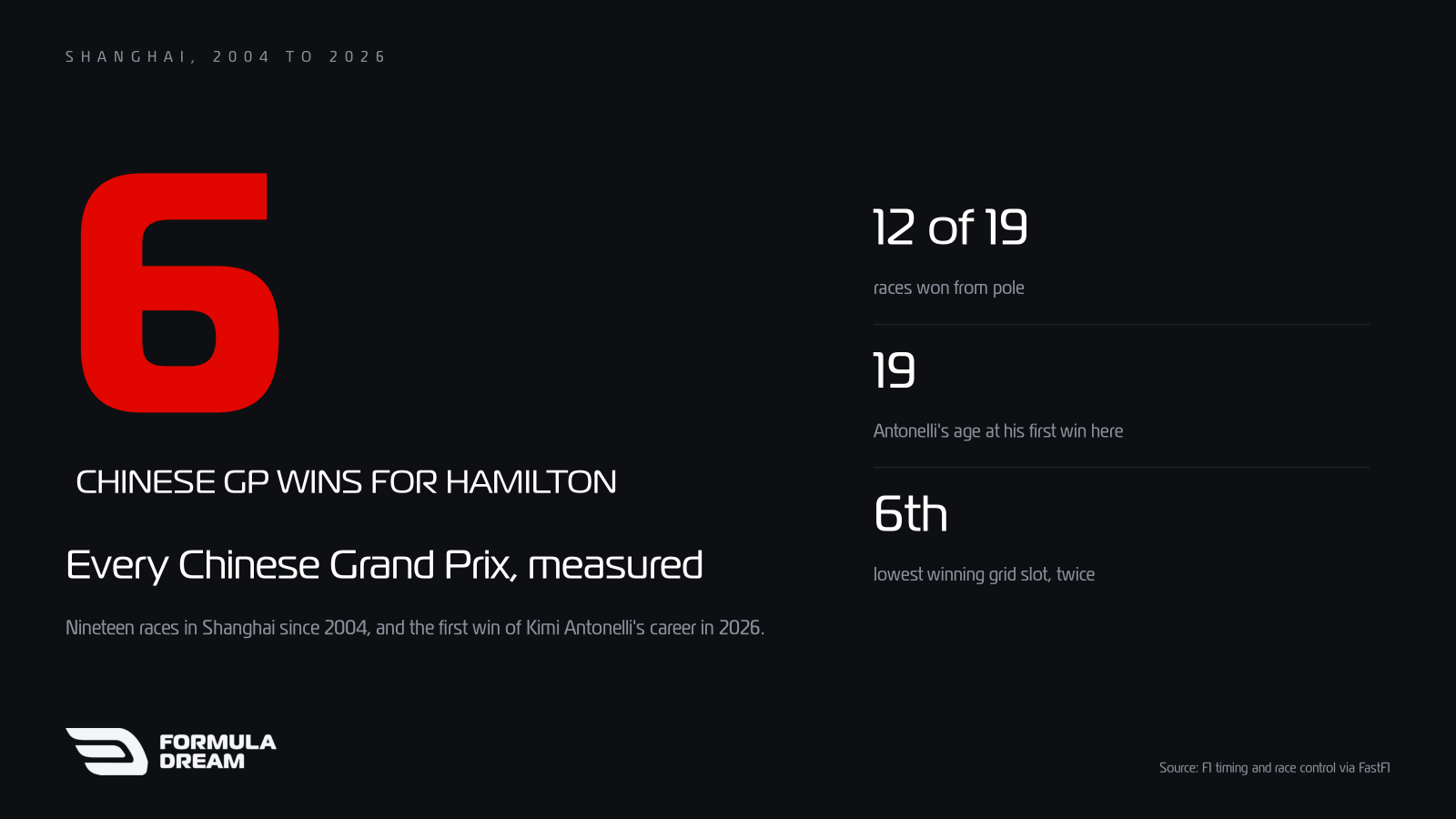
Nineteen Chinese Grands Prix have been held in Shanghai since 2004. Lewis Hamilton won six, pole won twelve, and in 2026 Kimi Antonelli took the first win of his career there, at 19, with Hamilton on the podium for Ferrari for the first time. Every winner, grid slot and safety car, measured.