Why Do F1 Cars Spark? Skid Blocks Explained | Formula Dream
Guides
Why Do F1 Cars Spark? The 10mm Rule Behind the Show
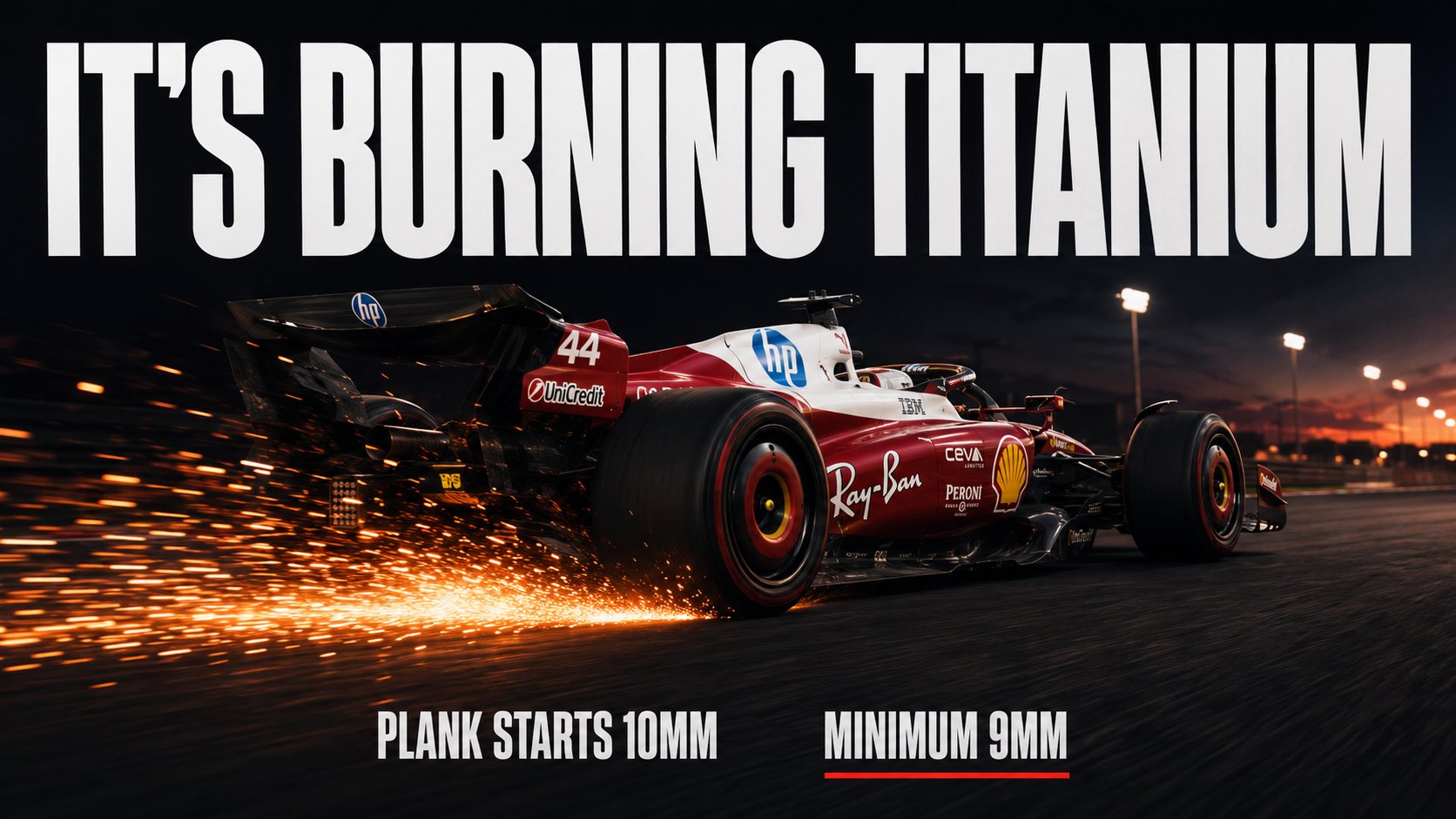
The sparks are burning titanium, and they come from a safety device fitted in 1994. Half a millimetre of wear on it has disqualified a driver from a Grand Prix.
F1 cars spark because metal skid blocks set into the floor are scraping the track. As the car bottoms out, friction tears tiny particles of metal off the skids, and those particles burn as they fly, which is what you are actually watching.
The interesting part is why the skids are there at all. They are protecting a plank, a strip of composite running down the middle of the floor, fitted as a safety measure in 1994. And that plank is measured after the race to a tolerance so tight that half a millimetre of extra wear has disqualified a driver from a Grand Prix.
The sparks are a side effect of one of the strictest rules in the sport.
What the plank is, and why it exists
The plank is a strip of dense material fixed along the underside of the car from front to back. The 2026 rules leave the material free, provided it is homogeneous and within a set density range, a specific gravity of 1.3 to 1.45.
It was introduced in 1994, in the aftermath of the San Marino Grand Prix at Imola, the weekend that killed Ayrton Senna and Roland Ratzenberger and changed F1 safety permanently. Much of what followed is covered in how F1 became so safe.
Its job is indirect but effective: it forces a minimum ride height. Aerodynamically, teams want to run the car as low as possible, because a lower floor generates more downforce. Run it too low and the car bottoms out violently, becomes unpredictable over bumps and kerbs, and grounds out under braking. The plank means that a team running dangerously low will wear it through and be disqualified. It is a rule that polices itself through physical evidence.
That principle matters more than ever with modern ground effect floors, where the downforce gain from running low is enormous.
Where the sparks come from
The plank is composite, and composite wears fast. So teams fit metal skids, flush inserts set into the plank around its measuring holes, to take the abrasion instead. Under Article C3.6.3 of the 2026 Technical Regulations a metal skid is mandatory around the front hole and optional around the other two, and it must be made from a specified titanium alloy, Ti6Al4V, or from 17-4PH stainless steel.
Titanium is used because it is light, hard and durable. It also happens to spark spectacularly. When a titanium insert drags across asphalt at speed, the friction heats and shears off tiny fragments, and those fragments ignite in air as they are thrown backwards. What you see behind the car is burning metal.
You see it most on straights, which is counterintuitive until you think about it. Downforce rises with speed, so the faster the car goes the harder aerodynamic load presses it into the ground. At the end of a long straight, with the car at maximum speed and low on fuel late in a stint, the floor is being squeezed closest to the track. Add a crest or a compression and the skids touch.
It is also why you see more sparks at some circuits than others. Bumpy surfaces, big elevation changes and long flat-out sections all increase the contact.
Under Article C3.6.1 of the 2026 Technical Regulations, the plank assembly must be 10mm thick, plus or minus 0.2mm, and uniform when new.
After the session the FIA measures it around the plank's three 34mm holes, with the skids taken off the car and checked with a micrometer. Around those holes it must not have worn below 8mm. In other words, a team may wear away 2mm, and no more.
That is a change for 2026. Until 2025 the limit was 9mm, measured at four holes, which allowed just 1mm of wear.
If the plank measures under the limit, disqualification is effectively automatic. There is no discretion for a team that got its sums slightly wrong, and no allowance for a bumpy circuit or an unexpected kerb strike.
The half millimetre that cost a win
The rule sounds theoretical until you see it applied.
At the 2025 Chinese Grand Prix, Lewis Hamilton's car was measured after the race. The plank assembly on Car 44 came in at 8.6mm on the left, 8.6mm at the centreline and 8.5mm on the right, against the 9mm minimum that applied in 2025, under Article 3.5.9 of that year's Technical Regulations.
Four to five tenths of a millimetre. He was disqualified from the results.
Mercedes and Ferrari have both been caught by this over the years, and the response is always the same: no mitigating circumstances, a genuine error in setting the car up. That is what makes the rule so effective. It is not a judgement call by the stewards, it is a measurement, and the number either clears the limit or it does not.
Why teams run so close to the line anyway
If the penalty is disqualification, why does anyone risk it?
Because ride height is worth a lot of lap time, and the optimum is right next to the limit. A team that runs conservatively high gives away performance for the entire race. A team that runs at the edge is faster all afternoon and only loses everything if the wear runs slightly over.
The calculation gets harder because wear is not fully predictable. It depends on fuel load, which changes through the race, on how much kerb a driver uses, on track temperature and on the surface itself. Teams model it, then set the car for the wear they expect. Get the model wrong by a fraction of a millimetre and a podium becomes nothing.
This is also why you will hear engineers on the radio asking a driver to avoid specific kerbs, or to stop running so wide at a particular corner. It is often not about track limits. It is about the plank.
Watch the checks happen
Plank measurements, scrutineering results and the disqualifications that follow all arrive as published documents, usually hours after the flag when most people have stopped watching.
The Formula Dream app collects every FIA document of the weekend as it is released, which is where a post-race technical breach actually appears, and where a result quietly changes. It also runs a live Dashboard through every session with all the cars on the circuit map, a timing tower carrying lap times, gaps, intervals, tyre compound and age, flag and safety car alerts, and live driver radio as it is broadcast, which is where the kerb warnings happen.
Free, no subscription, no ads, independent. Not affiliated with Formula 1.
Metal skid blocks under the floor, titanium or stainless steel, scrape the track when the car bottoms out. Friction shears off tiny metal particles which burn in the air, producing the sparks you see behind the car.
What is the plank on an F1 car?
A strip of composite material running along the underside of the car, introduced in 1994 as a safety measure. It enforces a minimum ride height, because wearing it beyond the limit means disqualification.
How much can an F1 plank wear?
Under the 2026 rules it starts at 10mm, with a tolerance of 0.2mm, and must not measure below 8mm around its three measuring holes after the session, which allows 2mm of wear. Until 2025 the minimum was 9mm.
Has a driver been disqualified for plank wear?
Yes. Lewis Hamilton was disqualified from the 2025 Chinese Grand Prix after his plank measured 8.6mm, 8.6mm and 8.5mm against the 9mm minimum that applied that year, a shortfall of less than half a millimetre.
Why do F1 cars spark more on straights?
Because downforce increases with speed, so the car is pressed hardest into the track at maximum speed. Late in a stint, with a lighter fuel load and a low ride height, the skids touch down most often on the fastest parts of the lap.
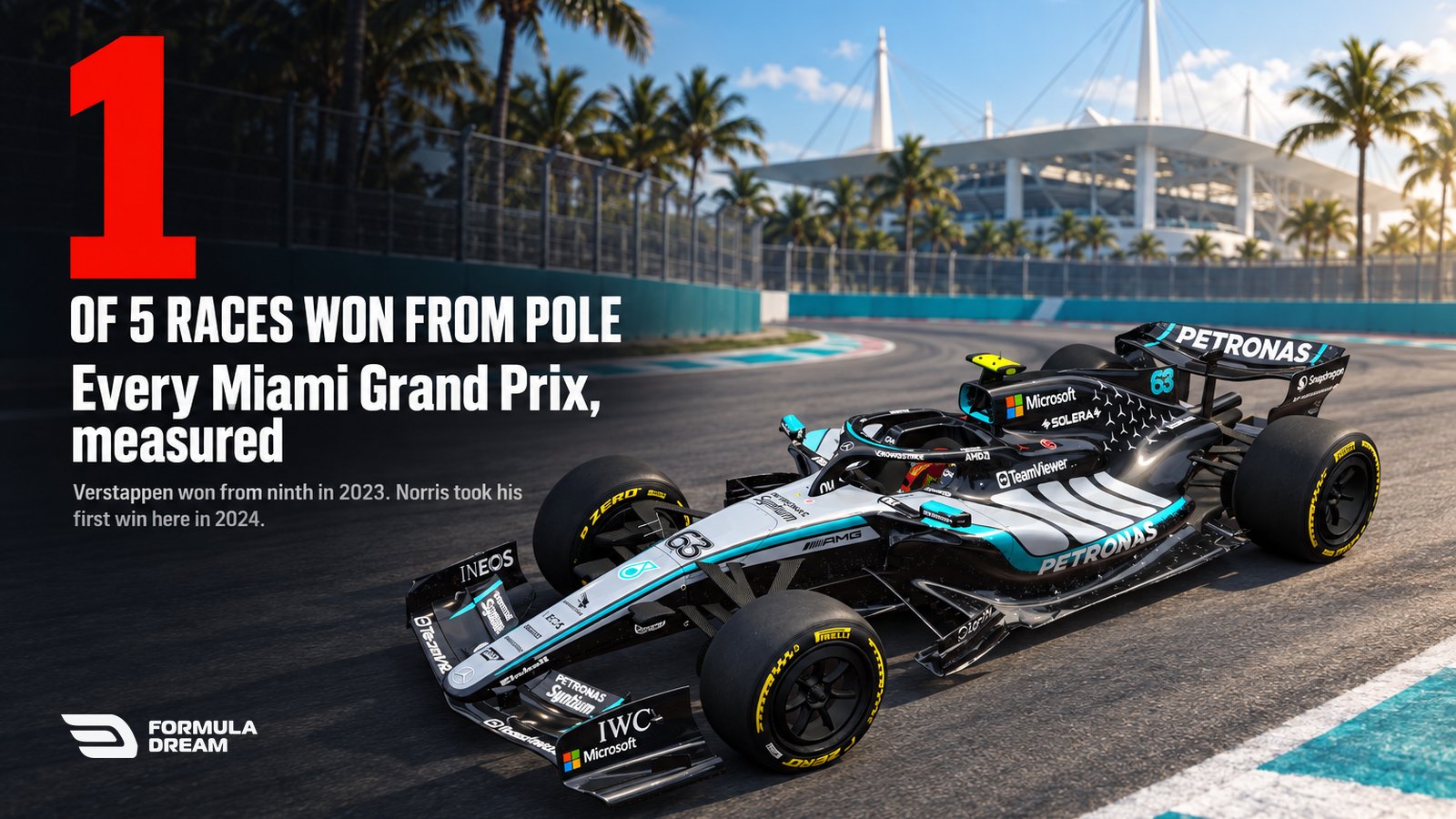
Every Miami Grand Prix winner, measured: five races, and pole has won only one of them
Five Miami Grands Prix have been held since 2022, and only one was won from pole: Kimi Antonelli's in 2026. Max Verstappen won from ninth in 2023, and Lando Norris took his first win there in 2024. Every winner, grid slot and safety car, measured.