F1 Race Strategy Explained, With the Numbers Behind It
Every F1 strategy decision is an arithmetic problem with known values. Here are the real numbers, measured across full seasons, that teams are actually working with.
F1 race strategy is usually explained as intuition and gambling. It is neither. It is an arithmetic problem where most of the values are known before the race starts, and the teams are all solving the same equation.
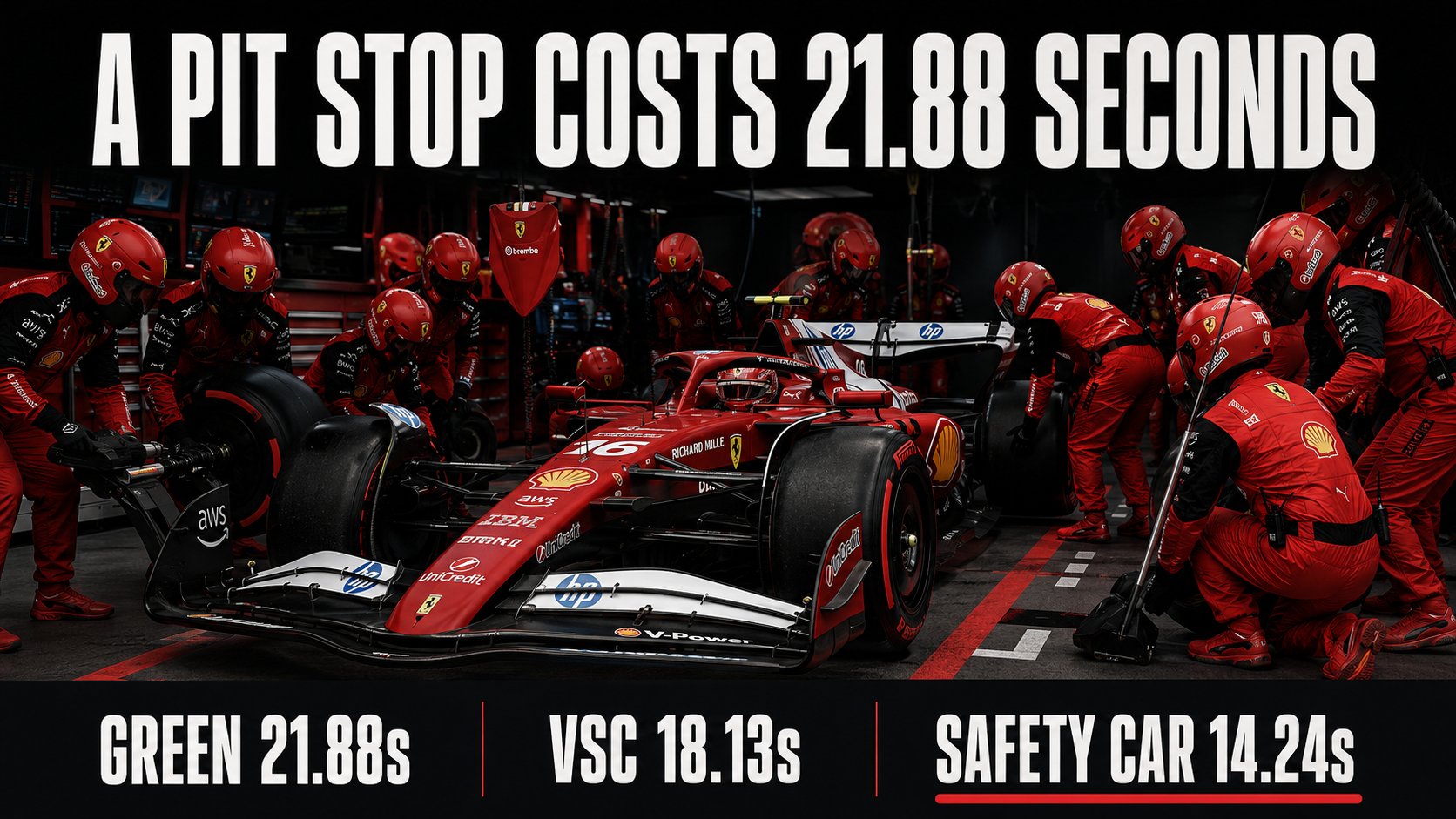
The core of it: a pit stop costs about 21.88 seconds. Everything else is a judgement about whether fresh tyres will give that back.
We have measured the rest of the inputs across full seasons. Here is what the numbers actually say, and how they combine into the decisions you watch on a Sunday.
The one rule that forces a stop
There is no rule limiting pit stops in Formula 1. There is a rule about tyres, and it does the same job.
In a dry race, every driver must use at least two of the different dry compounds Pirelli brings to that event. A driver cannot change compound without stopping, so that requirement makes one stop compulsory. Most dry races are therefore one or two stops, occasionally three.
Two consequences catch people out. If it rains and intermediate or wet tyres are used, the requirement disappears entirely, so a driver could in principle never stop. And the minimum is one, not two: Formula 1 trialled a mandatory two-stop race at Monaco in 2025, it was widely disliked, and the rule was struck out of the 2026 regulations.
What a pit stop actually costs
The two-second figure everyone quotes is the stationary time. It is the smallest part of the cost.
Measured across a full season, the real cost of a pit stop is:
Green flag conditions: 21.88 seconds. That covers the whole detour, the slow-down, the pit lane at its speed limit, the stop itself and the acceleration back to racing speed.
Under a virtual safety car: 18.13 seconds.
Behind a full safety car: 14.24 seconds.
So a safety car saves about 7.6 seconds, which is 35% of the normal cost, and a VSC saves about 3.8 seconds. That is smaller than the saving usually described on television, and it is the reason a caution at the wrong moment ruins a race that was going perfectly. The method is in what an F1 pit stop actually costs.
That 21.88 seconds is the number every strategy decision is measured against. To make a stop worthwhile, fresh tyres have to give back more than that before the end of the race.
How tyre degradation drives everything
The reason fresh tyres give time back is degradation, and it is measurable.
Across 854 race stints in 2025, tyres lost pace with age at these rates:
Soft: 0.048 seconds per lap of tyre age
Medium: 0.027 seconds
Hard: 0.011 seconds
The soft degraded 4.4 times faster than the hard. That hierarchy is the whole basis of compound choice: a soft gives you more grip now and takes it away quickly, a hard gives you less grip and holds it.
Measured the same way across 439 stints in 2026, those numbers are 0.045, 0.037 and 0.039. The hierarchy has collapsed. When the compounds degrade at nearly the same rate, the strategic case for stopping weakens, because the fresh tyre you fit is not much better than the one you took off. The full breakdown is in how fast F1 tyres actually degrade.
The undercut: how often it really works
The undercut is pitting before the driver you are racing, using fresh tyres to set faster laps while they are still on old ones, and emerging ahead when they stop.
Across a season of 81 attempts, it worked 44.4% of the time. Slightly worse than a coin flip.
The number that actually matters is timing:
Pitting one lap earlier than your rival works 34% of the time.
Pitting two laps earlier works 69%.
One lap is not enough. The out-lap on cold tyres eats most of the advantage, and it takes a second flying lap for the gain to accumulate. That single distinction explains most failed undercuts you have watched. The detail is in does the undercut actually work.
The undercut also needs degradation to work at all. Where tyres hold their pace, there is nothing to gain from being fresher, which is why the same move succeeds routinely at one circuit and fails all afternoon at another.
What a safety car really does
This is the strategic variable teams cannot control and plan hardest around.
A full safety car cuts the spread from the leader to the last runner from about 75 seconds to 22. That is 71% of the field advantage deleted, plus the cheaper pit stop above. A driver who has already stopped watches their earned gap evaporate; a driver who has not gets a nearly free stop.
A virtual safety car does not do this. It closes up nothing. The field comes out of a VSC as spread as it went in, because every car slows by the same proportion. It still makes a stop cheaper, but it does not hand anyone track position.
Strategy is a trade between fresh tyres and track position, and track position is worth more than it looks, for one measurable reason: overtaking is hard.
Running within one second of another car costs 0.49 seconds a lap, and inside half a second it costs 0.61. A car that is genuinely faster can sit behind a slower one indefinitely, losing time and destroying its tyres, which is why teams will accept an inferior tyre to stay ahead.
It also explains the grid. Pole position has won 56% of races since 2021, and the front row 77.6%. Saturday decides more than it used to, and strategy on Sunday is often an attempt to undo it.
Putting it together
A team's strategy call is roughly this calculation, made continuously:
A stop costs 21.88 seconds under green, less under a caution.
Fresh tyres give back time at a rate set by the degradation curve for that compound and circuit.
Whatever you gain must survive traffic, which costs up to 0.61 seconds a lap.
The whole thing can be rewritten by a safety car at any moment.
And you must use two dry compounds, so at least one stop is happening regardless.
That is why two cars on the same lap in the same race make opposite decisions and both are defensible. They are weighting the same numbers differently, mostly on how likely they think a safety car is.
Watch strategy unfold live
Strategy is decided in the numbers, and almost all of them are visible while the race is happening.
The Formula Dream app runs a live Dashboard through every session: every car on the circuit map, and a timing tower with lap times, gaps and intervals, tyre compound and age, pit counts and positions gained or lost, plus flag and safety car alerts the moment race control calls them. Tyre age next to interval is how you see an undercut coming two laps early.
You also get live driver radio as it is broadcast, which is where the stop is actually called, and every FIA document of the weekend as it is published.
Free, no subscription, no ads, independent. Not affiliated with Formula 1.
It is a trade between the time a pit stop costs, about 21.88 seconds under green flags, and the time fresh tyres give back through lower degradation. Teams must also use two dry compounds in a dry race, which forces at least one stop.
How much time does an F1 pit stop lose?
About 21.88 seconds under green flag conditions, counting the full detour rather than just the stationary time. Under a virtual safety car it is 18.13 seconds, and behind a full safety car 14.24.
Does the undercut work?
Just under half the time. Measured across 81 attempts it succeeded 44.4% of the time. Pitting one lap earlier than a rival works 34% of the time, but two laps earlier works 69%.
Why do teams pit under a safety car?
Because the stop costs about 7.6 seconds less, and the field bunches up so the time lost in the pit lane costs less track position. A full safety car removes roughly 71% of the spread from leader to last.
How many pit stops does an F1 race have?
Usually one to three. There is no maximum, but the requirement to use two different dry compounds makes one stop compulsory in a dry race.
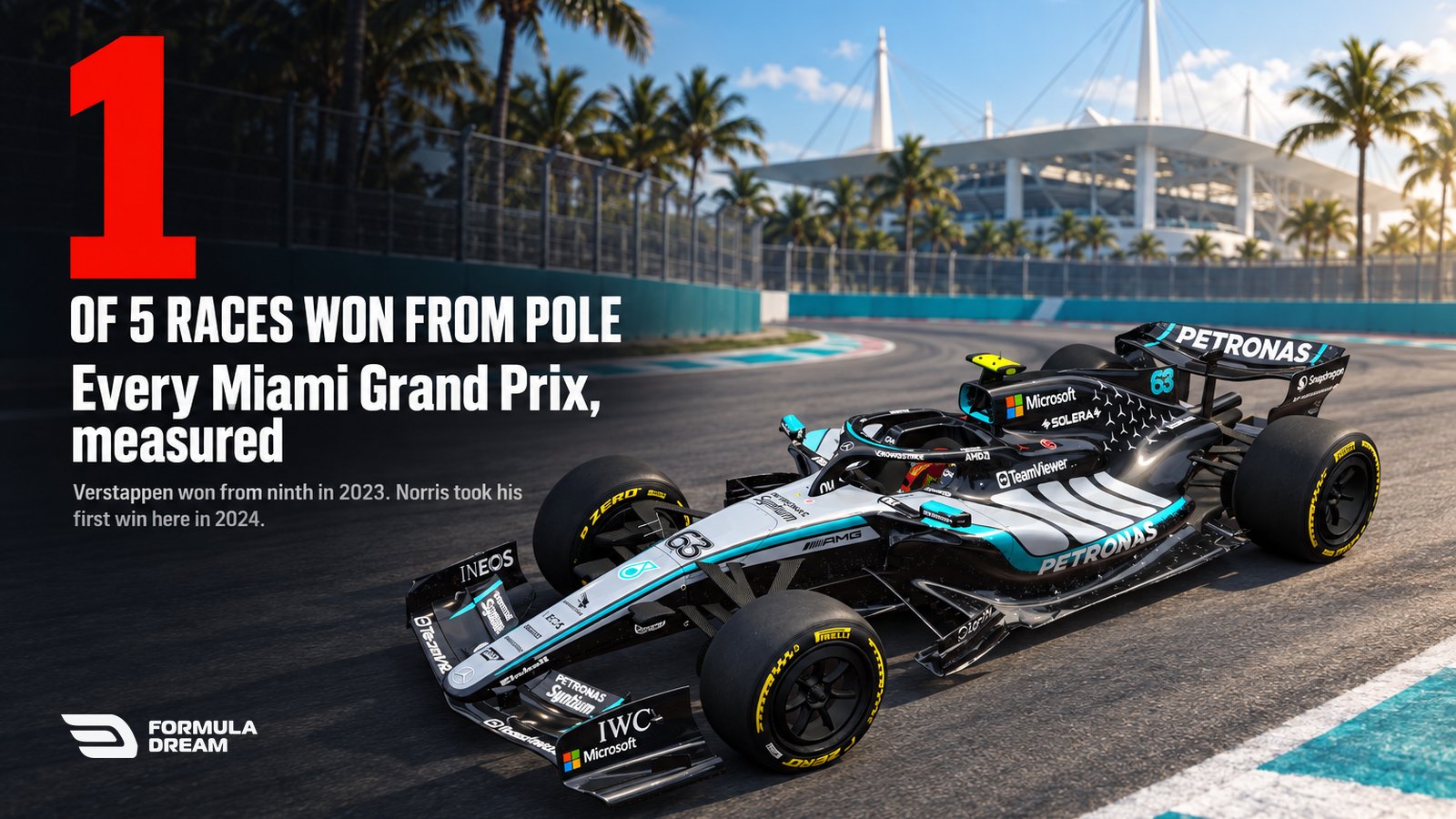
Every Miami Grand Prix winner, measured: five races, and pole has won only one of them
Five Miami Grands Prix have been held since 2022, and only one was won from pole: Kimi Antonelli's in 2026. Max Verstappen won from ninth in 2023, and Lando Norris took his first win there in 2024. Every winner, grid slot and safety car, measured.