Fastest Street Circuit in F1: All 8 Ranked | Formula Dream
Guides
The Fastest Street Circuit in F1, Measured
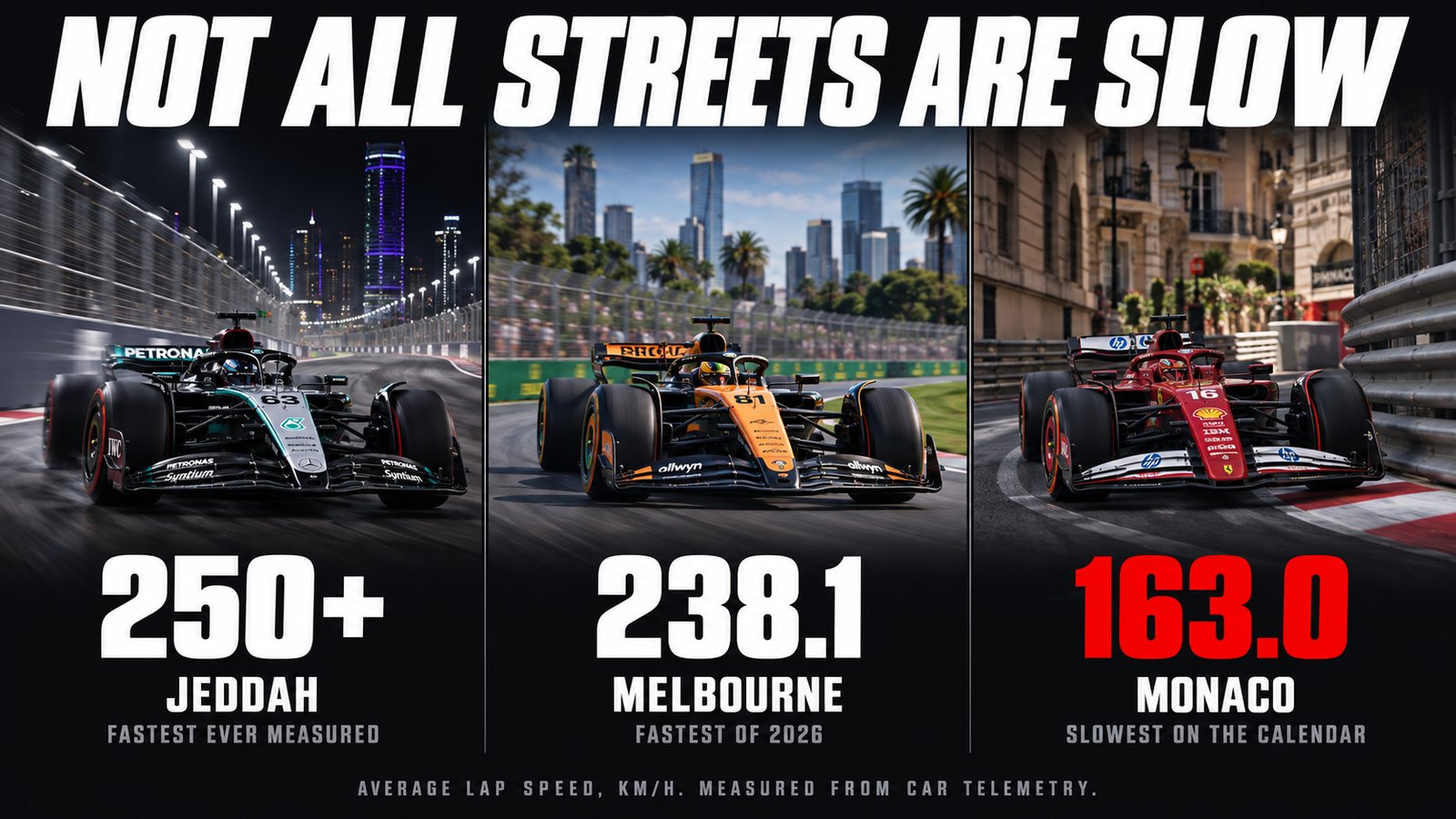
Jeddah is the fastest street circuit in Formula 1, but only just. Measured on the same cars, Melbourne is 1.9 km/h behind it and Monaco is 83 km/h slower.
Jeddah is the fastest street circuit in Formula 1. Max Verstappen's pole lap there in 2025 averaged 251.6 km/h, quicker than any other street or temporary circuit on the same generation of car.
It only just holds on. Measured on identical machinery, Melbourne is 1.9 km/h behind it, and Monaco, the circuit most people picture when they hear the words street race, is 83 km/h slower.
We measured all eight the same way: the fastest dry qualifying lap at each circuit, the real distance the car covered divided by the real lap time, and every lap set on the 2022 to 2025 generation of car so that no figure flatters an older one.
Fastest dry qualifying lap at each circuit on the 2022 to 2025 generation of car. Las Vegas uses 2024 because its 2025 qualifying session was fully wet.
The slowest point column explains the table better than the top speed column does. Las Vegas has the highest top speed of the eight and finishes third. Melbourne never drops below 98 km/h anywhere on the lap, the highest minimum of any street circuit, and finishes second. Speed that a circuit never takes away is worth more than speed it gives you for a few seconds on one straight.
Which circuits actually count as street circuits?
This is where most rankings quietly cheat, so here are the definitions we used.
Five are street circuits in the strict sense, laid out on roads that are open to traffic for the rest of the year: Jeddah, Las Vegas, Baku, Singapore and Monaco.
Three are temporary or semi-permanent circuits that get grouped with them. Melbourne runs on park roads around Albert Park lake. Montreal runs on the roads of an island park. Miami is a temporary circuit built around the Hard Rock Stadium.
Apply the strict definition and the answer does not change at the top. Jeddah is still first, Las Vegas second at 239.4 km/h, and Monaco still last.
Why Jeddah is so fast
The Jeddah Corniche Circuit has 27 corners, which on paper should make it slow. It is the opposite, because almost every one of those corners is a flat-out or near-flat kink rather than a corner in the normal sense.
The data shows it plainly. Across a 6 km lap the fastest car needed only six braking zones, as few as any circuit in the table, and never dropped below 88 km/h. That is Monza pace with concrete walls a couple of metres from the wheels, blind crests and very little run-off.
It is not on the 2026 calendar. The Saudi Arabian Grand Prix, scheduled for April, was cancelled along with the Bahrain Grand Prix because of the conflict in the Middle East, so its place at the top of this table rests on 2024 and 2025. Both years agree: 251.0 km/h in 2024, 251.6 in 2025.
Baku has the longest straight and still finishes sixth
Baku owns the longest uninterrupted full-throttle run of any circuit here, about 1.85 km from the final corner to Turn 1. If straights decided speed it would be near the top.
It is sixth, because the rest of the lap takes it all back. The castle section drops the car to 72 km/h, and a Baku lap needed ten braking zones. The layout is broken down in the Baku City Circuit guide.
Las Vegas has Monza's top speed
Las Vegas reached 347 km/h on its fastest lap, the highest top speed of any street circuit we measured and a figure normally associated with Monza. It averaged 239.4 km/h, third overall and second among strict street circuits.
One warning for anyone repeating this. Las Vegas qualifying in 2025 was fully wet, 282 laps on full wets and 93 on intermediates with no slick running, and a lap from that session averages 204.9 km/h. That figure measures the rain, not the circuit, which is why the table uses 2024. The circuit is covered in the Las Vegas circuit guide.
Singapore and Monaco: where the brakes decide the lap
The two slowest circuits in the table are the two with the most braking. Singapore needed twelve braking zones, the most of any circuit here, which is why a lap there averages 197.0 km/h despite a 316 km/h top speed. Its layout is in the Marina Bay circuit guide.
Monaco is in a category of its own. A 3.3 km lap, nine braking zones, and a slowest point of 46 km/h at the hairpin. Its 168.6 km/h average is 28.4 km/h slower than Singapore, the next slowest, and its top speed of 289 km/h is the only one in the table under 300.
What the 2026 cars have changed
Every figure above comes from the previous generation of car on purpose. The 2026 regulations cut downforce sharply and lap times are around 3% slower, as we measured in are F1 cars getting faster. Mixing a 2026 lap into this table would make its circuit look slower than it is.
The street and temporary circuits raced in 2026 so far confirm the shift without changing the order: Melbourne 238.1 km/h, Miami 218.8, Montreal 213.8 and Monaco 163.0. Baku, Singapore and Las Vegas are still to come this season. The full 2026 ranking of every circuit, street and permanent, is in the fastest F1 circuits.
Method
Data: Formula 1 timing and car telemetry via FastF1, qualifying sessions only.
The fastest legal lap at each circuit, with deleted laps excluded and the tyre compounds checked. A session run mostly on wet or intermediate tyres was rejected.
Average lap speed is the distance the car actually covered on that lap divided by the lap time. That is the racing line, so it runs slightly shorter than the official circuit length.
Every lap comes from the 2022 to 2025 generation of car. Las Vegas uses 2024 because its 2025 session was wet.
Braking zones count each application of the brake held for at least 20 metres, so a brief touch does not register.
We left full-throttle share out of the table deliberately. At Melbourne in 2025 both McLarens' throttle channels read just under 100% along the straights: Norris's pole lap measures 62.7% at full throttle with a 99% threshold and 80.0% with a 95% threshold, while Verstappen's lap reads 79.4% either way. A figure that moves by seventeen points depending on where the line is drawn is not one we are willing to rank circuits on.
Sources
Cancellation of the 2026 Bahrain and Saudi Arabian Grands Prix: Sky Sports
Watch the fast ones live
Street circuits are where a lap that looked safe stops being safe, and where safety cars decide races.
The Formula Dream app runs a live Dashboard through every session: every car on the circuit map, and a timing tower with lap times, gaps and intervals, tyre compound and age, plus flag and safety car alerts the moment race control calls them. You also get live driver radio as it is broadcast, and every FIA document of the weekend as it is published, which is where the stewards' decisions that change results appear.
Free, no subscription, no ads, independent. Not affiliated with Formula 1.
Jeddah, in Saudi Arabia. Max Verstappen's 2025 pole lap there averaged 251.6 km/h, the fastest of any street or temporary circuit measured on the same generation of car. Melbourne is second at 249.7 km/h.
Is Monaco the slowest circuit in F1?
Yes. On the 2022 to 2025 cars its fastest qualifying lap averaged 168.6 km/h, the lowest of any circuit, and in 2026 it measured 163.0 km/h. Its slowest point is 46 km/h at the hairpin.
Which street circuit has the highest top speed?
Las Vegas. Its fastest qualifying lap in 2024 reached 347 km/h, higher than any other street circuit we measured, although it averaged less than both Jeddah and Melbourne.
Is Melbourne a street circuit?
Not in the strict sense. Albert Park is a temporary circuit on park roads around a lake. On the strict definition, the street circuits are Jeddah, Las Vegas, Baku, Singapore and Monaco, and Jeddah is still the fastest.
Is Jeddah on the 2026 F1 calendar?
No. The 2026 Saudi Arabian Grand Prix, scheduled for April, was cancelled along with the Bahrain Grand Prix because of the conflict in the Middle East.
How was this measured?
From Formula 1's own timing and telemetry. We took the fastest legal dry qualifying lap at each circuit, excluded deleted laps, and divided the distance the car recorded by the lap time, using only laps from the same generation of car.
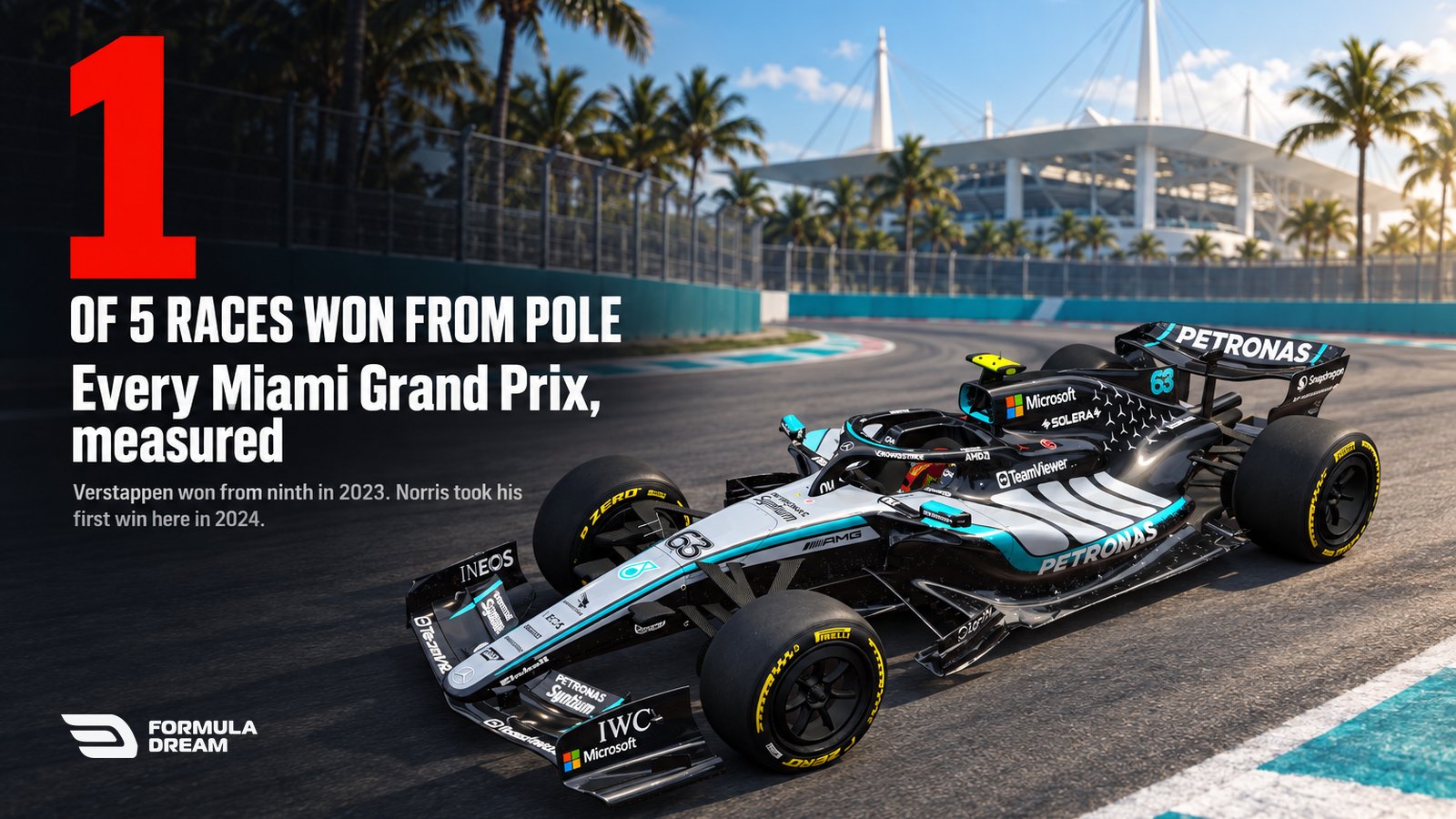
Every Miami Grand Prix winner, measured: five races, and pole has won only one of them
Five Miami Grands Prix have been held since 2022, and only one was won from pole: Kimi Antonelli's in 2026. Max Verstappen won from ninth in 2023, and Lando Norris took his first win there in 2024. Every winner, grid slot and safety car, measured.