Las Vegas F1 Circuit Explained, Measured From Telemetry
Guides
Las Vegas Explained: Monza Speed on a Freezing Street
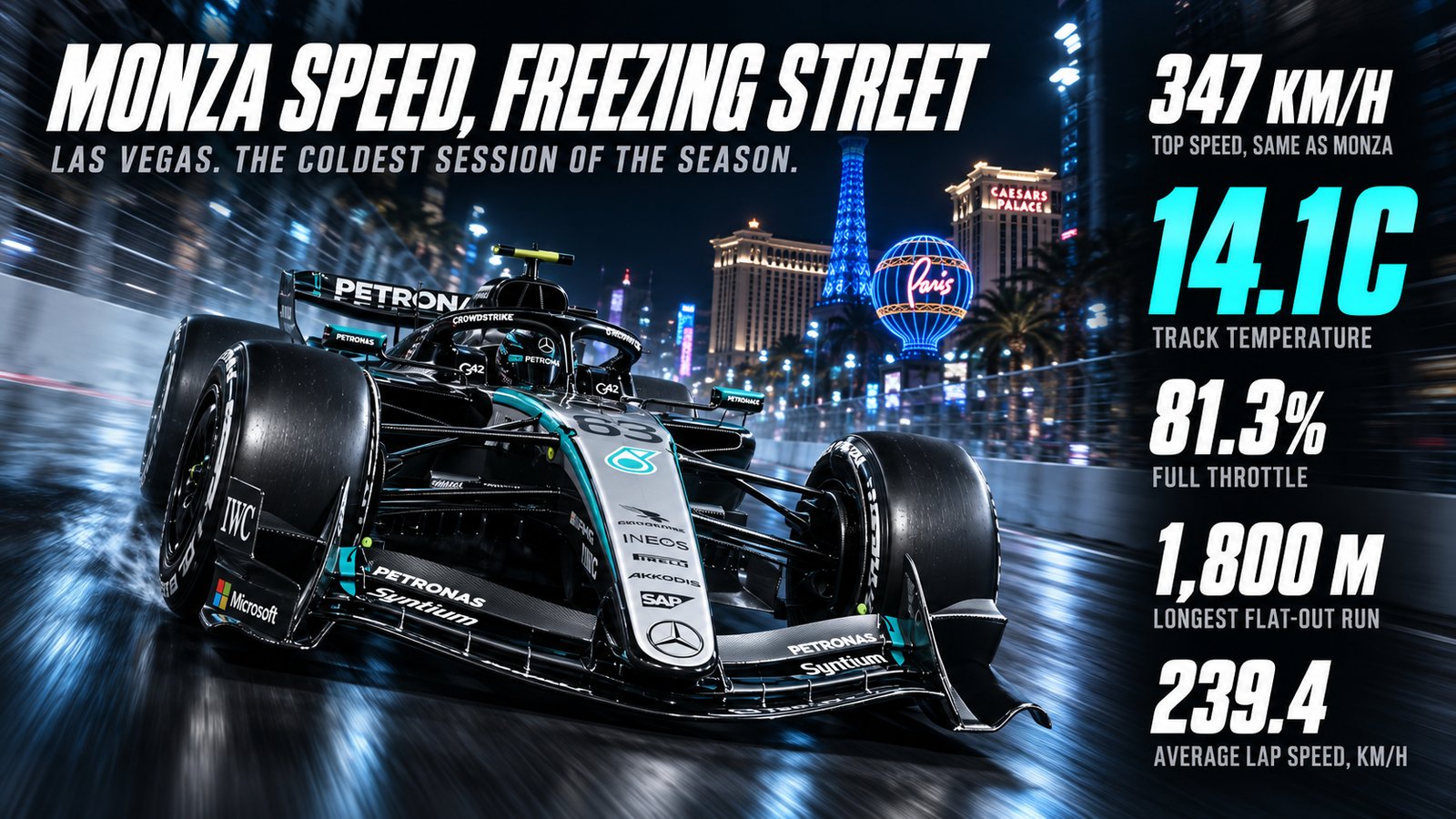
We measured the Las Vegas lap from telemetry. It reaches 347 km/h, exactly what Monza reached, on a track 34.6C colder than any other session of the year.
The fastest qualifying lap ever set in Las Vegas reached 347 km/h. The fastest lap ever set at Monza reached 347 km/h. The difference is that the Las Vegas track surface was 34.6 degrees colder.
That is the whole circuit in one sentence. Las Vegas asks a Formula 1 car to do Monza things in conditions no other race weekend comes close to.
We pulled the fastest legal qualifying lap from all three Las Vegas Grands Prix held so far, plus the weather data from every qualifying session of a full season, to measure it properly.
Las Vegas Strip Circuit, fastest legal qualifying lap measured from car telemetry. Deleted laps excluded.
Las Vegas, drawn from the car rather than traced: the path of George Russell's 2024 pole lap, 347 km/h at its fastest and 89 km/h at its slowest.
What the drivers said on this circuit is in our Las Vegas Grand Prix 2025 race radio, every broadcast message with the audio and a transcript coloured by who is speaking.
Two dry years, within one kilometre per hour of each other. That is a repeatable lap, which matters on a circuit made of public roads that get resurfaced and reopened to traffic between races.
81.3% full throttle is the highest of any street circuit we have measured, and it is within a whisker of Monza's 81.9%. Seven braking events on a 6.14 km lap is barely more than one per kilometre.
We nearly published the wrong number
The 2025 Las Vegas qualifying session produced an average lap speed of 204.9 km/h. Taken at face value, that would have placed the circuit near the bottom of the calendar, slower than Mexico.
It was fully wet. Of the 375 laps run in that session, 282 were on full wet tyres and 93 on intermediates. Not a single lap was set on a slick tyre, and the weather data records rainfall throughout.
So the 2025 figure measures rain, not the circuit. The dry number is 239.4 km/h, and we use that everywhere on this site. We ran into the identical trap at Interlagos, where the 2024 session was also fully wet, and turned it into a measurement of its own in what rain actually costs.
Where it actually ranks
Las Vegas is fast, but it is not the fastest, and the comparison has to be made carefully because Formula 1 cars change year to year.
Measured against other circuits on the same generation of car, in dry qualifying:
Monza 260.2 km/h
Jeddah 251.0
Melbourne 247.4
Silverstone 244.1
Las Vegas 239.4
So it sits fifth of those, and second among street circuits behind Jeddah. Comparing it to a lap set by a different generation of car would flatter or punish it unfairly, which is why the list above is all one season. The full ranking is in the fastest F1 circuits, and the street circuit comparison in the fastest street circuit in F1.
What Las Vegas does own outright is peak speed for a street circuit. 347 km/h is not a street circuit number. It is a Monza number, recorded between walls.
The 1,800 metre problem
The long blast down Las Vegas Boulevard is the second longest continuous full-throttle section in Formula 1, behind Baku's 1,842 metres. We measured the 2024 pole lap running flat out for 1,800 metres without a lift.
That length is why the top speed is so high, and it creates the setup problem that defines the weekend. A car trimmed out to be quick over 1,800 metres of straight has almost no wing left for the rest of the lap. A car with enough wing to work in the slow middle sector gets eaten alive on the Strip.
Every team arrives with a compromise, and the corner-exit traction it costs them is audible on the radio.
We measured the mean track temperature in every qualifying session of a full 24 round season. Las Vegas is not merely the coldest. It is not close.
Las Vegas 14.1C
Silverstone 21.2C
Bahrain 21.5C
Lusail 21.7C
Spa 22.0C
Interlagos 23.4C
The next coldest session of the year is 7.1C warmer. At the other end, Monza qualifying ran at 48.7C, so the same cars that hit 347 km/h in Vegas do it again in Italy on a surface 34.6 degrees hotter.
This is a November night race in a desert, run after dark when the surface has been shedding heat for hours. Formula 1 tyres are designed to work in a temperature window, and 14C sits below the bottom of it.
The consequences are specific and measurable. The slowest point of the Las Vegas lap is 89 km/h, faster than COTA's 80 and much faster than Singapore's 65, so there is no slow, grinding corner sequence to put heat back into the rubber. The car spends 81.3% of the lap at full throttle, which is exactly the condition in which tyres cool down rather than warm up. Then the driver arrives at a corner with tyres that are colder than they were at the last one.
That is why Las Vegas produces so many spins and lock-ups on out-laps, why the first laps of a stint are so unpredictable, and why graining rather than degradation is the tyre problem here.
Race day: the least predictable strategy on the calendar
Year
Laps
Mean stops per driver
Most common
Safety cars
Virtual safety cars
2025
50
1.25
1
2
2
2024
50
2.05
2
0
0
2023
50
1.55
2
3
1
Las Vegas Grand Prix race data, from F1 timing data.
Three races, three different answers. A clean two-stop in 2024 with no interruptions at all, a chaotic 2023 with three safety cars and a virtual safety car, and a 2025 race that settled into a one-stop after a wet qualifying day.
Compare that with Monza, which has produced zero safety cars in three consecutive years, or COTA, which has produced exactly one in each of the last two. Las Vegas has no pattern yet. Our season-wide figures are in how many pit stops in an F1 race.
The cold is part of that too. When tyres never reach their window, a team's pre-race model of how long a set will last is worth less than usual, and strategy calls get made on the evidence of the first stint rather than on simulation.
What 2026 changes
The current cars carry roughly 30% less downforce than the generation that set the laps in the table above, which we measured in are F1 cars getting faster.
At most circuits that costs lap time in the corners. Las Vegas is one of the few places where less downforce is close to free, because 81.3% of the lap does not use it. Expect the straight-line numbers to hold up well here and the middle sector to suffer.
The bigger change is thermal. Less downforce means less energy going through the tyre in the corners, and less energy through the tyre means less heat. On the coldest surface of the season, at the circuit where warming tyres is already the central problem, that points in an uncomfortable direction. Whether the 2026 cars can get a tyre switched on at 14C in the middle of the night is one of the genuinely open questions of the season.
The Las Vegas circuit hub pulls together everything we hold for this venue in one place: every qualifying gap drawn as real distance, the track domination maps where we have them, and the team radio from previous races here.
What the drivers said here
The radio is the part of a weekend that does not make the highlights. We hold every message Formula 1 broadcast from Las Vegas in 2025, 102 of them across the whole weekend, transcribed with the original audio and the driver and engineer colour coded, on the Las Vegas 2025 team radio page.
It is worth a scroll before a race here, because the complaints repeat. Drivers tend to raise the same two or three things about a circuit every year, and reading last season back is the quickest way to know what to listen for in this one.
Follow the weekend with the data on screen
The Las Vegas Grand Prix is round 21 of the 2026 season, on 21 November. Every race held here, from Caesars Palace in 1981 to the Strip, is in every Las Vegas Grand Prix winner, measured.
The Formula Dream app runs a live Dashboard through every session: every car on the circuit map, and a timing tower with lap times, gaps and intervals, tyre compound and age, plus flag and safety car alerts as race control calls them. In Vegas the column that tells you what is coming is tyre age, because on this surface the first lap of a stint is the dangerous one, not the last. You also get live driver radio as it is broadcast, which in Las Vegas is almost entirely about grip and temperature, and every FIA document of the weekend as it is published, which at a circuit with a history of track-limits and surface issues is where the real news appears first.
Free, no subscription, no ads, independent. Not affiliated with Formula 1.
The fastest dry qualifying lap averaged 239.4 km/h with a peak of 347 km/h, measured from car telemetry. That is the second fastest street circuit we have measured, behind Jeddah at 251.0 km/h, and its peak speed matches Monza's.
How long is the Las Vegas Strip Circuit?
6.201 km officially, with 17 corners, and the race is 50 laps. On the racing line our telemetry recorded 6.140 km, which is normal because the shortest line through a corner is shorter than the centre line the official figure uses.
Why is the Las Vegas Grand Prix so cold?
It is a night race in the Nevada desert in late November, run after the surface has been cooling for hours. We measured a mean track temperature of 14.1C in qualifying, the coldest session of the season by 7.1C, against 48.7C at Monza.
Why do F1 teams struggle with tyres in Las Vegas?
Because the lap gives them no chance to build heat. The slowest corner is still taken at 89 km/h, and the car is at full throttle for 81.3% of the lap, so the tyres cool on the straights faster than the corners can warm them. On a 14.1C surface the tyre spends much of the lap below its working range.
How many pit stops at the Las Vegas Grand Prix?
There is no settled pattern. The mean was 1.25 stops per driver in 2025, 2.05 in 2024 and 1.55 in 2023, and the most common strategy has been a two-stop twice and a one-stop once.
What is the longest straight in Las Vegas?
The run down Las Vegas Boulevard. We measured 1,800 metres of continuous full throttle on the 2024 pole lap, the second longest flat-out section in Formula 1 behind Baku's 1,842 metres.
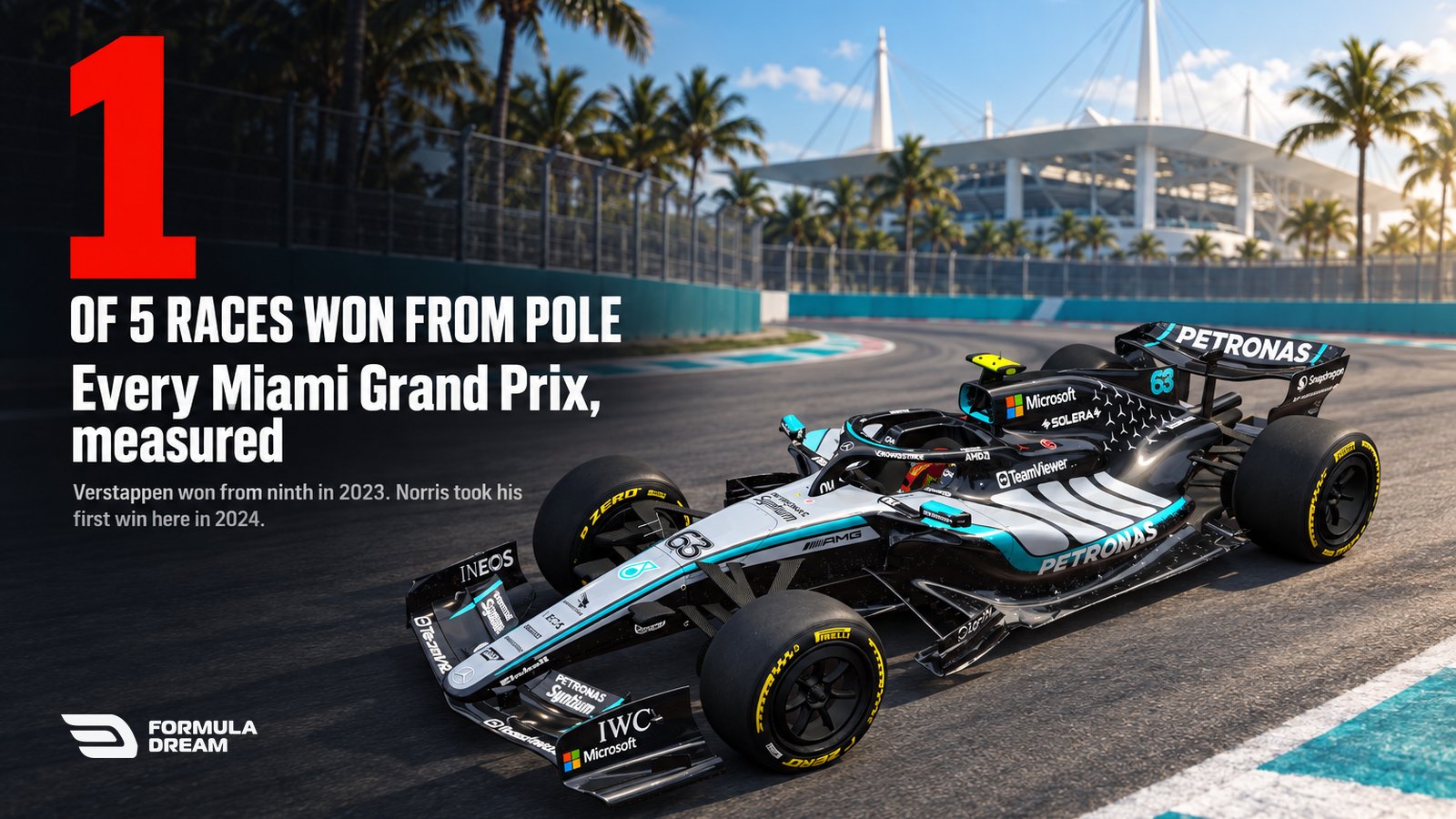
Every Miami Grand Prix winner, measured: five races, and pole has won only one of them
Five Miami Grands Prix have been held since 2022, and only one was won from pole: Kimi Antonelli's in 2026. Max Verstappen won from ninth in 2023, and Lando Norris took his first win there in 2024. Every winner, grid slot and safety car, measured.