How Many Laps in F1? Every 2026 Race | Formula Dream
Guides
How Many Laps Is an F1 Race? Every 2026 Circuit
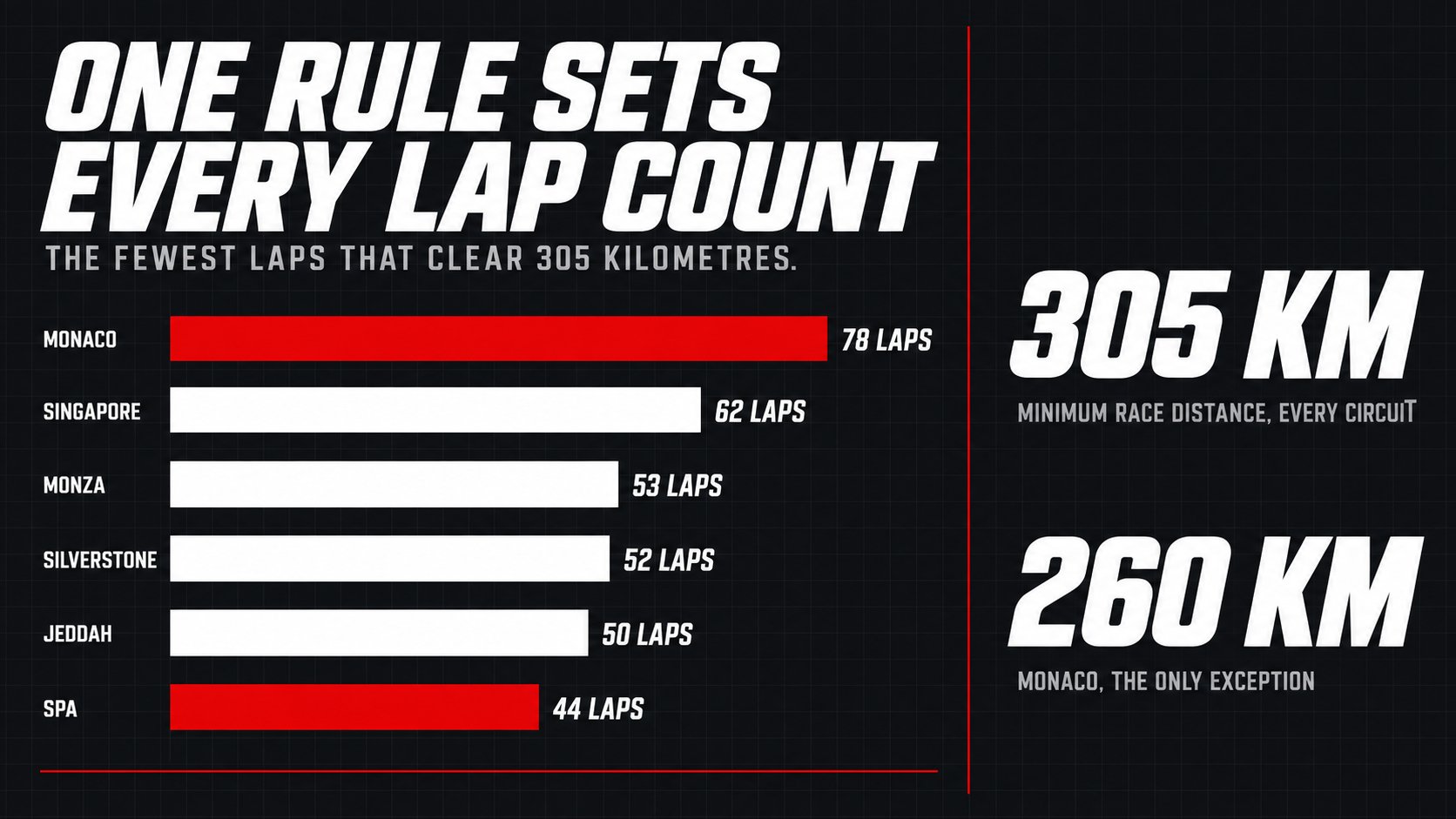
Monaco has the most laps of any race and the shortest distance. Spa has the fewest laps and one of the longest. One rule explains both, and here is every 2026 round.
A Formula 1 race is not a fixed number of laps. It is a fixed distance, and the lap count is whatever it takes to cover it.
Lap counts matter most when a race is shortened or a driver is told to save fuel, and both arrive by radio. Every message from the most recent race is in our Spanish Grand Prix 2026 race radio archive.
That is why Monaco runs 78 laps and Spa-Francorchamps runs 44. Both are correct, and neither is arbitrary.
The rule behind the numbers
A Grand Prix is the fewest complete laps that exceed 305 kilometres, with Monaco the one written exception at 260 km. So the lap count is arithmetic: take 305, divide by the circuit length, round up.
That rule, the two hour and three hour time limits, what happens when a race is stopped early and how sprints differ, are all covered properly in how long is an F1 race. This page is the reference table: what the rule produces at every circuit on the 2026 calendar.
Every 2026 race, by laps
Round
Grand Prix
Circuit
Length
Laps
Distance
1
Australian
Albert Park, Melbourne
5.278 km
58
306.1 km
2
Chinese
Shanghai
5.451 km
56
305.3 km
3
Japanese
Suzuka
5.807 km
53
307.8 km
4
Miami
Miami
5.412 km
57
308.5 km
5
Canadian
Montreal
4.361 km
70
305.3 km
6
Monaco
Monaco
3.337 km
78
260.3 km
7
Barcelona
Barcelona-Catalunya
4.657 km
66
307.4 km
8
Austrian
Red Bull Ring
4.318 km
71
306.6 km
9
British
Silverstone
5.891 km
52
306.3 km
10
Belgian
Spa-Francorchamps
7.004 km
44
308.2 km
2026 Formula 1 circuit lengths, lap counts and race distances, rounds 1 to 10.
Round
Grand Prix
Circuit
Length
Laps
Distance
11
Hungarian
Hungaroring
4.381 km
70
306.7 km
12
Dutch
Zandvoort
4.259 km
72
306.6 km
13
Italian
Monza
5.793 km
53
307.0 km
14
Spanish
Madring, Madrid
5.416 km
57
308.5 km
15
Azerbaijan
Baku
6.003 km
51
306.2 km
16
Bahrain, held in Malaysia
Sepang
5.543 km
56
310.4 km
17
Singapore
Marina Bay
4.940 km
62
306.3 km
18
United States
Circuit of the Americas
5.513 km
56
308.7 km
19
Mexico City
Mexico City
4.304 km
71
305.6 km
20
Sao Paulo
Interlagos
4.309 km
71
305.9 km
21
Las Vegas
Las Vegas
6.201 km
50
310.1 km
22
Qatar
Lusail
5.419 km
57
308.9 km
23
Abu Dhabi
Yas Marina
5.281 km
58
306.3 km
2026 Formula 1 circuit lengths, lap counts and race distances, rounds 11 to 23.
The circuits, longest to shortest
The lengths in those tables are the other half of the arithmetic, and they range further than most people expect. Spa-Francorchamps is the longest circuit in Formula 1 at 7.004 km. Monaco is the shortest at 3.337 km. Spa is more than twice the lap.
Everything else clusters tightly: Las Vegas 6.201 km and Baku 6.003 km at the long end, Zandvoort 4.259 km, Mexico City 4.304 km and Interlagos 4.309 km at the short end, and the bulk of the calendar between 5.2 and 5.9 km. That clustering is why most races land between 50 and 71 laps.
The most laps and the shortest race are the same event
Monaco has 78 laps, more than any other race on the calendar. It is also the shortest race, at 260.3 km.
Nothing else on the calendar is under 305 km. Monaco is 45 km shorter than the next shortest race.
The reason is the circuit. At 3.337 km Monaco is by far the shortest lap in Formula 1, so covering the standard 305 km would take 92 laps, and around a circuit where overtaking barely happens and the barriers are a metre away, that was judged to be too long. The 260 km figure is written into the regulations as a specific exception.
Spa-Francorchamps is the opposite case: 44 laps, the fewest of the year, over 308.2 km, one of the longest distances. At 7.004 km it is the longest circuit on the calendar, so it takes very few laps to cover the distance.
If you want a single sentence that catches people out: the race with the most laps is the shortest race, and the race with the fewest laps is one of the longest.
Lap count tells you circuit length, not race length
This is the same trap that catches people reading pole times, and it is worth stating plainly.
Every 2026 race except Monaco is scheduled between 305.3 km and 310.4 km. The spread across twenty-two races is about five kilometres. So when one race has 78 laps and another has 44, that is not telling you one race is longer. It is telling you one circuit is shorter.
Sorted by laps, the calendar looks wildly uneven:
Monaco 78
Zandvoort 72
Spielberg, Hungaroring, Mexico City, Interlagos 70 or 71
Spa 44
Sorted by distance, it is almost perfectly flat. We measured the same effect on single laps in F1 pole times 2026, where Monaco's 1:12.051 pole is sixteen seconds quicker than Silverstone's despite Monaco being the slowest circuit in Formula 1.
When a race does not go the distance
The lap counts above are the scheduled ones. A race can end short.
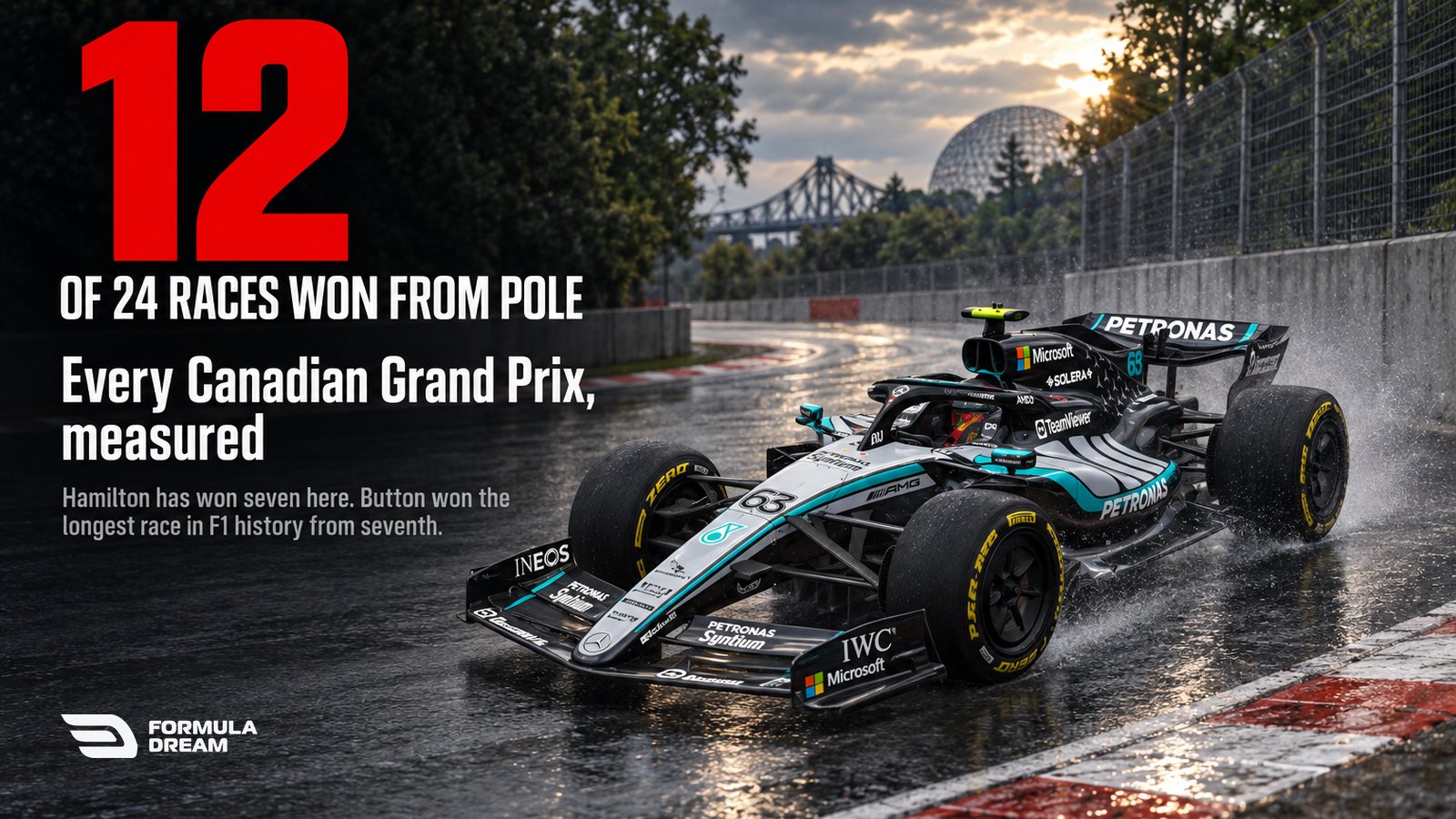
Round 5 in Montreal was scheduled for 70 laps and ran 68. Nothing went wrong mid-race. Arvid Lindblad's car stalled on the grid with a clutch issue, an extra formation lap was needed, and the race distance was reduced to 68 laps.
A race can also end short in other ways: a red flag with no restart, or the two hour and three hour time limits. If a race cannot be completed, points are awarded on a sliding scale below 75% of the distance, explained in the F1 points system.
So there are two honest answers to "how many laps is the Canadian Grand Prix": 70 scheduled, 68 completed in 2026. Anywhere you see a single number quoted, it is the scheduled one.
A new circuit gets a new number
Round 14 moves the Spanish Grand Prix to the Madring in Madrid, a new 5.416 km circuit, and its lap count follows from the same arithmetic: 57 laps, 308.5 km.
That is worth knowing because plenty of 2026 calendars still carry Barcelona's 66 laps for that round. Barcelona is a 4.657 km circuit, so 66 laps was its own correct answer to the same rule. Change the circuit and the lap count changes with it. The new circuit is broken down in the Madring guide.
Round 16 is the other new number. The Bahrain Grand Prix was originally scheduled at Sakhir in April, and it has been moved to the Sepang International Circuit in Malaysia, still under the Bahrain name. Sepang's 5.543 km lap means 56 laps and 310.4 km, the longest race distance of the year, instead of the 57 laps Bahrain would have run.
How we worked this out
The lap counts here are checked two ways rather than copied.
First, from Formula 1's own timing data for each round. Second, by applying the regulation directly: the fewest complete laps exceeding 305 km, using each circuit's official length.
For the 13 rounds raced so far, the two methods agree on 12. The exception is Montreal, which ran two laps short of its schedule for the reason above. For the rounds still to come, the count comes from the regulation and the official circuit length, and for the eight circuits also raced in 2025 it matches that year's lap count. Madrid and Sepang have no recent Formula 1 race to check against.
That kind of cross-check is the point. A lap count that survives both the rulebook and the stopwatch is one you can rely on.
Follow the lap count live
The lap counter is the number that turns a race into a strategy problem. Twenty laps to go is a different race from five.
The Formula Dream app runs a live Dashboard through every session: every car on the circuit map, and a timing tower with lap times, gaps and intervals, tyre compound and age, plus flag and safety car alerts as race control calls them. On a long race like Monaco or Zandvoort the useful column is tyre age against laps remaining, because that is the whole question a pit wall is trying to answer. You also get live driver radio as it is broadcast, and every FIA document of the weekend as it is published.
Free, no subscription, no ads, independent. Not affiliated with Formula 1.
It varies by circuit, because the rule sets a distance rather than a lap count. A Grand Prix is the fewest complete laps exceeding 305 kilometres, which in 2026 works out between 44 laps at Spa and 78 at Monaco.
How many laps is the Italian Grand Prix at Monza?
53 laps, which is 307.0 km around the 5.793 km circuit.
Which F1 race has the most laps?
Monaco, at 78. It is also the shortest race on the calendar at 260.3 km, because Monaco has a written exception to the usual 305 km minimum.
Which F1 race has the fewest laps?
Spa-Francorchamps, at 44. Spa is the longest circuit in Formula 1 at 7.004 km, so it takes the fewest laps to cover the distance.
How long is an F1 race in kilometres?
Just over 305 km for every race except Monaco, which is 260.3 km. Across the 2026 calendar the scheduled distances run from 305.3 km to 310.4 km, a spread of about five kilometres.
Why did the Canadian Grand Prix run 68 laps instead of 70?
Because the start was delayed. Arvid Lindblad's car stalled on the grid with a clutch issue, an extra formation lap was needed, and the race distance was reduced from 70 laps to 68.
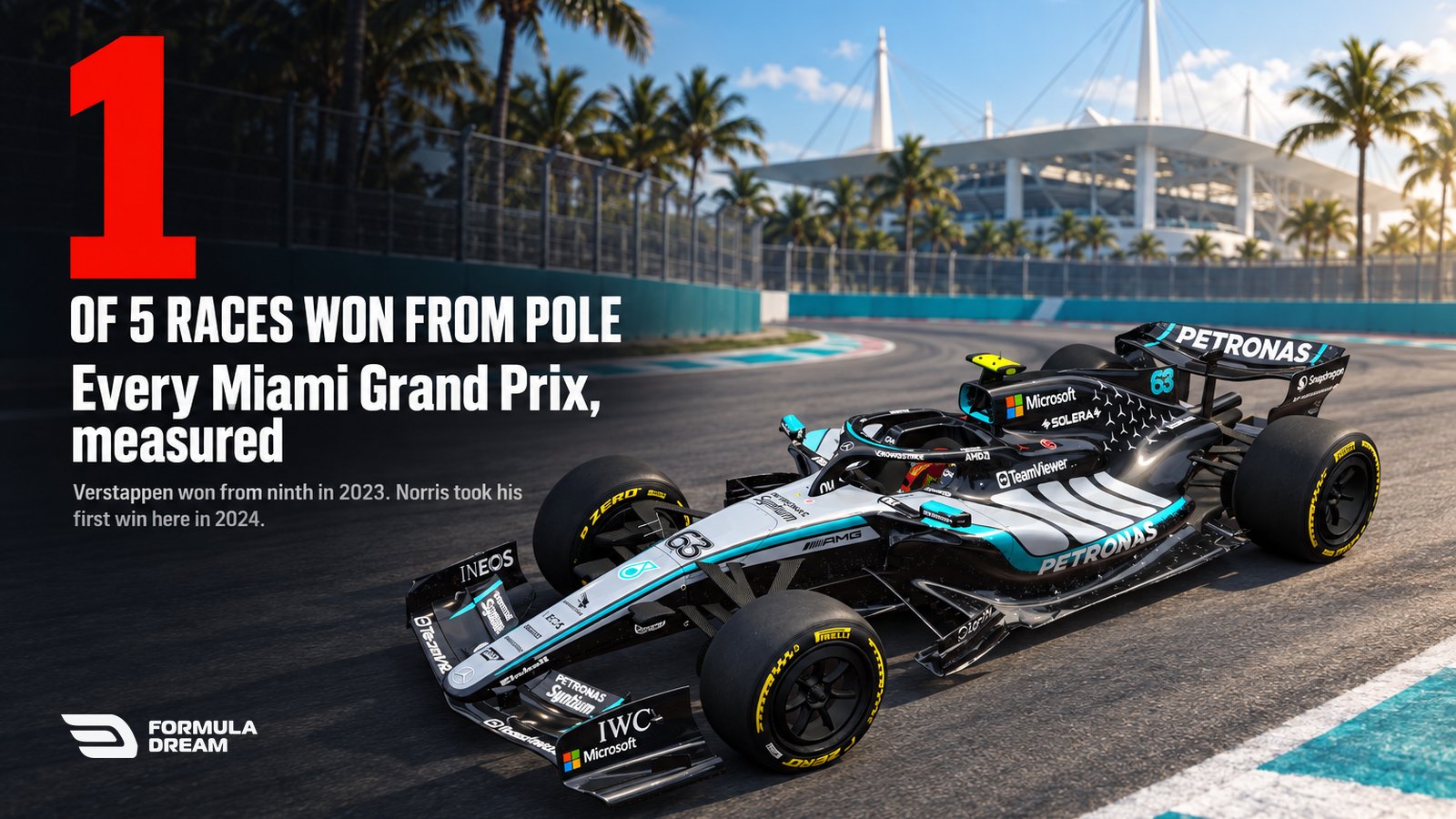
Every Miami Grand Prix winner, measured: five races, and pole has won only one of them
Five Miami Grands Prix have been held since 2022, and only one was won from pole: Kimi Antonelli's in 2026. Max Verstappen won from ninth in 2023, and Lando Norris took his first win there in 2024. Every winner, grid slot and safety car, measured.