How Long Is an F1 Race? We Timed 61 Races | Formula Dream
Guides
How Long Is an F1 Race? Distance, Laps and the Time Limits
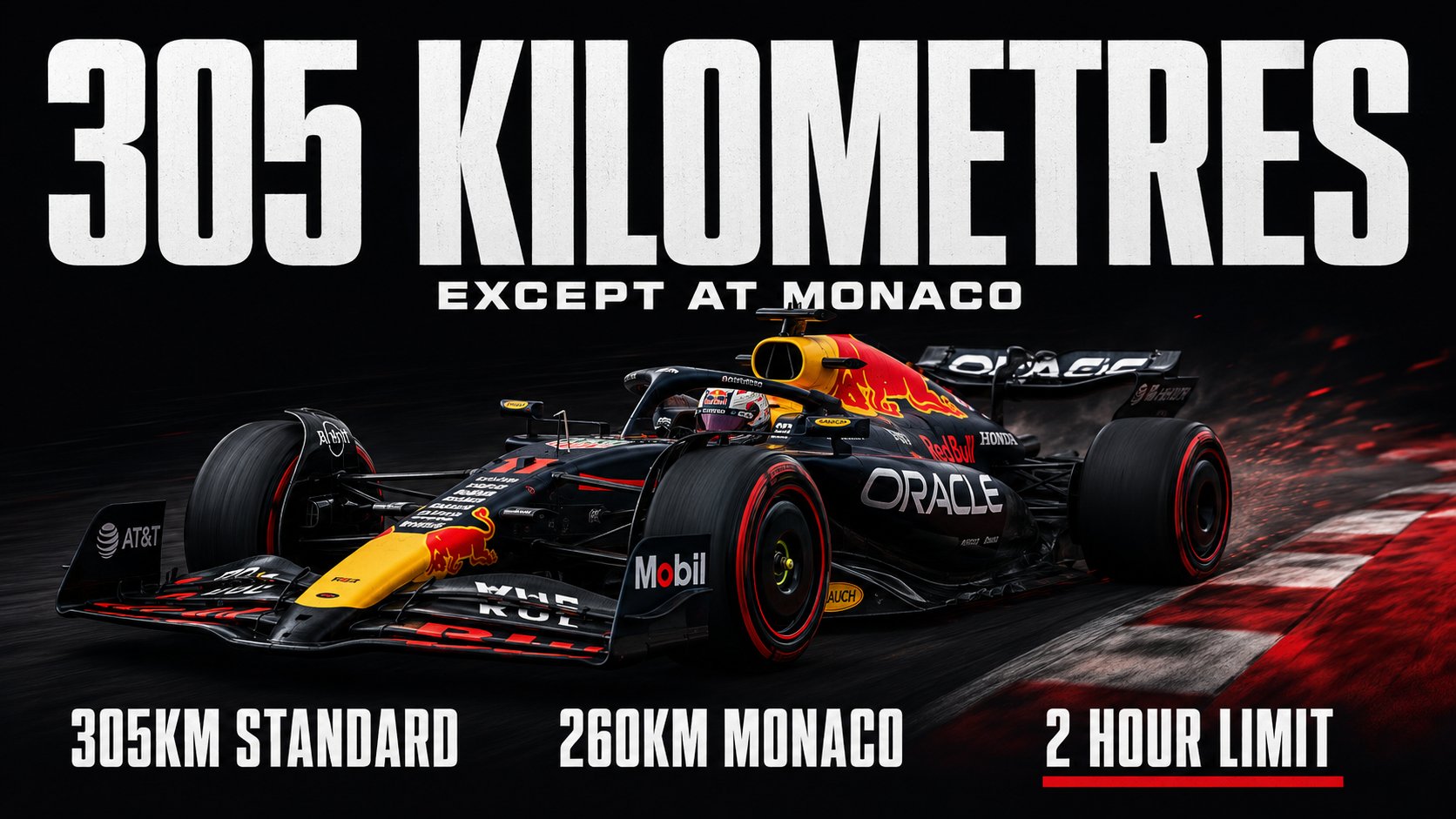
A Grand Prix is 305km, except at Monaco, and it is capped at two hours of racing. We timed 61 races to show how long one actually takes, and what makes the longest ones run past two hours.
A Formula 1 Grand Prix is 305 kilometres long, and it usually takes about an hour and a half. We timed every race from the start of 2024 to the 2026 Italian Grand Prix, 61 in all, and the median winner's race time was 1 hour 31 minutes 45 seconds.
The closing laps are where the radio gets interesting, whatever the distance. Every message from the last race is in our
The distance is fixed by the rules and the lap count follows from it. Monaco is the single exception, at 260km. There is also a clock: a race is limited to two hours, and if it is stopped by a red flag the stoppage is added on, up to a maximum of three hours.
Here is how those numbers combine, how long races really run, and why the lap count is different at every circuit.
How long does an F1 race actually take?
These are winners' race times, from the start signal to the chequered flag, including any time spent stopped under a red flag.
Median across 61 races: 1 hour 31 minutes 45 seconds.
Median of the 55 races without a red flag: 1 hour 30 minutes 55 seconds.
Under an hour and a half: 25 races. Between an hour and a half and two hours: 32. Over two hours: 4, and every one of those four had a red flag.
The safety car came out in 29 of the 61 races, and the virtual safety car in 26.
Race
Winner's race time
Laps
What made it that length
2026 Monaco GP
2:23:31
78
Red flag and safety car
2024 Monaco GP
2:23:16
78
Red flag and safety car
2024 São Paulo GP
2:06:54
69
Red flag and safety car
2026 Dutch GP
2:04:45
72
Red flag
2024 Belgian GP
1:19:58
44
No safety car or red flag
2024 Italian GP
1:14:41
53
No safety car at Monza
2025 Italian GP
1:13:24
53
No safety car at Monza
The longest and shortest Grands Prix we timed, 2024 to the 2026 Italian Grand Prix
Monza is the quickest race on the calendar for a simple reason: it is the fastest circuit, so 305km goes by faster there than anywhere else. The 2025 Italian Grand Prix was over in 1 hour 13 minutes 24 seconds.
The two Monaco races show the other end. Both ran to over 2 hours 23 minutes, which looks like it breaks the two-hour limit. It does not, because the time the cars spent stopped under the red flag is added to the two hours, as the next sections explain.
By season the median barely moves: 1:30:58 in 2024, 1:31:57 in 2025 and 1:32:28 in 2026 so far.
How the lap count is decided
There is no fixed number of laps in Formula 1. The rule is a distance, and the laps follow from it.
Under Article B2.5.2 of the 2026 Sporting Regulations, the race is the least number of complete laps which exceed 305km. You take 305, divide by the length of the circuit, and round up.
That is why lap counts look arbitrary and vary so widely:
Monaco has the most, at 78 laps, because its lap is so short, followed by Zandvoort (72) and the Red Bull Ring, Mexico City and Interlagos (71 each).
Spa, the longest lap on the calendar at around 7km, has the fewest, at 44 laps.
The number is always rounded up, so every Grand Prix runs slightly over 305km rather than under.
It also means a circuit that changes length, through a layout revision or a new chicane, changes its lap count too. The rule has one more wrinkle: if the formation lap is started behind the safety car, the race is shortened by the number of laps the safety car ran, minus one.
If you want the number for a specific circuit rather than the rule behind it, every 2026 round is listed with its lap count and race distance in how many laps is an F1 race.
Why Monaco is different
Monaco is the exception, at 260km, written into the same article of the regulations.
The reason is speed rather than tradition. A lap of Monaco is short and extremely slow, with the slowest corner in the sport taken at walking pace by F1 standards. Running the full 305km there would take too long and risk the two-hour limit, so the distance is cut.
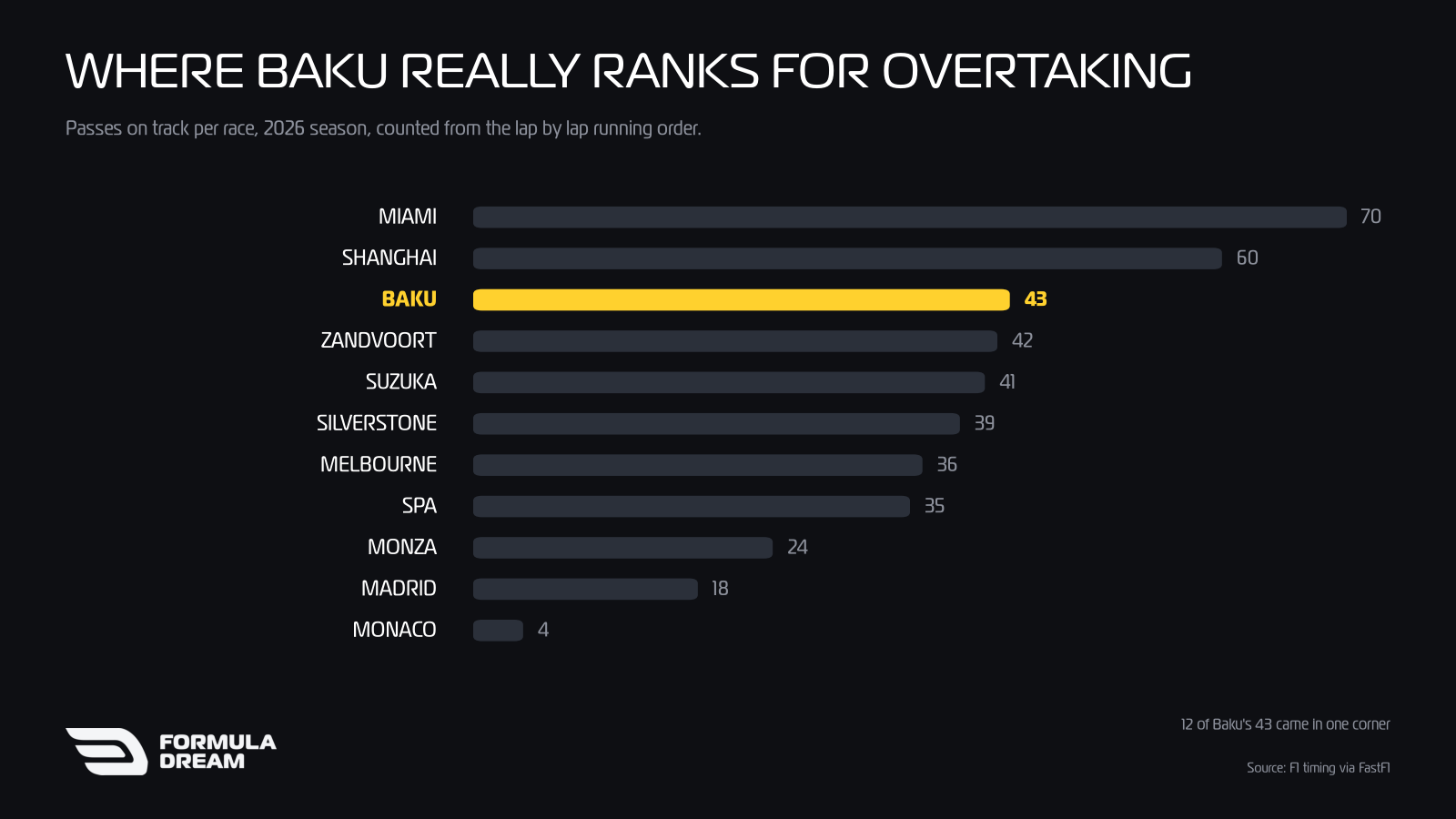
That shorter distance has strategic consequences. Less distance means less tyre wear and fewer natural pit windows, which combines with a circuit where overtaking barely happens to produce processional races. We counted three on-track overtakes across an entire Monaco Grand Prix, against 57 at Abu Dhabi.
It is why Formula 1 has experimented with the Monaco format. In 2025 every driver had to use at least three sets of tyres in a dry race, which in practice meant two pit stops. Teams used it to have one car back up the field to create a pit window for the other, and the FIA dropped the rule for 2026.
The two-hour limit
A race is capped at two hours, under Article B2.5.3 of the Sporting Regulations.
If two hours pass before the scheduled distance is complete, the race does not stop mid-lap. The leader is shown the chequered flag at the end of the lap after the one during which the two hours ran out, whatever the remaining lap count.
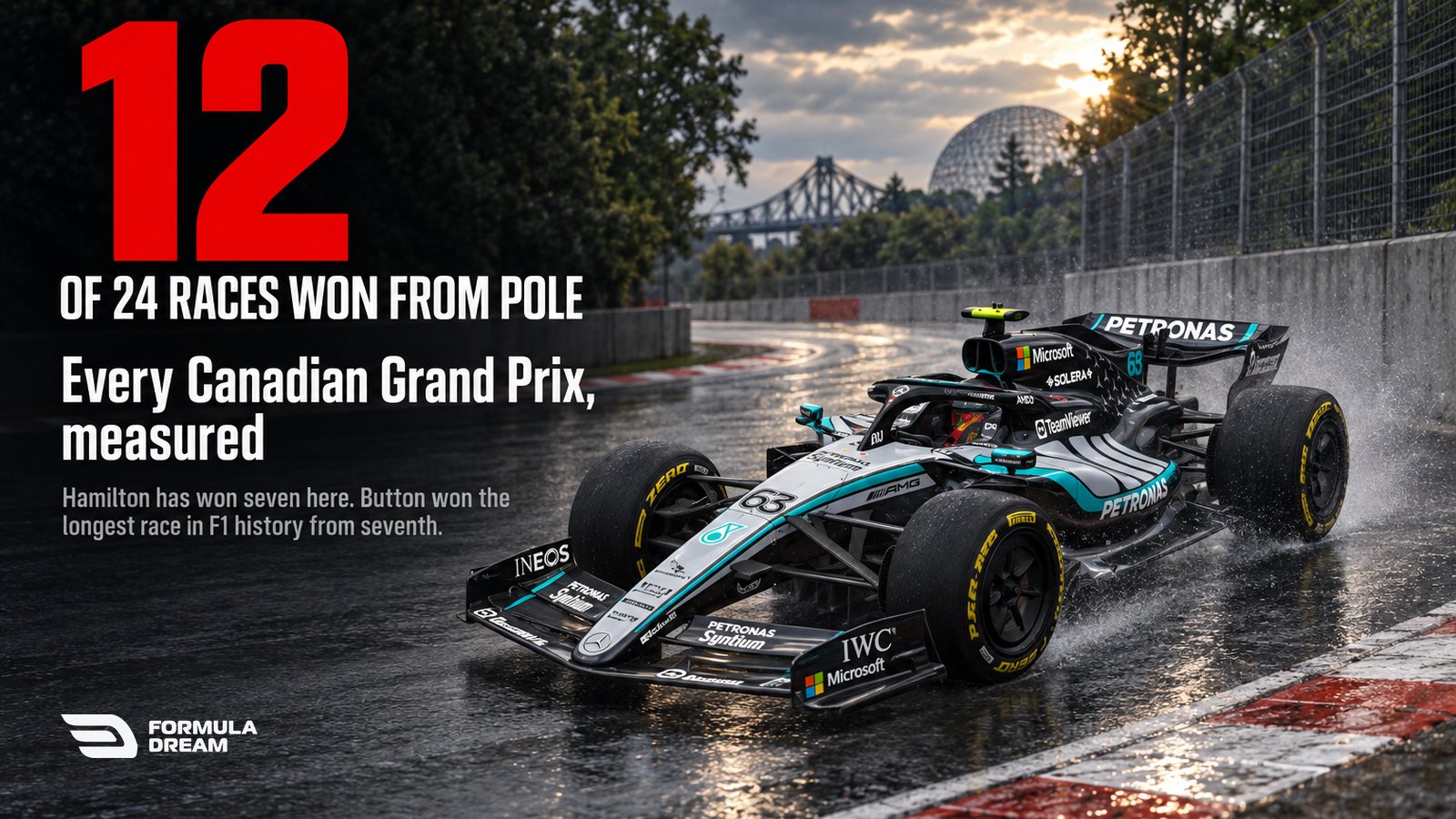
This limit almost never binds in dry conditions. None of the 55 races we timed without a red flag came close to it: the longest, the 2024 Canadian Grand Prix, took 1 hour 45 minutes 48 seconds. It becomes relevant in the wet, when safety car periods and heavy rain slow everything down and the distance takes far longer to cover.
The three-hour outer limit
A red flag does not stop the timing. What the rules do instead is add the length of the suspension to the two-hour period, up to a maximum total race duration of three hours.
So a race with a 20-minute stoppage has 2 hours 20 minutes to finish, and a race with a very long stoppage can end short of its scheduled distance because the three hours ran out first. That combination, a red flag plus a time limit, is the usual reason a Grand Prix ends early. The mechanics of a suspension and restart are in F1 red flag rules.
What happens if a race is stopped early
If a race cannot be resumed, the result is taken two laps before the red flag: stop a race during lap 10 and the result is the order at the end of lap 8. The result counts, but the points depend on how far the race got.
No points are awarded unless the leader has completed at least two laps without the safety car or virtual safety car. After that, the scale introduced for 2022 applies:
Distance completed by the leader
Points for 1st to 10th
Two laps to under 25%
6, 4, 3, 2, 1 (top five only)
25% to under 50%
13, 10, 8, 6, 5, 4, 3, 2, 1 (top nine)
50% to under 75%
19, 14, 12, 9, 8, 6, 5, 3, 2, 1
75% or more
Full points: 25, 18, 15, 12, 10, 8, 6, 4, 2, 1
Points for a shortened Grand Prix
This is why teams and drivers care so much about the distance completed in a chaotic wet race. The difference between stopping just before and just after one of those lines is worth real points. The rest of the scoring is in the F1 points system explained.
The longest and shortest F1 races ever
The longest was the 2011 Canadian Grand Prix, at 4 hours 4 minutes 39 seconds. Rain stopped it for more than two hours, and Jenson Button won after taking the lead on the last lap. It could not happen now: the three-hour cap would end the race first.
The shortest was the 2021 Belgian Grand Prix. Heavy rain meant the cars only ever ran behind the safety car, and after a long delay the result was taken from the first lap. Max Verstappen was declared the winner in a race time of 3 minutes 27 seconds, and half points were awarded. It is the race that led directly to the points scale above.
How long is a sprint?
A sprint is a different event with its own distance: the least number of laps exceeding 100km, roughly a third of a Grand Prix, run without a mandatory pit stop.
That shorter distance changes the racing rather than just shortening it. We measured sprints producing 0.90 on-track passes per lap against 0.44 in the Grand Prix at the same circuits, so a sprint is roughly twice as dense. But over the full session a sprint produced 15.4 passes and a Grand Prix 24.6, so the longer race still gives you more. The numbers are in what we measured about sprint races.
Races are getting shorter in 2027
The 305km distance is expected to change. In September 2026 Autosport reported that teams had broadly agreed to cut Grand Prix distance to 290km from 2027, because the next step in the power unit rules shifts more of the power to the combustion engine, which needs more fuel. The change still has to be ratified by the World Motor Sport Council, and Monaco's 260km is likely to be cut as well.
So how long is an F1 race, in short?
Typical Grand Prix: about 1 hour 30 minutes. The median of the 61 races we timed was 1:31:45.
The quickest: Monza, at around 1 hour 13 to 15 minutes.
A slow or wet race: up to the two-hour limit.
A race with a long red flag: up to three hours in total.
A sprint: 100km, roughly 30 minutes.
Follow the race distance live
Lap counts, the time remaining and whether a race is heading for the two-hour limit are all things the timing screen tracks and the broadcast tends to mention late.
The Formula Dream app runs a live Dashboard through every session: every car on the circuit map, and a timing tower with lap times, gaps and intervals, tyre compound and age, plus flag and safety car alerts the moment race control calls them, which is what tells you a suspension is coming. You also get live driver radio as it is broadcast, and every FIA document of the weekend as it is published, including the decisions to suspend, resume or shorten a race.
Free, no subscription, no ads, independent. Not affiliated with Formula 1.
305 kilometres, reached by running the least number of complete laps that exceeds that distance. Monaco is the exception at 260km. Both are expected to be cut from 2027, to 290km for most races.
How many laps is an F1 race?
It varies by circuit, because the rule is a distance rather than a lap count. Monaco has the most, 78, and Spa the fewest, 44.
How long does an F1 race take?
Usually about an hour and a half. The median of the 61 races from 2024 to the 2026 Italian Grand Prix was 1 hour 31 minutes 45 seconds. Racing is capped at two hours, plus any red flag stoppage, up to three hours in total.
What is the longest F1 race ever?
The 2011 Canadian Grand Prix, at 4 hours 4 minutes 39 seconds, after a rain stoppage of more than two hours. The current three-hour cap means it could not happen today.
Why is the Monaco Grand Prix shorter?
Because a lap of Monaco is short and slow, so covering the full 305km would take too long. The race is set at 260km instead.
What happens if an F1 race is stopped early?
The result is taken from the end of the lap two laps before the red flag. No points are awarded unless the leader has done two laps without the safety car, and reduced points apply below 75% of the distance.
How long is an F1 sprint race?
100km, about a third of a Grand Prix distance, and roughly 30 minutes of running with no mandatory pit stop.
Method
Winners' race times from FastF1 session results, every Grand Prix from the 2024 Bahrain Grand Prix to the 2026 Italian Grand Prix. Race time runs from the start signal to the finish and includes red flag stoppages.
Safety car, virtual safety car and red flag counts come from the track status recorded on each lap.
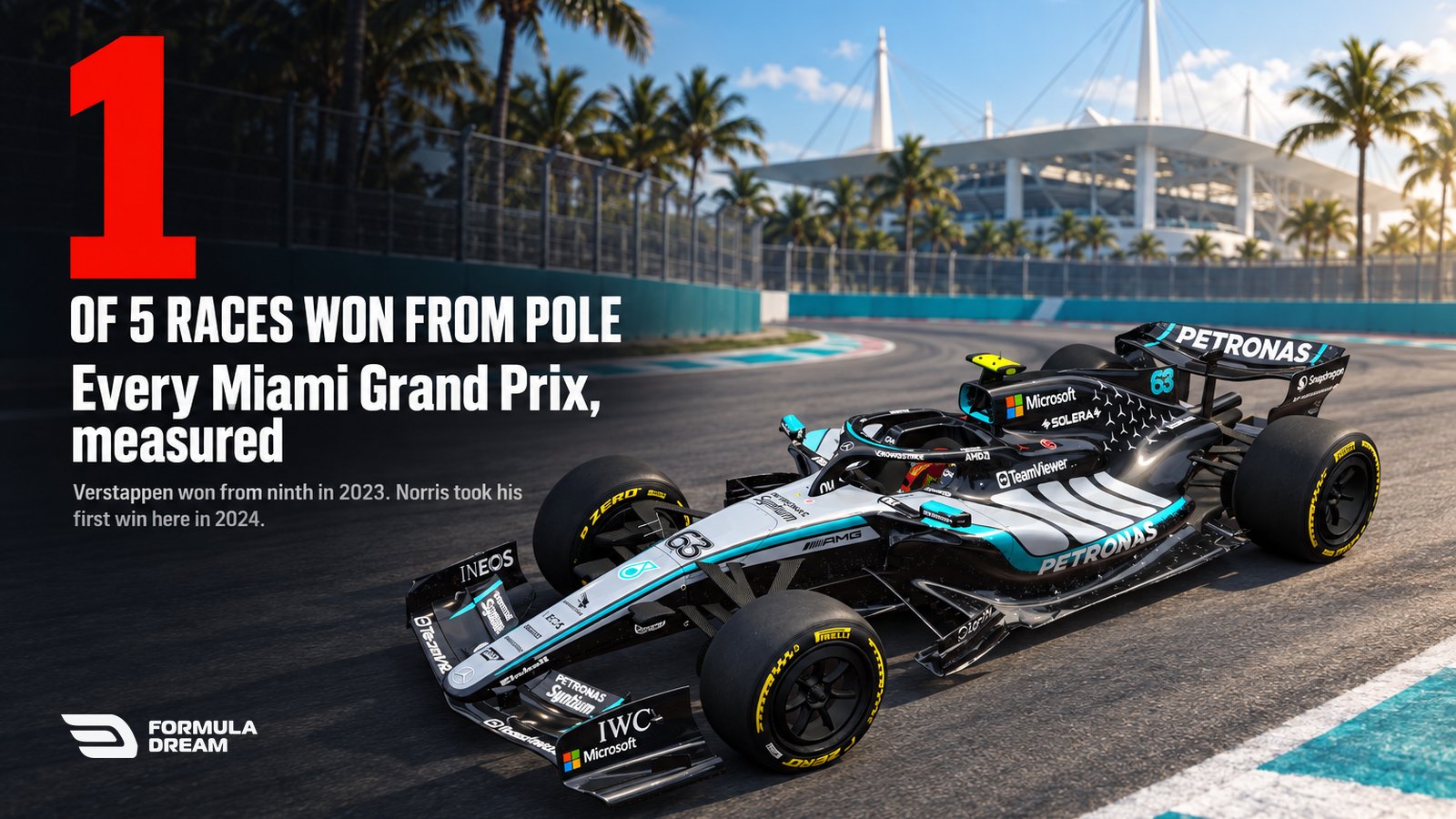
Every Miami Grand Prix winner, measured: five races, and pole has won only one of them
Five Miami Grands Prix have been held since 2022, and only one was won from pole: Kimi Antonelli's in 2026. Max Verstappen won from ninth in 2023, and Lando Norris took his first win there in 2024. Every winner, grid slot and safety car, measured.