Lusail Circuit Explained: Why Qatar Destroys F1 Tyres
Guides
Lusail Explained: The Only Race Where the FIA Tells You When to Pit
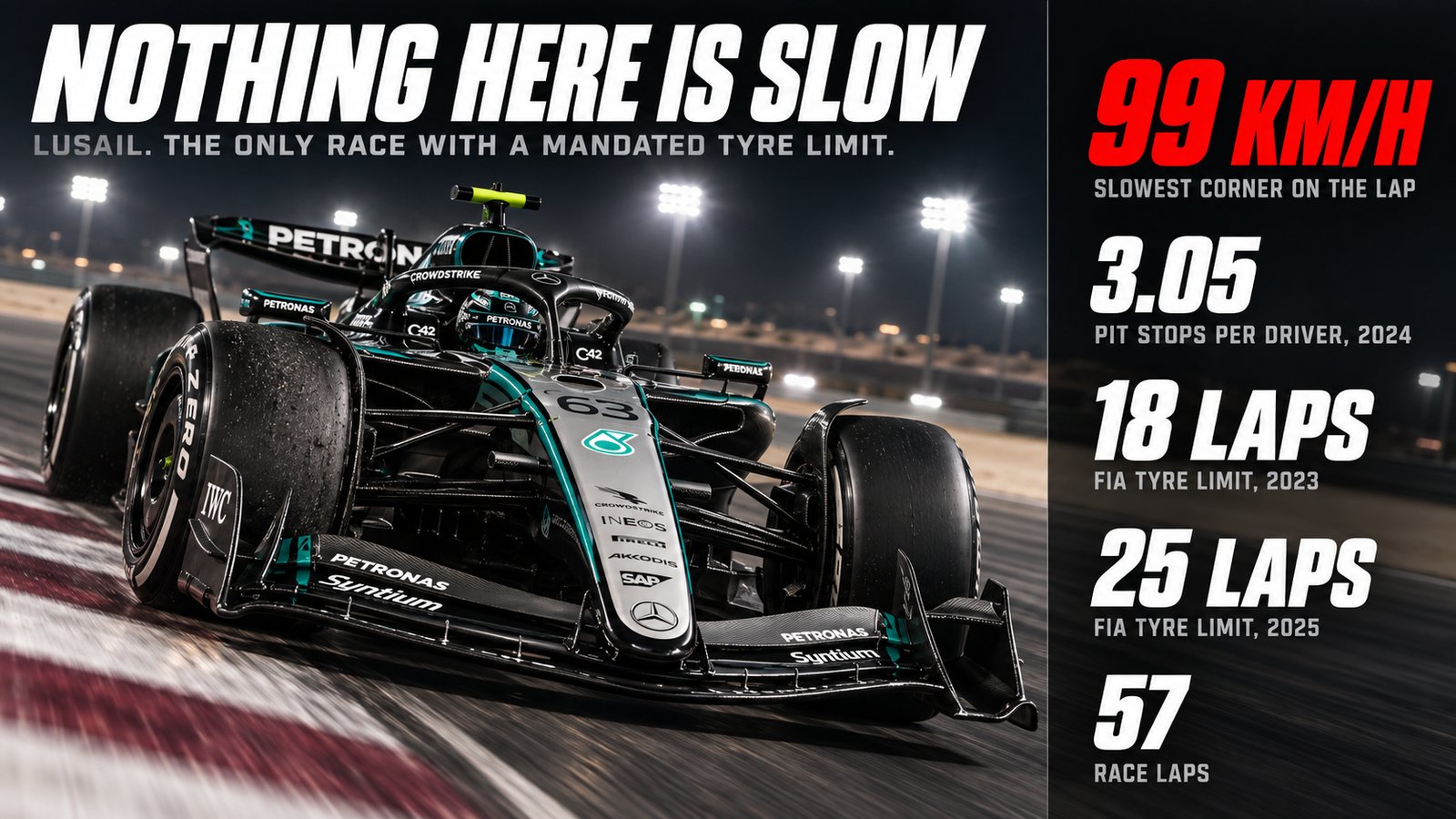
We measured the Qatar lap. Its slowest corner is taken at 99 km/h, the highest minimum speed of any circuit we have measured, and it is why Lusail eats tyres.
Qatar is the only race on the Formula 1 calendar where the governing body has told teams how long they are allowed to run a set of tyres.
It has happened twice. In 2023 the limit was 18 laps per set, which turned a 57 lap race into a forced three-stop. In 2025 it was 25 laps, forcing a minimum of two. No other circuit has ever needed it.
Lusail International Circuit, fastest legal qualifying lap measured from car telemetry. Deleted laps excluded. All three sessions were dry.
Lusail, drawn from the car rather than traced: the path of Oscar Piastri's 2025 pole lap, 327 km/h at its fastest and 99 km/h at its slowest.
What the drivers said on this circuit is in our Qatar Grand Prix 2025 race radio, every broadcast message with the audio and a transcript coloured by who is speaking.
One number on that table explains the whole circuit.
Nothing on this lap is slow
The slowest point of a flying lap at Lusail is 99 km/h. Not the slowest corner on average, the slowest single moment anywhere on the lap.
Set that against every other circuit we have measured:
Lusail 99 km/h
Las Vegas 89
COTA 80
Monza 72
Baku 72
Mexico 68
Singapore 65
Every other circuit in Formula 1 has somewhere the driver has to genuinely slow down. Lusail does not. It is a sequence of medium and high speed corners strung together with only seven braking events across 5.4 km, and the car is loaded up in a corner for almost the entire lap.
That is what destroys the tyres. Not temperature, and not the abrasive surface people usually blame. Lateral energy, applied continuously, with no slow corner anywhere to unload the tyre and let it recover.
What the tyres actually did
In October 2023, after analysing tyres used in first practice, Pirelli found separation in the sidewall between the topping compound and the carcass cords on a large number of sets. The cause was identified as high-frequency interference between the sidewall and the 50 mm pyramid kerbs used around the circuit, made worse by how heavily drivers were riding them.
The FIA and Pirelli imposed a maximum of 18 laps of total tyre life per set, on safety grounds. On a 57 lap race that is a mandatory three-stop.
In 2025 it happened again in a different form. After analysis of the 2024 event showed several tyres, particularly the left front, reaching maximum wear, a limit of 25 laps per set was set, counted cumulatively across the weekend and including safety car laps. That forces a minimum of two stops.
The part nobody expected
Here is the measurement that makes the case.
Year
Laps
Mean stops per driver
Most common
Safety cars
Mandated tyre limit
2025
57
2.20
2
1
25 laps per set
2024
57
3.05
3
4
none
2023
57
2.89
3
1
18 laps per set
Qatar Grand Prix race data, from F1 timing data.
2024 had no mandated limit at all, and produced more pit stops than the year the FIA forced a three-stop. A mean of 3.05 stops per driver, against 2.89 in the regulated 2023 race.
That matters, because the usual reading of the Qatar tyre rules is that officials are making teams do something artificial. The data says the opposite. Left alone, teams stopped three times anyway. The circuit was already a three-stop; the regulation only removed the option of gambling on fewer.
For context, the mean across the 2026 season is 2.05 stops per driver. Qatar in 2024 ran a full stop above that, and it is the highest figure of any circuit in this series. Interlagos, the next most demanding, sits at 1.90 to 2.00. Our season-wide numbers are in how many pit stops in an F1 race.
2024 also produced four safety car deployments plus a virtual safety car, comfortably the most of any race we have measured.
The tyre story tends to bury this, but Lusail is quick.
At 242.8 km/h in 2025 it is faster than every circuit in our measured series except the very fastest few, and quicker than Las Vegas at 239.4 despite Las Vegas having a 1,800 metre straight and Lusail having nothing longer than 1,197 metres.
That is the same point from the other direction. Lusail does not need a long straight to be fast, because it never slows down. Las Vegas gets its average from one enormous flat-out run and gives some of it back in the middle sector. Lusail carries speed everywhere. The full ranking is in the fastest F1 circuits.
The 2023 figure of 230.8 km/h is the odd one out, and there is a reason for it that is not the car. That weekend ran with the 18-lap tyre limit and a track temperature of 34.4C, nine degrees hotter than 2025, and full throttle was down at 67.5% against 74.1%. Drivers were managing, not attacking.
What 2026 changes
The current cars carry roughly 30% less downforce than the generation that set the laps above, which we measured in are F1 cars getting faster.
Lusail is close to the worst possible circuit at which to lose downforce. A lap made almost entirely of sustained high-speed cornering is exactly where downforce earns its lap time, so the corner speeds should fall further here than at a stop-start circuit.
Whether that helps the tyres is genuinely unclear, and worth watching rather than predicting. Less downforce means less load through the tyre, which points to less wear. But it also means lower corner speeds, longer lap times and more laps spent sliding, which points the other way. Qatar in 2026 is the first real test of which effect wins.
One structural change is already known: the 2026 Qatar Grand Prix is a conventional weekend, not the sprint format used in 2023 and 2024. That removes a race distance worth of tyre wear from the weekend before the Grand Prix even starts.
The Lusail circuit hub pulls together everything we hold for this venue in one place: every qualifying gap drawn as real distance, the track domination maps where we have them, and the team radio from previous races here.
What the drivers said here
The radio is the part of a weekend that does not make the highlights. We hold every message Formula 1 broadcast from Lusail in 2025, 65 of them across the whole weekend, transcribed with the original audio and the driver and engineer colour coded, on the Lusail 2025 team radio page.
It is worth a scroll before a race here, because the complaints repeat. Drivers tend to raise the same two or three things about a circuit every year, and reading last season back is the quickest way to know what to listen for in this one.
The Formula Dream app runs a live Dashboard through every session: every car on the circuit map, and a timing tower with lap times, gaps and intervals, tyre compound and age, plus flag and safety car alerts as race control calls them. Qatar is the one weekend where tyre age is not a detail but the whole race, because a mandated stint limit turns every strategy into arithmetic you can follow live. You also get live driver radio as it is broadcast, and every FIA document of the weekend as it is published, which at the circuit where the FIA has twice changed the rules mid-weekend is where you find out first.
Free, no subscription, no ads, independent. Not affiliated with Formula 1.
Because of sidewall damage. In 2023 Pirelli found separation between the sidewall topping compound and the carcass cords, caused by high-frequency interference with the circuit's 50 mm pyramid kerbs, and the FIA imposed a maximum of 18 laps per set on safety grounds. In 2025 a 25-lap limit was set after 2024 tyres, particularly the left front, reached maximum wear.
How many pit stops at the Qatar Grand Prix?
Three is the usual answer. The mean was 3.05 stops per driver in 2024 with no limit in force, 2.89 in the regulated 2023 race, and 2.20 in 2025 under a 25-lap limit. The 2026 season average across all circuits is 2.05.
Why does Lusail destroy tyres?
Because nothing on the lap is slow. We measured the slowest point of a flying lap at 99 km/h, the highest minimum speed of any circuit we have measured, with only seven braking events. The tyre is loaded laterally almost continuously and never gets a slow corner in which to recover.
How fast is the Lusail circuit?
The fastest 2025 qualifying lap averaged 242.8 km/h with a peak of 327 km/h, measured from car telemetry. That is quicker than Las Vegas at 239.4 km/h, despite Lusail's longest flat-out run being 1,197 metres against Las Vegas's 1,800.
How long is the Lusail International Circuit?
Our telemetry recorded 5.355 km on the racing line for the 2025 pole lap, and the Qatar Grand Prix is 57 laps.
Is the Qatar Grand Prix a sprint weekend in 2026?
No. Round 22 of the 2026 season is a conventional weekend, unlike 2023 and 2024, which both ran the sprint format.
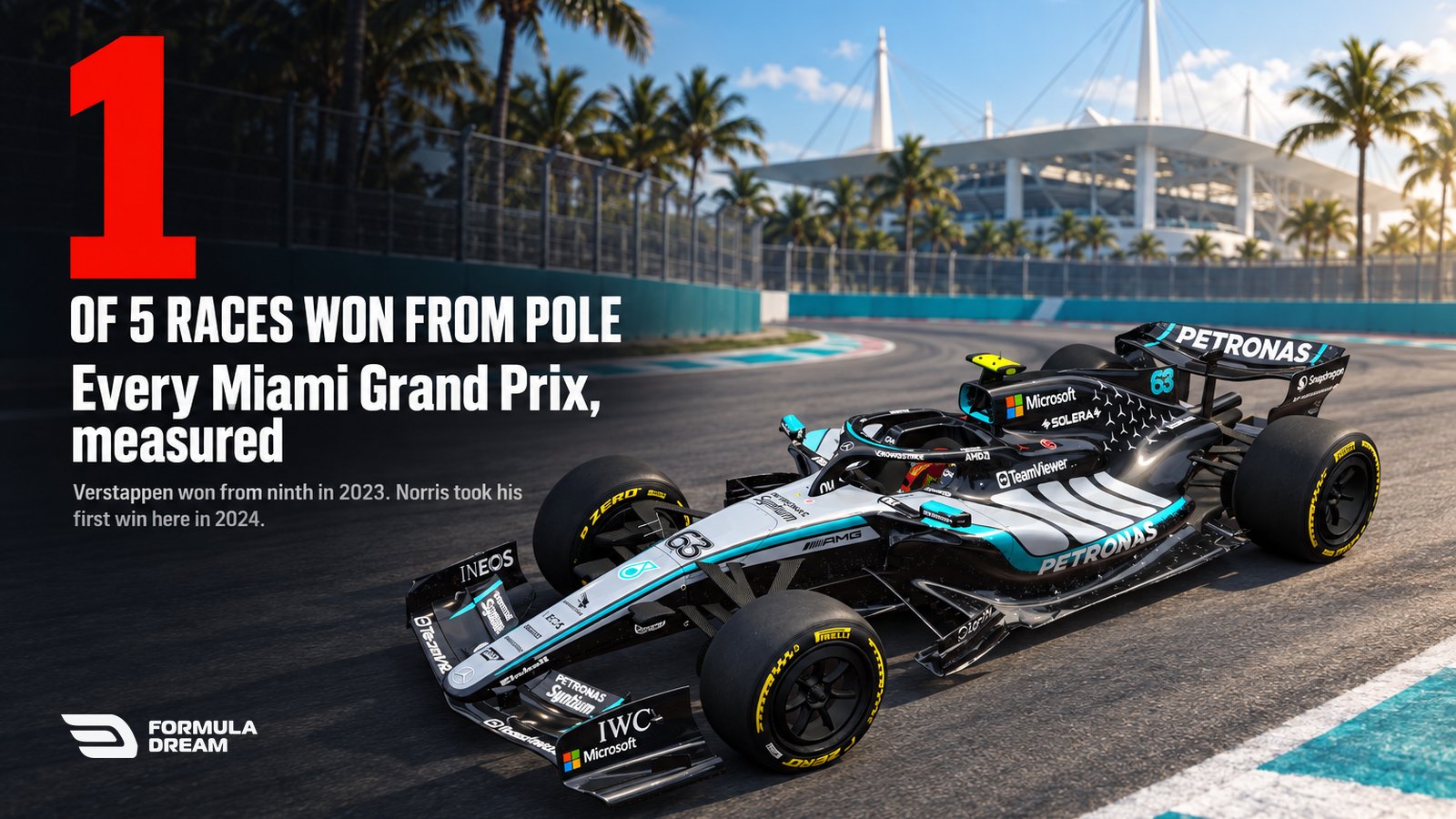
Every Miami Grand Prix winner, measured: five races, and pole has won only one of them
Five Miami Grands Prix have been held since 2022, and only one was won from pole: Kimi Antonelli's in 2026. Max Verstappen won from ninth in 2023, and Lando Norris took his first win there in 2024. Every winner, grid slot and safety car, measured.