Why F1 Teams Barely Get to Test, and What They Do Instead
Track time is rationed to a handful of hours a year, one car at a time. Simulator time is unlimited. That single asymmetry explains how modern F1 teams are built.
A Formula 1 team will spend most of a season's budget developing a car it is barely allowed to drive.
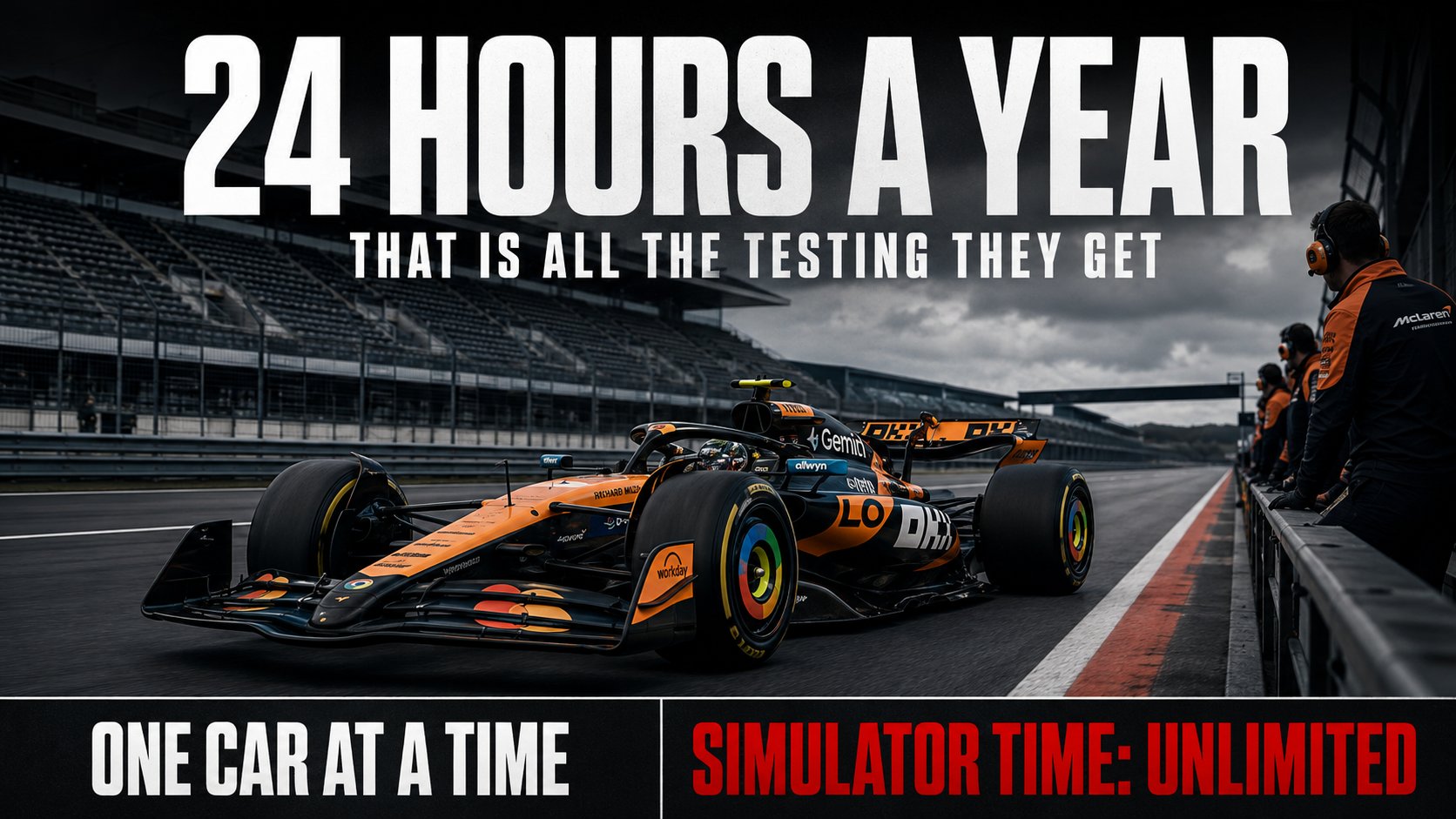
Official pre-season testing gives a team roughly 24 hours of track time across a three-day event, and they may only run one of their cars at a time. In-season, there is essentially none.
Meanwhile simulator time is unlimited.
That asymmetry is not a quirk. It is the single rule that shaped how modern Formula 1 teams are organised, staffed and spend their money.
Pre-season testing is a small number of officially organised events, each running three days. Days run from 10:00 to 19:00 with an hour's break, which works out at two four-hour sessions, and Formula 1 describes it as "a total testing time of just 24 hours over the course of the event", with teams "only allowed to run one of their cars at a time."
That last clause matters more than the hours. Two drivers must share one car, so a team is not choosing how much to test, it is choosing who tests and when, and every hour given to one driver is taken from the other.
Promotional and demonstration running is separately capped. Teams get a small number of filming days each season, limited by distance rather than time, plus a couple of demonstration events limited to a few kilometres. These exist for sponsors and content, and the distance caps are deliberately low enough that they cannot be used as covert testing.
Testing of Previous Cars, or TPC, is the loophole that is not really a loophole. Teams may run privately on track using cars that are at least two seasons old. It is genuinely useful for running young drivers and for mileage, but it is old machinery, so it teaches you little about this year's aerodynamics.
Why it is capped
Formula 1's own explanation is fairness rather than cost: a test is "a regulated event that ensures equal opportunity for track time (in the same conditions) for all teams and their drivers."
The reasoning behind that is straightforward. Unlimited testing is a spending contest, and one only the wealthiest teams can win. In the era before restrictions, the biggest teams ran near-continuous test programmes with dedicated cars and crews, and the gap between them and everyone else widened because of budget rather than ideas.
The same instinct runs through modern F1 regulation: the cost cap limits spending, and the wind tunnel sliding scale actively hands more aerodynamic testing to the teams who finished lower. Track testing was capped first, for exactly the same reason.
What replaced it
If you cannot drive the car, you simulate it. That is where the money went.
Driver-in-loop simulators. A full-size cockpit on a motion platform, running the team's own vehicle model. Drivers work in them for hours, often on the evening before a session, and the setup they arrive with on Friday has usually been chosen in a simulator days earlier.
CFD and the wind tunnel, both of which are themselves rationed by the sliding scale, because otherwise they would become the new spending contest.
Race weekend practice. This is the real reason free practice matters more than it appears. With almost no other track time available, FP1 to FP3 are not a warm-up, they are the team's entire opportunity to correlate the simulation against reality. When you watch a car doing aero rake runs on a Friday morning, you are watching a team check whether their model is telling the truth.
The correlation problem is the whole game. A simulator is only as good as the model inside it, and the only way to validate the model is track data you are barely allowed to collect.
Why this makes a sprint weekend brutal
The restriction bites hardest when practice is cut.
A sprint weekend has one practice session instead of three, and the car enters parc fermé conditions far earlier, locking setup. So a team gets a single hour to validate its simulation, choose a setup for two different races, and commit.
That is why sprint weekends produce more surprises, and why a team that has misjudged its model can be lost for the entire event with no way to recover. There is no second session in which to work out what went wrong.
Why rule resets are so dangerous
A new set of regulations makes every existing model less trustworthy at exactly the moment testing is most valuable.
The 2026 reset changed the aerodynamics, the power unit and the weight of the car all at once. Simulation models built on years of data about the previous generation became, in part, guesses. And the teams still only had their allotted handful of hours to check.
That is a large part of why the field spread so much. We measured the gap from pole to the slowest car in qualifying at 2.49% of lap time in 2025, the tightest in six seasons, and 5.54% in 2026, more than double and the widest in the period. Some of that is design. Some of it is that everyone was guessing, and some guessed better. The measurements are in how close is the F1 grid.
Watch practice like a team does
Given how little else they get, practice sessions are where the real work happens.
The Formula Dream app runs a live Dashboard through every session including FP1: every car on the circuit map, and a timing tower with lap times, gaps and intervals, tyre compound and age, plus flag and safety car alerts as race control calls them. Long runs against low-fuel runs is the distinction the broadcast cannot show you and the whole point of the session. You also get live driver radio as it is broadcast, which is where correlation problems get discussed out loud, and every FIA document of the weekend as it is published.
Free, no subscription, no ads, independent. Not affiliated with Formula 1.
Very little. Official pre-season testing gives roughly 24 hours of track time across a three-day event, and teams may only run one of their cars at a time, so two drivers must share it. In-season track testing is essentially unavailable.
Why is F1 testing so limited?
Formula 1 frames it as fairness, ensuring every team and driver gets equal track time in the same conditions. The underlying reason is that unlimited testing becomes a spending contest that only the wealthiest teams can win.
Can F1 teams test with old cars?
Yes, under Testing of Previous Cars, which allows private running with cars at least two seasons old. It is useful for driver mileage but teaches a team little about the current car's aerodynamics.
Is simulator time limited in F1?
No. Simulator time is unlimited, which is precisely why teams invested so heavily in driver-in-loop simulators once track testing was capped. Wind tunnel and CFD time, by contrast, are rationed by the sliding scale.
Why does free practice matter so much?
Because it is almost the only track time a team gets. Practice is where a team correlates its simulation against reality, which is what the aero rake runs on a Friday morning are for.
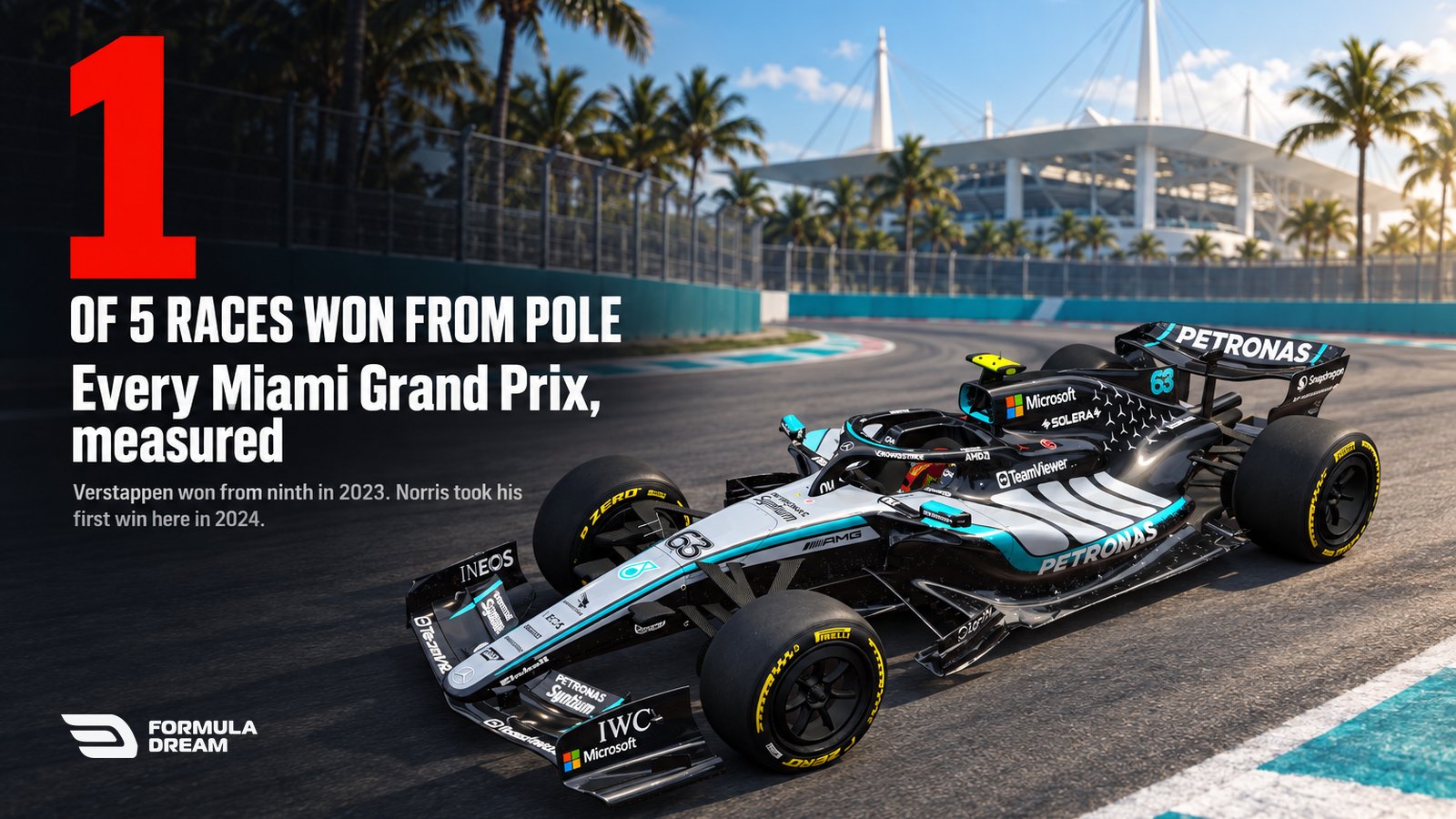
Every Miami Grand Prix winner, measured: five races, and pole has won only one of them
Five Miami Grands Prix have been held since 2022, and only one was won from pole: Kimi Antonelli's in 2026. Max Verstappen won from ninth in 2023, and Lando Norris took his first win there in 2024. Every winner, grid slot and safety car, measured.