Do F1 Cars Have Traction Control or ABS? | Formula Dream
Guides
Do F1 Cars Have Traction Control? The Ban, the Return, the Ban
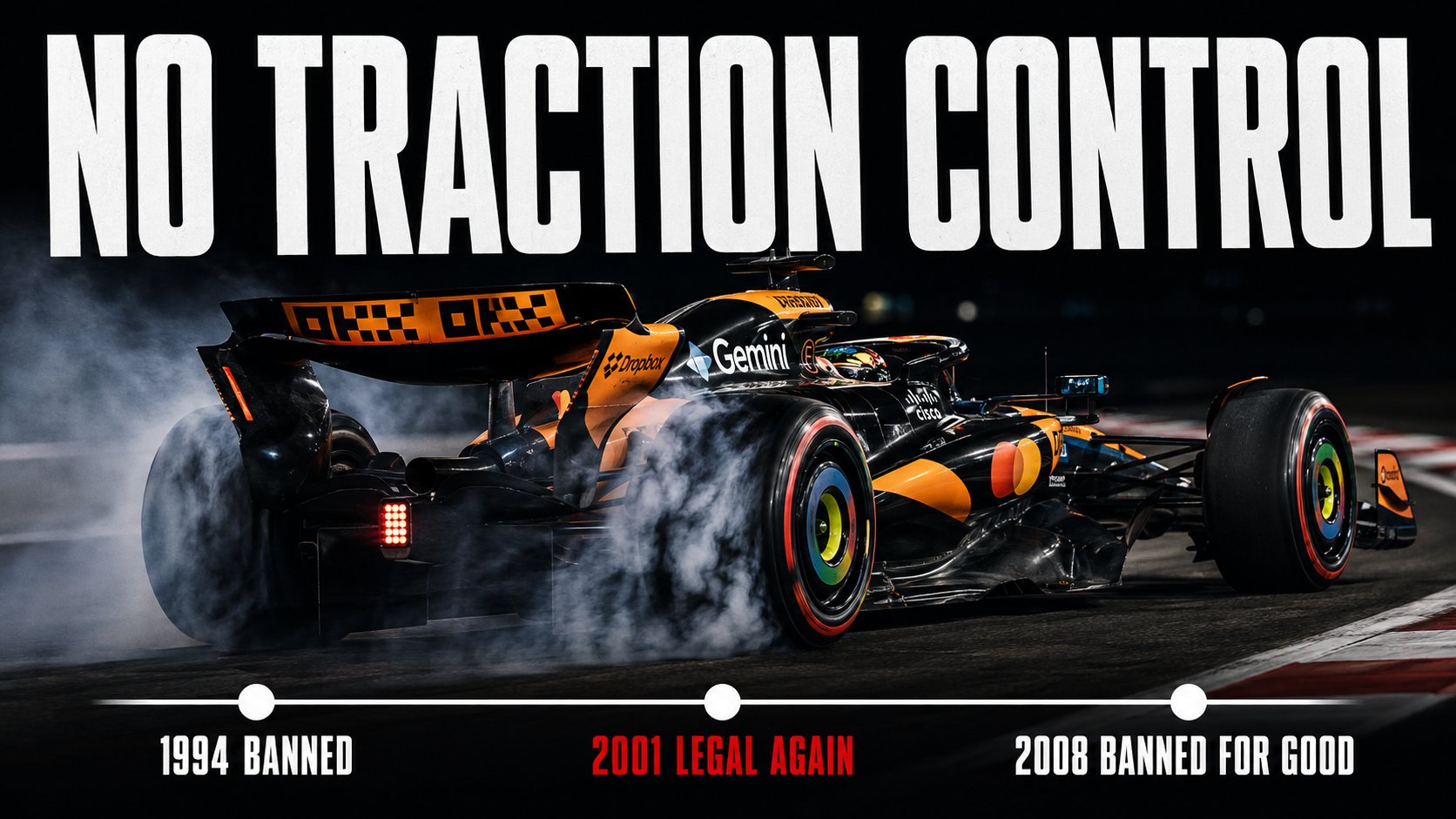
F1 banned traction control, then brought it back because it could not catch anyone cheating, then banned it again with a standard ECU. The reason why is the interesting part.
No. Formula 1 cars have no traction control, no ABS and no launch control. A driver managing wheelspin out of a slow corner is doing it with their right foot, and nothing else.
That is the simple answer. The interesting one is that F1 has banned traction control twice, because the first ban did not work. For seven seasons in the middle, the sport gave up and made it legal again, not because it wanted to, but because it could not prove anyone was using it.
The current rules outlaw the systems that would take control away from the driver:
Traction control, which cuts engine power when a rear wheel spins. Article C9.1.2 of the 2026 Technical Regulations bans any system that can stop the driven wheels spinning or compensate for too much throttle, and even any device that warns the driver wheelspin is starting.
ABS, which releases brake pressure when a wheel locks. Under Article C11.4.1, no braking system may be designed to stop the wheels locking when the driver presses the pedal.
Launch control, which manages the getaway from a standing start automatically. The driver launches the car on a hand clutch paddle instead.
Active suspension, which adjusts ride height and stiffness on the move. Article C10.2.4 forbids any powered device that can alter a suspension system, and nothing on it may be adjusted while the car is moving.
Automatic gear changes, which the rules explicitly call a driver aid (Article C9.8.1). Every shift is the driver's.
The principle is that the car must be driven. Electronics may inform the driver and manage the power unit, but they may not intervene between the driver's inputs and the tyres.
The 1994 ban, and what caused it
The FIA outlawed electronic driver aids ahead of the 1994 season: traction control, ABS, launch control and active suspension, all at once.
The cause was the previous two seasons. Williams had built comprehensively electronic cars and dominated with them, and the governing body reached a conclusion it found unacceptable: technology had overtaken driver skill as the thing deciding races. The bans were an attempt to hand the sport back to the drivers, and to stop an arms race that only the richest teams could afford.
The bit most explanations skip: it came back
Here is the part that makes this story worth telling.
Traction control was banned in 1994. It was made legal again from the 2001 Spanish Grand Prix. Launch control came back with it, and was banned again from 2004.
Not because the FIA changed its mind about whether it was good for racing. Because it could not police the ban. Traction control is software. It lives inside an engine control unit that each team built themselves, and detecting a subtle power cut on corner exit, buried in a team's own proprietary code, turned out to be close to impossible. The paddock was full of accusations and short of evidence.
Faced with a rule everyone suspected was being broken and nobody could prove, the FIA legalised it. If it cannot be enforced, an unenforceable ban is worse than no ban, because it rewards whoever is most willing to cheat.
How it was finally banned for good
Traction control was banned again from 2008, and this time it stuck, for one structural reason: a standard ECU.
Instead of policing what each team wrote, the sport mandated that every car run the same control unit, supplied by McLaren Electronic Systems, with software the governing body could inspect. You cannot hide a traction control map in code you did not write and do not control.
That is the actual lesson of the whole saga. The rule did not become enforceable because the FIA got better at looking. It became enforceable because the sport changed the thing being looked at. This is the same logic behind parc fermé and the technical directives that govern how the rules are interpreted.
What F1 cars do still have
Modern cars are not primitive. They are full of electronics, all of which sit on the driver's side of that line:
Engine and energy modes, adjusted from the steering wheel, changing how the power unit deploys electrical energy.
Brake balance and brake migration, which shift braking front to rear, but only where the driver sets them.
Differential settings for corner entry, mid-corner and exit.
Brake-by-wire on the rear axle, where a computer blends the electrical braking with the hydraulic braking. This surprises people, but it is not ABS: it is not releasing brake pressure to stop a lock-up, it is balancing two braking systems to deliver what the driver asked for. Article C11.6 caps the powered rear system at 1.2 times the pressure the driver's own foot is generating.
A start safety net run by the FIA, not the team. At a standing start in 2026 the electric motor may only drive the car once it reaches 50 km/h, except when the FIA's standard ECU steps in below that speed to keep a minimum acceleration (Article C5.2.12).
The distinction the rules draw is between configuration and intervention. A driver may set the car up however they like, including mid-lap. The car may not override them.
Why it matters to watching a race
Without traction control, corner exit is a skill with a visible failure mode. Wheelspin costs lap time, overheats the rear tyres, and compounds across a stint. A driver who is struggling for rear grip on old tyres has no electronic safety net, which is why you hear so much about tyre management on the radio and why degradation punishes some drivers more than others in identical cars.
It is also why the wet is such a leveller. We measured a car on intermediates as 13.2% slower than on slicks, roughly 11 seconds a lap, and across 140 wet stints not one driver got within 6% of their own dry pace. In those conditions the absence of electronic help is the entire story.
Hear the grip running out
Traction is one of those things you can hear before you can see it.
The Formula Dream app carries live driver radio as it is broadcast, which is where a driver reports losing the rear end, usually several laps before it shows up in the timing. Alongside it, a live Dashboard puts every car on the circuit map with lap times, gaps and intervals, tyre compound and age, and flag or safety car alerts as race control calls them. You also get every FIA document of the weekend as it is published, including the technical checks that keep bans like this one enforceable.
Free, no subscription, no ads, independent. Not affiliated with Formula 1.
No. Traction control is banned, along with ABS, launch control and active suspension. Drivers manage wheelspin themselves with the throttle.
When was traction control banned in F1?
Twice. It was first banned for 1994, then made legal again from the 2001 Spanish Grand Prix because the FIA could not police the ban, then banned for good from 2008 once a standard ECU made it detectable.
Why did F1 allow traction control again in 2001?
Because it was software hidden inside each team's own engine control unit, and proving a car was using it was close to impossible. An unenforceable ban rewards whoever is most willing to break it, so the FIA legalised it rather than pretend.
Do F1 cars have ABS?
No. ABS has been banned since 1994, and Article C11.4.1 of the 2026 rules still forbids any braking system designed to stop the wheels locking. Rear brake-by-wire exists, but it blends electrical and hydraulic braking to deliver what the driver asked for, rather than releasing pressure to prevent a lock-up.
Do F1 cars have launch control?
No. Launch control was banned from 2004, and drivers control the start themselves with a clutch paddle. The only automatic help at a 2026 start is an FIA-controlled safety net that lets the electric motor add torque below 50 km/h to keep a minimum acceleration.
Why are driver aids banned in F1?
To keep the driver as the deciding factor and to limit an electronics arms race that favoured the wealthiest teams. The rules allow drivers to configure the car, but not the car to override the driver.
---
Sources
The bans on traction control, anti-lock braking, powered suspension and automatic gear changes, the clutch paddles, the rear brake system and the 2026 start rule: FIA 2026 Formula 1 Technical Regulations, Issue 18, Articles C5.2.12, C9.1.2, C9.2, C9.8.1, C10.2.4, C11.4 and C11.6
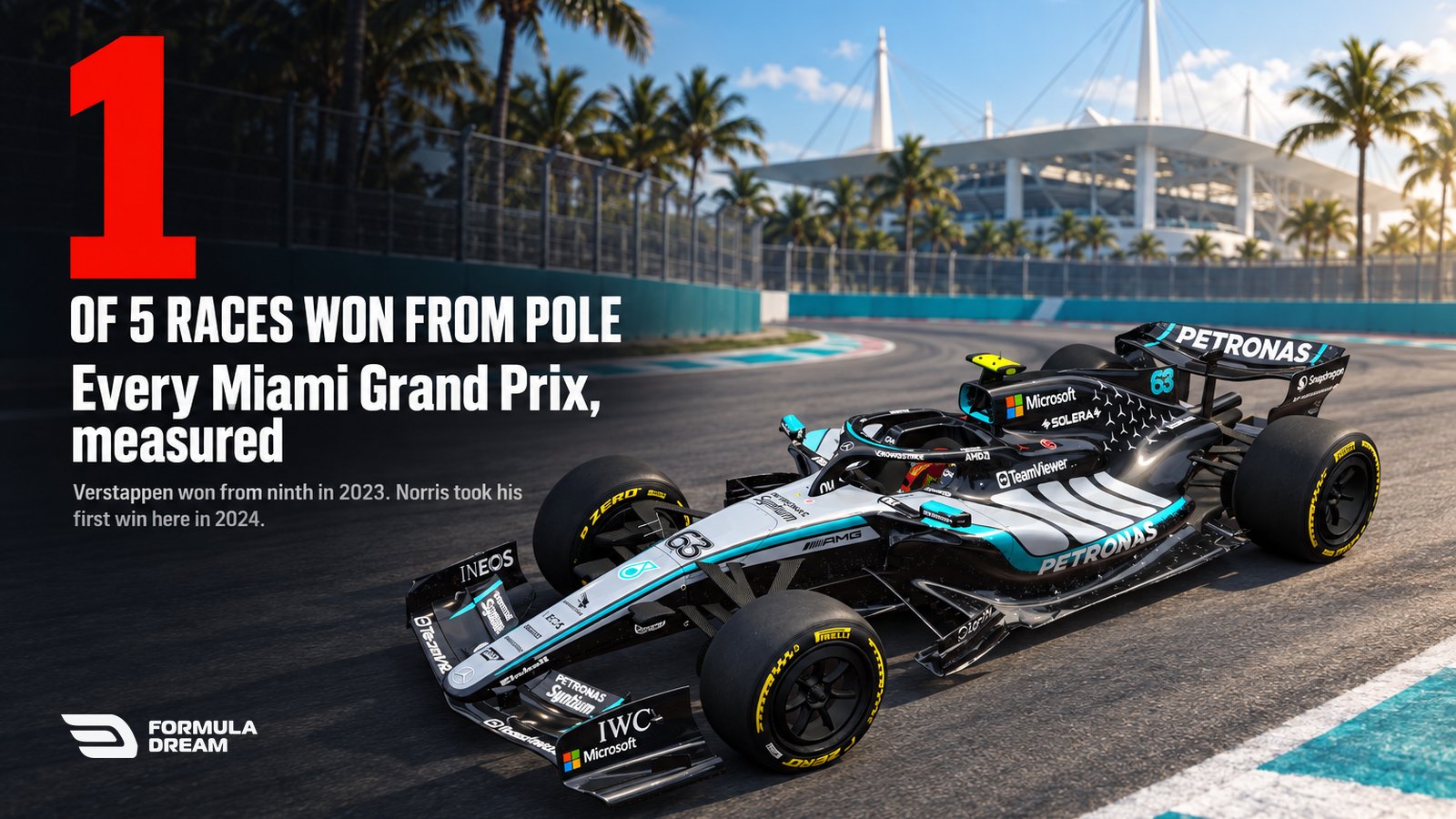
Every Miami Grand Prix winner, measured: five races, and pole has won only one of them
Five Miami Grands Prix have been held since 2022, and only one was won from pole: Kimi Antonelli's in 2026. Max Verstappen won from ninth in 2023, and Lando Norris took his first win there in 2024. Every winner, grid slot and safety car, measured.