Yas Marina was rebuilt in 2021 for one reason: the racing was bad. Five years and 273 fewer metres of circuit later, the obvious question is whether it worked. We measured it.
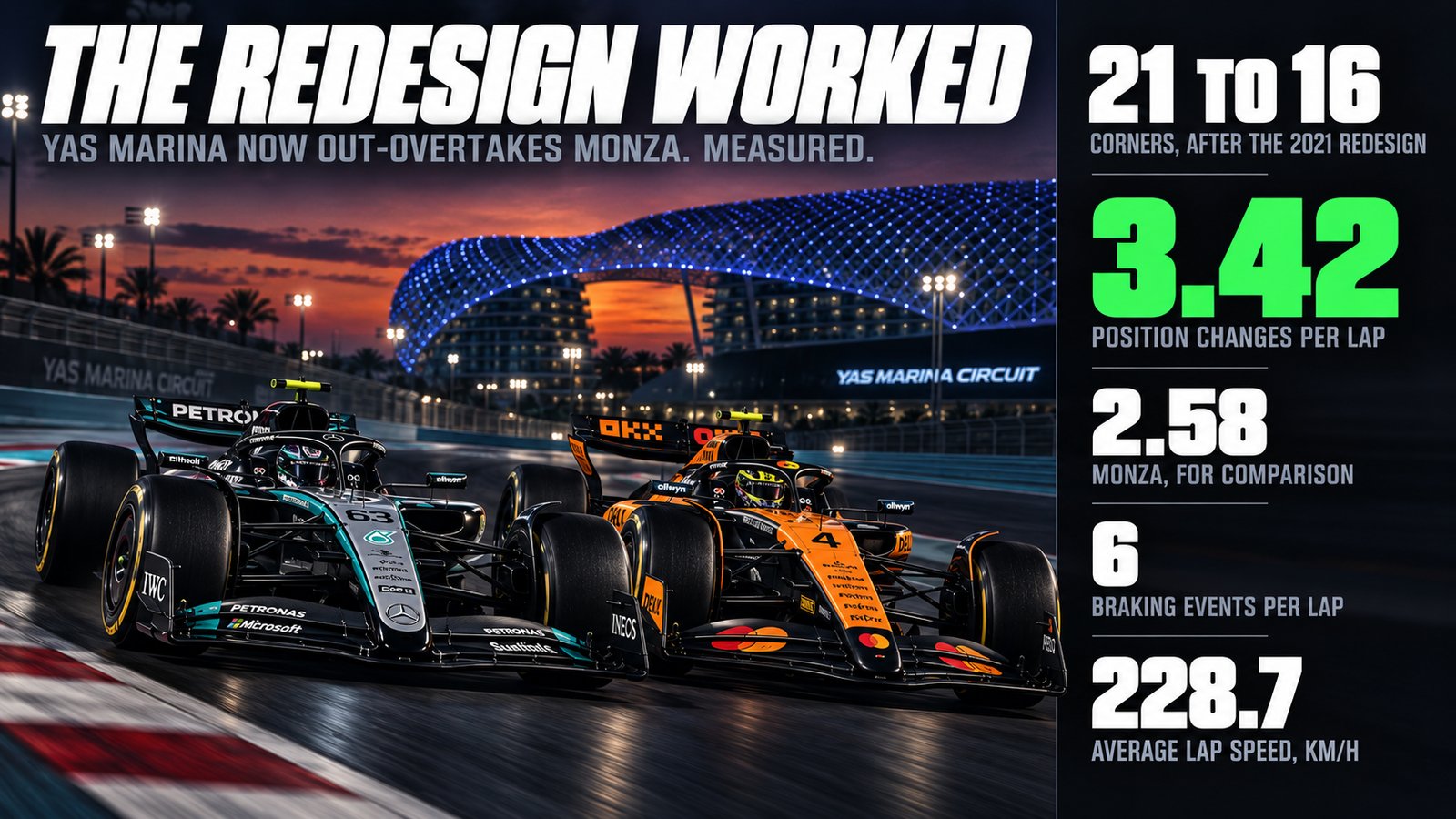
The answer is yes, and by more than its reputation allows. Since the redesign, Abu Dhabi has produced more on-track position changes per lap than Monza.
The 2021 rebuild was not cosmetic. Analysis had found that Yas Marina's slow, off-camber corners made it unusually hard for a following car to stay close, so three separate areas were reworked and the circuit went from 21 corners to 16, losing 273 metres of length.
Yas Marina, drawn from the car rather than traced: the path of Max Verstappen's 2025 pole lap, 331 km/h at its fastest and 68 km/h at its slowest.
What the drivers said on this circuit is in our Abu Dhabi Grand Prix 2025 race radio, every broadcast message with the audio and a transcript coloured by who is speaking.
The tight left-right-left chicane at the old turns five to seven went, replaced by a 20 metre wide hairpin brought forward. The bigger change was in the South Marina, where the old turns 11 to 13 and the following left-hander were removed entirely and replaced by a single long, banked left-hand sweep now called Marsa. Every change followed the same principle: ease the corner, or replace a slow sequence with one quicker bend.
The Yas Marina lap, measured
2025
2024
2023
Fastest qualifying lap
1:22.207, Verstappen
1:22.595, Norris
1:23.445, Verstappen
Lap distance recorded
5.224 km
5.211 km
5.214 km
Average lap speed
228.7 km/h
227.1 km/h
224.9 km/h
Highest speed on the lap
331 km/h
324 km/h
329 km/h
Full throttle
76.4%
76.2%
75.5%
Braking events
6
6
6
Slowest point
68 km/h
68 km/h
67 km/h
Longest flat-out run
1,050 m
1,014 m
999 m
Yas Marina Circuit, fastest legal qualifying lap measured from car telemetry. Deleted laps excluded. All three sessions were dry.
Six braking events, the joint fewest of any circuit we have measured, level with Interlagos and against ten at Singapore and COTA. That is the redesign showing up directly in the data: fewer corners that demand a proper stop, more that can be taken as one flowing input.
At 76.4% full throttle it is high, close to Las Vegas's 81.3% and well above COTA's 58.3%, on a lap whose longest flat-out run is only 1,050 metres. Like Lusail, Yas Marina gets its speed from never really slowing down rather than from one long straight.
Did it fix the racing?
This is the part that usually gets asserted rather than measured, so here is what we did.
For every pair of consecutive race laps we counted how many drivers improved position, excluding any driver who entered or left the pits on either lap, and excluding the opening lap because the start is not overtaking. It is a proxy, and worth stating its limits: it counts positions gained, which includes cars recovering after an incident and cars passing rivals on a different strategy. It is not a hand-verified overtake count. But it is applied identically to every race, so the comparison between circuits holds.
Position changes per racing lap:
Abu Dhabi 2023: 4.38
Interlagos 2025: 3.80
Abu Dhabi 2025: 3.67
Monza 2025: 2.58
Singapore 2025: 2.39
Abu Dhabi 2024: 2.21
Monaco 2025: 1.15
Abu Dhabi averages 3.42 across the three years, above Monza at 2.58 and Singapore at 2.39. Its best year, 2023, is the highest single figure in the set, above Interlagos, which has a reputation as one of the best races of the season.
The weak year is 2024 at 2.21, and it is the year that had a safety car and a virtual safety car, which bunch the field and then freeze it.
So the honest verdict: a circuit that was a byword for processional racing now sits in the upper half of the calendar on this measure, and above the Temple of Speed. The redesign did what it was built to do.
Race day is genuinely predictable, though
Year
Laps
Mean stops per driver
Most common
Safety cars
Virtual safety cars
2025
58
1.35
1
0
0
2024
58
1.50
1
1
1
2023
58
1.90
2
0
0
Abu Dhabi Grand Prix race data, from F1 timing data.
Two of the last three finales ran with no safety car of any kind, and the most common strategy has been a one-stop in two of three years. Against a 2026 season mean of 2.05 stops per driver, Abu Dhabi at 1.35 to 1.90 is a low-degradation race.
That combination is unusual and it is why the circuit reads as calm even though cars are changing places: the racing happens, the strategy does not intervene much. Our season-wide figures are in how many pit stops in an F1 race.
The qualifying laps say the same thing. Three years, three dry sessions, and a spread of just 3.8 km/h in average lap speed. This is the most repeatable circuit in the series, which is one reason it works as a season finale and as the venue for post-season testing.
At 228.7 km/h Yas Marina is quick, sitting between Lusail at 242.8 and Interlagos at 217.8, and comfortably above COTA at 211.4 and Mexico at 201.4. The full ranking is in the fastest F1 circuits.
What is striking is how close its profile is to Lusail's. Both are floodlit desert circuits with six or seven braking events, full throttle in the mid seventies, and no long straight to speak of. The difference is the slowest corner: Lusail's is 99 km/h, Yas Marina's is 68. That single number is why Qatar shreds tyres and Abu Dhabi is a one-stop, and it is the clearest example in this whole series of how much a circuit's character comes down to whether the car ever gets a rest. We broke Lusail down in the Qatar circuit guide.
What 2026 changes
The current cars carry roughly 30% less downforce than the generation that set the laps above, which we measured in are F1 cars getting faster.
Yas Marina should lose less than most. Only six braking events and a slowest corner of 68 km/h means a lap that spends comparatively little time in the high-downforce regime, and the long flowing sections that were added in 2021 are exactly the kind of corner a lower-downforce car can still take at speed.
The more interesting question is whether the racing holds up. The 2021 redesign worked by letting a following car stay close through fast corners. The 2026 cars produce less wake but also less downforce of their own, and nobody yet knows how those two effects net out at a circuit built specifically to solve the following problem. The finale should be an unusually good test of the new regulations.
The Yas Marina circuit hub pulls together everything we hold for this venue in one place: every qualifying gap drawn as real distance, the track domination maps where we have them, and the team radio from previous races here.
What the drivers said here
The radio is the part of a weekend that does not make the highlights. We hold every message Formula 1 broadcast from Yas Marina in 2025, 68 of them across the whole weekend, transcribed with the original audio and the driver and engineer colour coded, on the Yas Marina 2025 team radio page.
It is worth a scroll before a race here, because the complaints repeat. Drivers tend to raise the same two or three things about a circuit every year, and reading last season back is the quickest way to know what to listen for in this one.
Follow the finale with the data on screen
The Abu Dhabi Grand Prix is round 23 of the 2026 season, on 6 December, and it is the last race of the year. Every race here since 2009 is in every Abu Dhabi Grand Prix winner, measured.
The Formula Dream app runs a live Dashboard through every session: every car on the circuit map, and a timing tower with lap times, gaps and intervals, tyre compound and age, plus flag and safety car alerts as race control calls them. At a title-deciding finale the column that matters is gaps and intervals, because the championship is usually decided by a number on that screen rather than by anything you can see on the broadcast. You also get live driver radio as it is broadcast, which in Abu Dhabi is where the championship maths gets said out loud, and every FIA document of the weekend as it is published.
Free, no subscription, no ads, independent. Not affiliated with Formula 1.
Because its slow, off-camber corners made it hard for cars to follow each other closely, which produced processional races. The 2021 rebuild reworked three areas, cutting the circuit from 21 corners to 16 and removing 273 metres of length.
Did the Yas Marina redesign improve overtaking?
On our measurements, yes. Counting on-track position changes per racing lap and excluding pit cycles, Abu Dhabi has averaged 3.42 since the redesign, against 2.58 at Monza and 2.39 at Singapore. Its 2023 race produced 4.38 per lap, the highest figure in our comparison set.
How long is the Yas Marina circuit?
Our telemetry recorded 5.224 km on the racing line for the 2025 pole lap, and the Abu Dhabi Grand Prix is 58 laps.
How fast is Yas Marina?
The fastest 2025 qualifying lap averaged 228.7 km/h with a peak of 331 km/h. That puts it between Lusail at 242.8 km/h and Interlagos at 217.8.
How many pit stops at the Abu Dhabi Grand Prix?
Usually one. The mean was 1.35 stops per driver in 2025, 1.50 in 2024 and 1.90 in 2023, against a 2026 season average of 2.05 across all circuits.
Why does Abu Dhabi have so few safety cars?
Two of the last three races had none at all, and the third had one safety car and one virtual safety car. The circuit has generous asphalt run-off, so incidents that would bring out a safety car elsewhere are more often recovered without stopping the race.
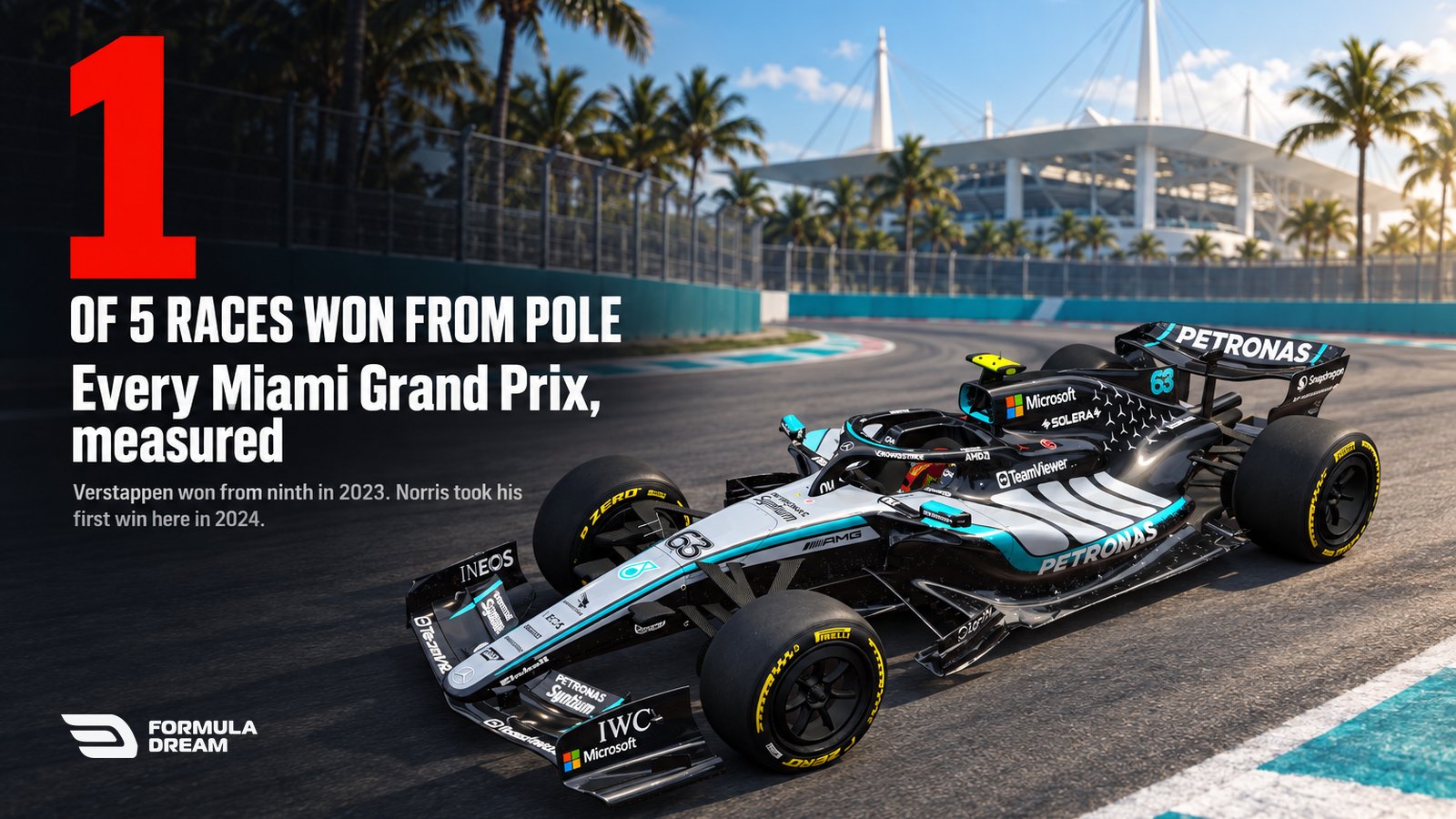
Every Miami Grand Prix winner, measured: five races, and pole has won only one of them
Five Miami Grands Prix have been held since 2022, and only one was won from pole: Kimi Antonelli's in 2026. Max Verstappen won from ninth in 2023, and Lando Norris took his first win there in 2024. Every winner, grid slot and safety car, measured.