What Does Box Box Mean in F1? We Counted 37,359 Messages
Guides
What does box box mean in F1? We counted every pit call in 37,359 radio messages
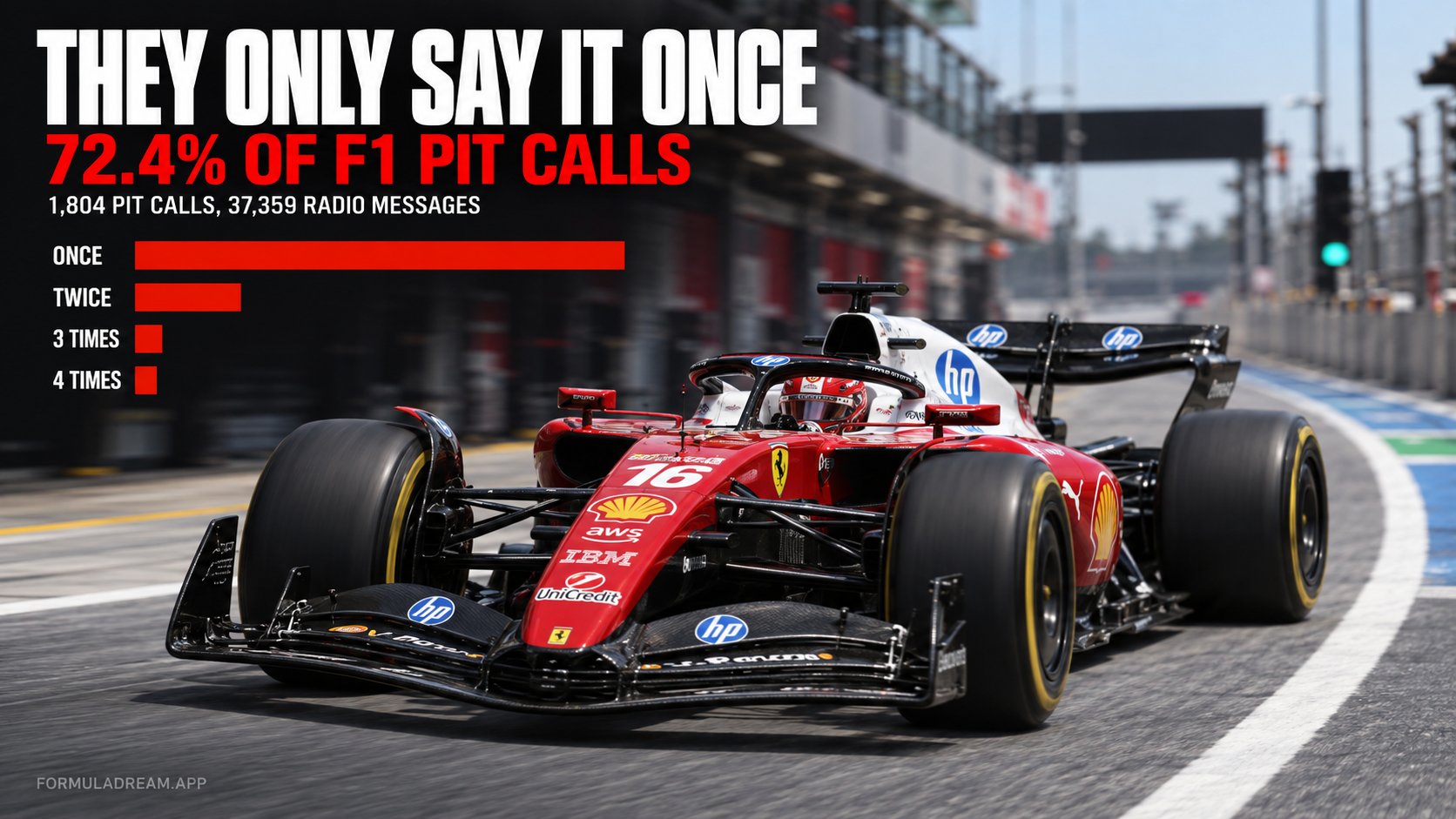
Everyone knows the phrase as box box box. The radio says otherwise: nearly three quarters of real pit calls say the word exactly once, and the busiest session for pit calls is not the race.
"Box" means come into the pit lane this lap. Everyone knows it as "box box box". Almost nobody actually says it that way.
We counted every pit call across 37,359 broadcast Formula 1 radio messages in our team radio archive, covering 2018 to 2026. The word turns up in 1,804 of them, one message in every 21. Then we counted how many times it gets repeated, which is the part that turns out to be a myth.
It means one thing: come into the pit lane at the end of this lap. Not next lap, not when you like. Now.
There are two explanations for why the word is "box" rather than "pit", and the honest position is that both are plausible and neither is settled.
The first is German. A pit stop is a Boxenstopp, and the pit garages are Boxen. Formula 1 has had German teams, German engineers and German drivers throughout its history, and the word plausibly crossed over.
The second is acoustic, and it is the one engineers themselves tend to give. A driver is listening through earplugs, inside a helmet, in a car doing 300 km/h. "Box" starts with a hard plosive and carries. "Pit" is short, soft, and sits close to other words a driver hears constantly. If a single syllable has to survive that environment and be understood first time, "box" is the better bet.
Both stories are repeated widely and neither has a definitive primary source, so treat this as the sport's received wisdom rather than a documented decision.
The myth: it is almost never said three times
Here is what the radio actually does when a team calls a driver in.
How many times "box" is said in a row
Messages
Share
Once
1,306
**72.4%**
Twice
332
18.4%
Three times
80
4.4%
Four times
74
4.1%
Five or more
12
0.7%
Caption: Longest consecutive run of the word "box" in each of the 1,804 messages containing a pit call, 2018 to 2026.
Nearly three quarters of pit calls say the word exactly once. The famous triple appears in 4.4% of them. Even counting everything from three repetitions upwards, you only reach 9.2%.
So where does "box box box" come from? From the broadcast. A producer choosing radio clips for television picks the urgent ones, and a tripled command sounds urgent. The phrase people know is not the average pit call, it is the pit call most likely to be aired. That is the same selection effect that shapes everything you hear on a race weekend.
The record is eight, and it happened to Lewis Hamilton twice
The longest unbroken run of the word in the entire archive is eight. It occurs three times, and every one of them is an engineer.
Twice it was said to Hamilton. At the 2018 British Grand Prix his engineer simply said:
"Box, box, box, box, box, box, box, box."
At the 2019 Chinese Grand Prix, the same thing with one extra word on the front: "So box, box, box, box, box, box, box, box."
The third is the most human of them. Daniel Ricciardo at the 2020 Eifel Grand Prix, a safety car call coming in under pressure, engineer first:
He answered in the same language he was being shouted at in. That is worth noticing, because it is rare.
The pit call comes from the pit wall, not the driver
Of the messages containing a pit call, 1,539 have the word in an engineer's line and 402 have it in a driver's. Those overlap, because a single exchange can contain both, so treat it as a ratio of roughly four to one rather than a clean split.
The driver instances are not drivers calling themselves in. They are almost always one of three things: confirming they heard it, asking whether the call still stands, or arguing. "Confirm box" and its variants appear 67 times, which is a driver making certain before throwing away a lap of track position.
The pit call is one of the few genuinely one-directional messages in Formula 1. A driver can refuse it, and occasionally does, but they do not initiate it. Who says what on the radio, and in what proportion, is something we measured across the whole archive in who actually talks on F1 team radio.
The words they use around it
"Box" rarely travels alone. These are the constructions built around it across all 37,359 messages.
Phrasing
Messages
"Do not box" or "stay out"
244
"Box this lap"
309
"Box now"
185
"Boxing"
159
"Box box box"
155
"Box for" a named compound
85
"Confirm box"
67
"Box opposite"
9
Caption: Pit call constructions across the archive. "Box opposite" means pit on the lap your rival does not.
The line worth staring at is the first one. "Do not box" and "stay out" appear 244 times, more often than "box this lap". The instruction to keep going is given more often than the most common instruction to come in.
That makes sense once you think about what a pit wall is actually doing. A driver who is losing time, sliding around or watching a rival dive into the pit lane will ask to stop. Most of the time the answer is no, because the strategy model says the lap they are complaining about is cheaper than the twenty two seconds a stop costs. The most common pit conversation in Formula 1 is a team telling a driver to stay out there.
The busiest session for pit calls is not the race
This is the result we did not expect.
Session
Pit calls
Messages
Rate per 1,000
Practice 1
429
5,562
**77.1**
Practice 2
359
5,094
70.5
Practice 3
285
4,096
69.6
Qualifying
286
6,275
45.6
Race
423
14,769
**28.6**
Caption: Pit calls per 1,000 broadcast messages by session type.
A practice session produces pit calls at nearly three times the rate of a Grand Prix.
The reason is structural rather than surprising once you see it. A race contains one or two scheduled stops per car. A practice session is nothing but stops: run a set, come in, change something, go out, come in again. The car is in and out of the garage continuously for an hour, and every one of those is a pit call.
The race number is also flattered downward by how much else is being said. A Grand Prix generates 14,769 broadcast messages in our archive, more than all three practice sessions combined, because there is a race to talk about. The pit calls are a smaller share of a much bigger conversation.
Some garages say it twice as often as others
Teams with at least 1,000 messages in the archive:
Team
Pit calls
Messages
Rate per 1,000
Alfa Romeo
104
1,360
76.47
AlphaTauri
115
1,689
68.09
McLaren
291
4,952
58.76
Haas
138
2,698
51.15
Ferrari
202
4,290
47.09
Aston Martin
76
1,747
43.50
Mercedes
246
5,691
43.23
Red Bull
247
5,791
42.65
Williams
104
2,550
40.78
Alpine
79
2,198
35.94
Caption: Pit calls per 1,000 broadcast messages on each team's own radio channel.
Alfa Romeo at 76.47 against Alpine at 35.94 is a spread of more than two to one, and we would caution against reading team character into it. This measures pit calls as a share of broadcast radio, and a team whose radio gets aired mostly for dramatic moments will show a lower pit call rate than a team whose radio is aired for routine traffic. The number is real. What causes it is not something this method can separate.
What this measures, and what it does not
Two things have to travel with every number above.
This is broadcast radio, not team radio. Formula 1 chooses which messages reach the world feed, and we can only count what was aired. The true rate of pit calls on a full team channel is certainly higher, because most of a session's traffic never airs at all. Read every figure here as a rate within what was broadcast.
The transcripts come from speech recognition. Counts across nearly 1,800 messages are robust, because a handful of mishearings cannot move a percentage that size. Individual quotes are a different matter, and every quote in this piece was checked against its own audio and speaker attribution before it went in.
Listen to any of it
Every message counted here is in the archive with the original audio and a transcript that colours itself by who is speaking, so you can hear the difference between a routine call and the eight-box version yourself: the full team radio archive.
A pit call is the only moment in a Grand Prix where you know what is about to happen before it happens, and on television you usually find out afterwards.
The Formula Dream app carries live driver radio as it is broadcast, with the transcript running beside the audio and the driver and engineer colour coded, so a pit call arrives while the car is still on track. It sits next to a live Dashboard, currently in beta, with every car on the circuit map, a timing tower showing gaps, intervals, tyre compound and tyre age, and every FIA document of the weekend as the stewards publish it.
Free, no subscription, no ads, independent. Not affiliated with Formula 1.
It means come into the pit lane at the end of this lap. It is an instruction from the race engineer to the driver, and it is not a suggestion. In our archive of 37,359 broadcast messages, a pit call appears in 1,804 of them, roughly one message in 21.
Why do F1 teams say box instead of pit?
Two explanations are given and neither is definitively documented. One is that it comes from the German Boxenstopp, meaning pit stop. The other, which engineers tend to offer, is that "box" carries better over a noisy radio into a helmet at speed, because the hard opening consonant cuts through where the softer "pit" can be missed or confused.
Do they really say box box box?
Usually not. We counted the repetitions in every pit call in the archive and 72.4% say the word exactly once. Three or more repetitions account for only 9.2%. The tripled version is famous because it is dramatic, and dramatic clips are the ones chosen for the television broadcast.
What is the most times box has been said in one message?
Eight, in an unbroken run. It has happened three times in the archive and every instance came from an engineer, twice to Lewis Hamilton at the 2018 British Grand Prix and the 2019 Chinese Grand Prix, and once to Daniel Ricciardo at the 2020 Eifel Grand Prix.
What does box opposite mean?
Pit on the lap that your rival does not, to put your stop out of sequence with theirs. It is rare on broadcast radio, appearing nine times in the archive, because it gives away strategic intent to every pit wall listening to the same world feed.
Do drivers ever say box themselves?
They appear in 402 of the messages, but almost never to call themselves in. They are confirming they heard the instruction, checking it still stands, or disagreeing with it. "Confirm box" and its variants appear 67 times.
All figures were measured from our own archive of transcribed broadcast team radio covering the 2018 to 2026 seasons. Coverage is not even across those years and 2022 is absent.
Mercedes W17: The 2026 Car, and What It Actually Does
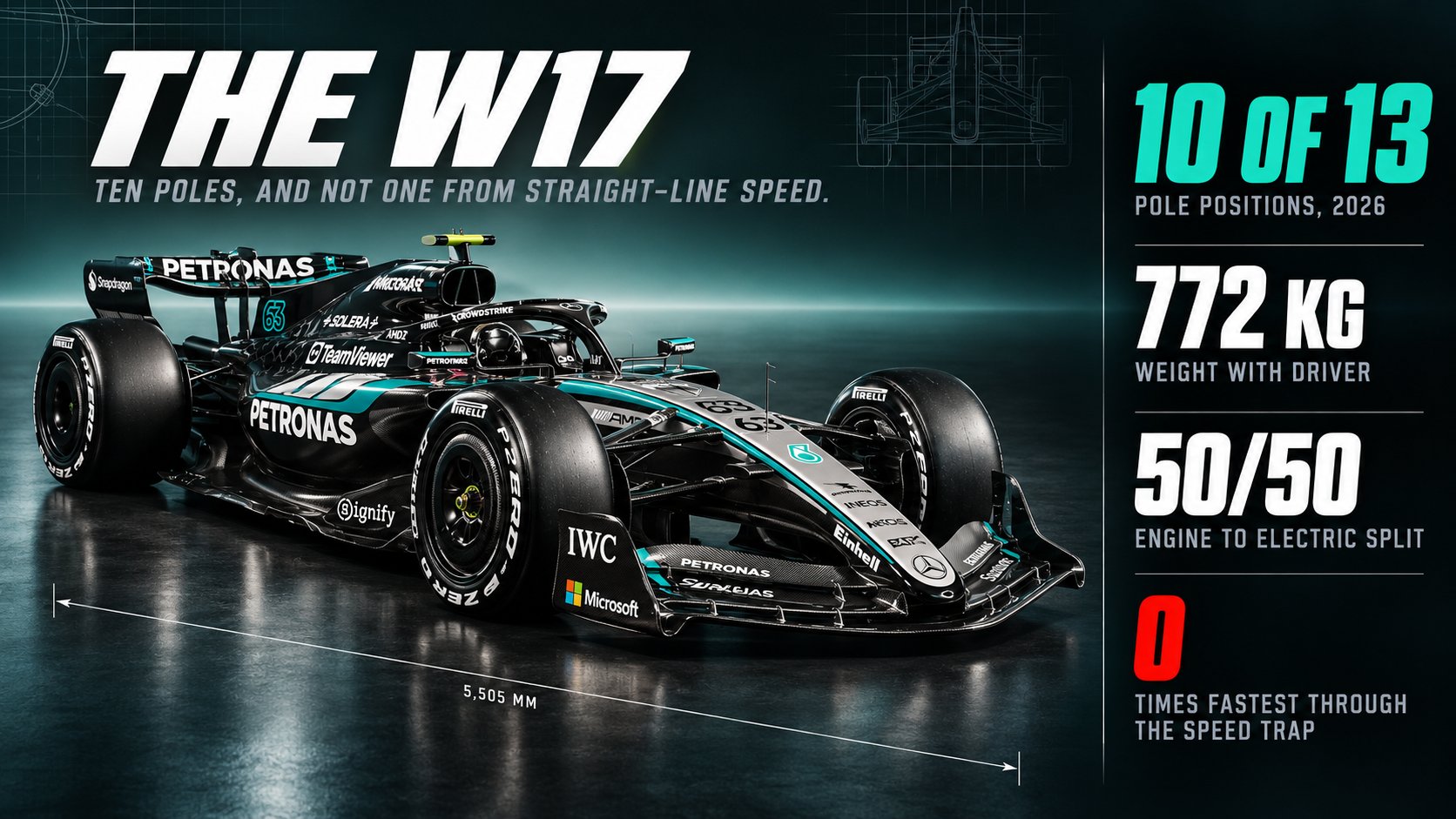
The W17 is smaller, narrower and lighter than the car before it, and it has taken ten of the first thirteen poles. We measured where its advantage actually comes from.