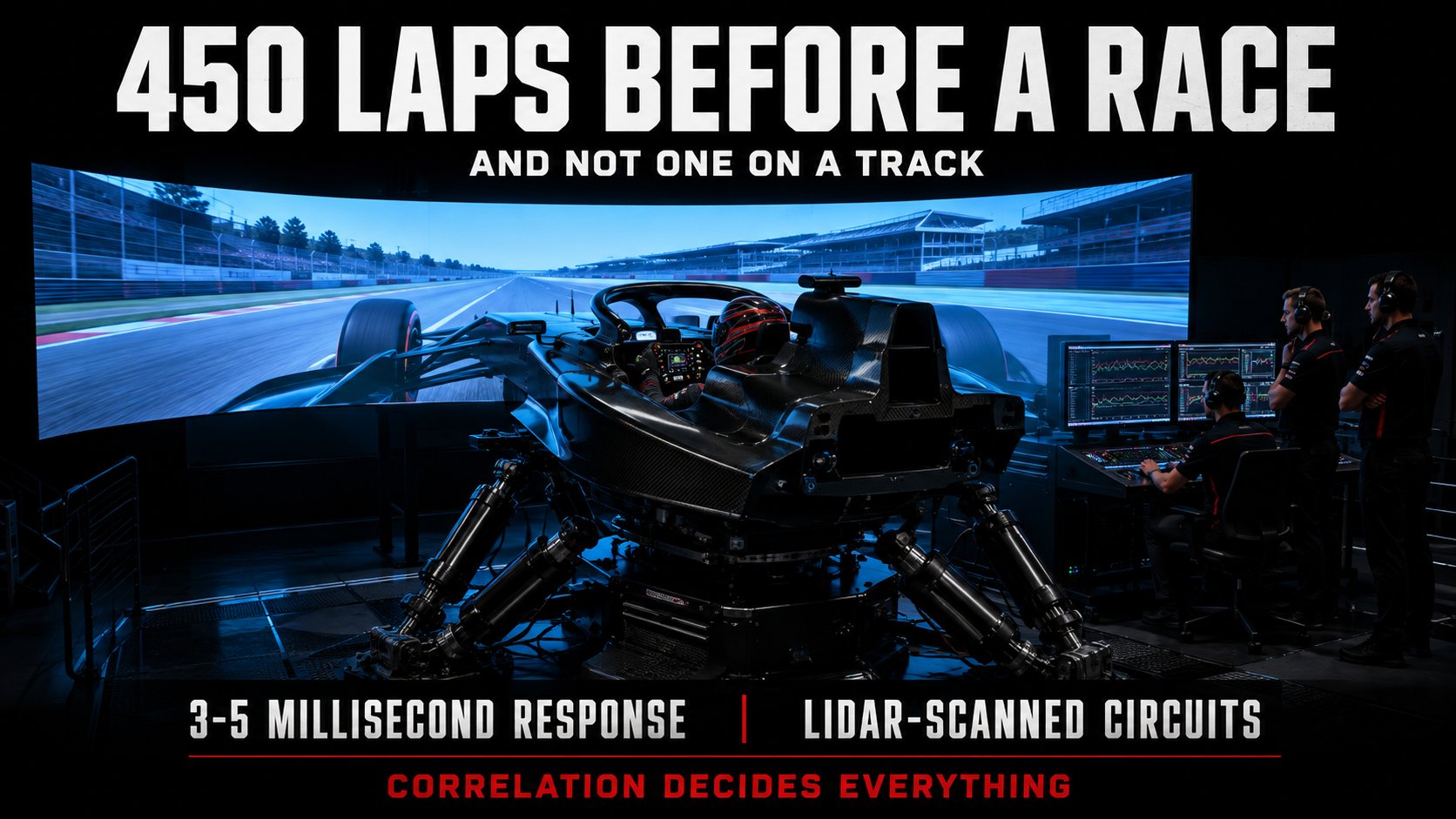
A team simulator is a lidar-scanned virtual test track on a motion platform that responds in milliseconds. Its value depends entirely on one unglamorous thing: correlation.
When Formula 1 capped track testing, the development work did not stop. It moved indoors.
A team simulator is not a good gaming rig. Mercedes describe theirs as "our virtual test track, where our car and the tracks we race on are modelled in incredible detail". A driver can complete around 450 laps in it before a single Grand Prix, on a circuit built from a lidar scan of the real thing, on a platform that answers their inputs in three to five milliseconds.
And all of that is worthless if one unglamorous thing is not right.
Three parts, and the least visible one matters most.
The motion platform. Six degrees of freedom, reproducing heave, yaw and roll along with the g-forces of cornering and braking. The critical specification is not travel, it is latency: feedback arrives in three to five milliseconds, which is fast enough that a driver can catch a slide the way they would in a real car. Slower than that and the brain stops believing it.
The circuit. Built from lidar scanning, where laser imaging produces a 3D map of the entire track: surface, kerbs, and the surrounding environment. That is why a driver arriving at a new venue already knows where the bumps are.
The vehicle model. The mathematical description of how this specific car behaves. This is the part nobody photographs and the only part that determines whether any of it is useful.
Correlation is the whole job
A simulator does not tell you how a car behaves. It tells you how your model of the car behaves. If the model is wrong, the simulator will confidently give you the wrong answer, and you will take it to a race.
Mercedes are blunt about the effort this takes: "A significant amount of time is spent correlating the virtual model of the car to the car in the real world, so that the car can handle in the simulator just like it does out on track."
That is the loop the entire modern sport runs on. Collect real data, adjust the model, test in the simulator, take the result to the track, compare, adjust again. And the loop has a bottleneck: real track data, which teams are barely allowed to collect. Official pre-season testing gives around 24 hours across a three-day event with only one car running at a time, as covered in why F1 teams barely get to test.
So the simulator is unlimited and the thing that makes it trustworthy is rationed. That tension is the defining engineering problem of a modern team.
Who is actually driving it
Mostly not the people you have heard of.
Teams run dedicated simulator drivers, and at Mercedes "the majority of the running is completed by our team of simulator drivers". Race drivers use it too, but their time is limited and expensive, so it is spent where it matters most.
The programme runs on a rhythm:
Before an event: roughly two days for a familiar circuit, about 450 laps. A new venue gets more, including a day dedicated to the race drivers learning the layout.
During the weekend: a Friday programme for each Grand Prix, running back at the factory in parallel with the real session, supporting the drivers and engineers at the track.
After the race: a post-event programme to understand what actually happened.
That Friday detail is the one most people miss. While the cars are running in practice, someone is in a simulator hundreds or thousands of miles away, driving the same circuit, testing setup changes the team is considering, and feeding results back before qualifying.
What it is used for
Two distinct jobs that happen to share a machine.
Driver preparation. Learning a circuit, refining technique, building the muscle memory for a braking point. This matters most for rookies and at new venues, and it is why a driver's first lap at an unfamiliar track is far less of an adventure than it used to be.
Car development. Testing setup directions, evaluating aerodynamic and suspension changes, and running strategy scenarios. Most of the setup a car arrives with on Friday was chosen in a simulator days earlier.
The second job is the expensive one, and it is where the correlation problem bites hardest. A setup direction that works in a poorly correlated model is a wasted weekend.
Why it went from useful to essential
Follow the regulations and the reason is obvious.
Track testing was capped for cost and fairness. Wind tunnel and CFD time are rationed by a sliding scale that deliberately gives more to the teams who finished lower. The cost cap limits total spending.
Simulator time is the one significant development resource with no cap at all. So it absorbed the demand, and teams built facilities running around the clock. Reported costs for a full driver-in-loop package sit in the region of a few million pounds, with high-end configurations quoted considerably higher, though teams do not publish their real figures.
Where it stops working
Two honest limits.
A rules reset breaks the model. Years of correlation data describe a car that no longer exists. The 2026 regulations changed aerodynamics, power unit and weight together, and every model became partly a guess at the moment accuracy mattered most. We measured the consequence: the spread from pole to the slowest car went from 2.49% of lap time in 2025 to 5.54% in 2026, the widest in six seasons. Some teams guessed better than others. The data is in how close is the F1 grid.
It cannot simulate everything. Tyre behaviour across a stint, track evolution, temperature and the exact way rubber goes off remain hard. A simulator is at its best on a repeatable single lap and at its weakest on the messy, cumulative things that decide races, which is why degradation still has to be learned on Friday.
Watch the correlation happen
Friday practice is where the simulator's homework meets reality, and the timing screen is where you see whether it was right.
The Formula Dream app runs a live Dashboard through every session including FP1: every car on the circuit map, and a timing tower with lap times, gaps and intervals, tyre compound and age, plus flag and safety car alerts as race control calls them. A team that arrives with the right setup shows it immediately; one whose model was wrong spends the session chasing. You also get live driver radio as it is broadcast, which is where those findings are discussed, and every FIA document of the weekend as it is published.
Free, no subscription, no ads, independent. Not affiliated with Formula 1.
A full-scale simulator combining a six degree of freedom motion platform, a lidar-scanned model of the circuit, and a mathematical model of the team's own car. Mercedes describe it as a virtual test track.
How realistic are F1 simulators?
Realistic enough that motion feedback arrives in three to five milliseconds, fast enough for a driver to catch a slide as they would on track. The bigger question is not realism of motion but accuracy of the vehicle model.
How many laps do F1 drivers do in the simulator?
Around 450 laps across roughly two days before a familiar Grand Prix, with more for a new circuit including a day for the race drivers to learn the layout.
Do F1 teams use simulators during a race weekend?
Yes. Teams run a Friday programme at the factory in parallel with practice, testing setup changes and feeding results to the track, and continue with a post-event programme afterwards.
What is correlation in F1 simulation?
Matching the virtual model of the car to how the real car actually behaves. Without it a simulator gives confident answers about a car that does not exist, which is why teams spend so much effort on it.
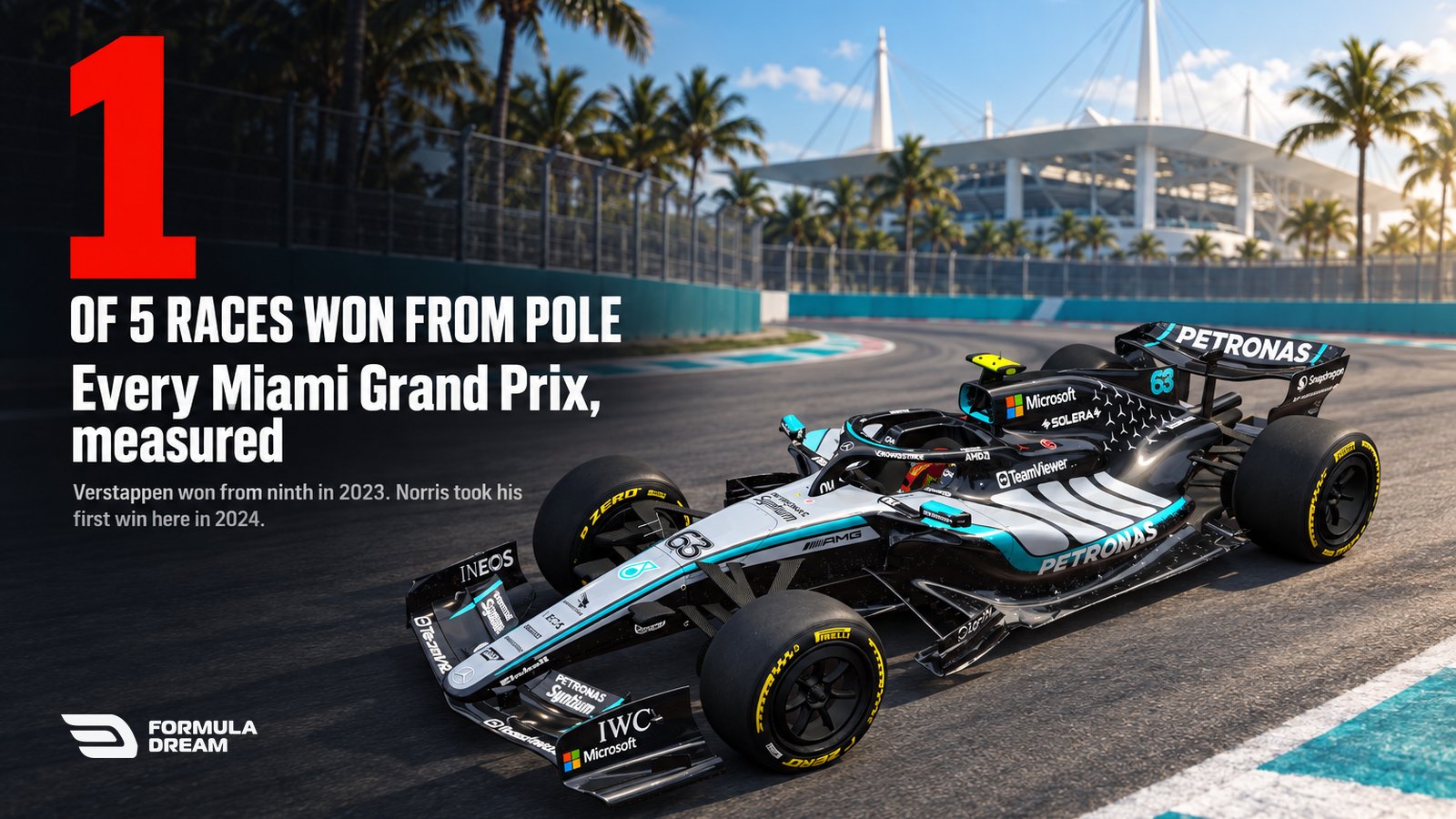
Every Miami Grand Prix winner, measured: five races, and pole has won only one of them
Five Miami Grands Prix have been held since 2022, and only one was won from pole: Kimi Antonelli's in 2026. Max Verstappen won from ninth in 2023, and Lando Norris took his first win there in 2024. Every winner, grid slot and safety car, measured.