F1 Car Setup Explained: What Teams Actually Change
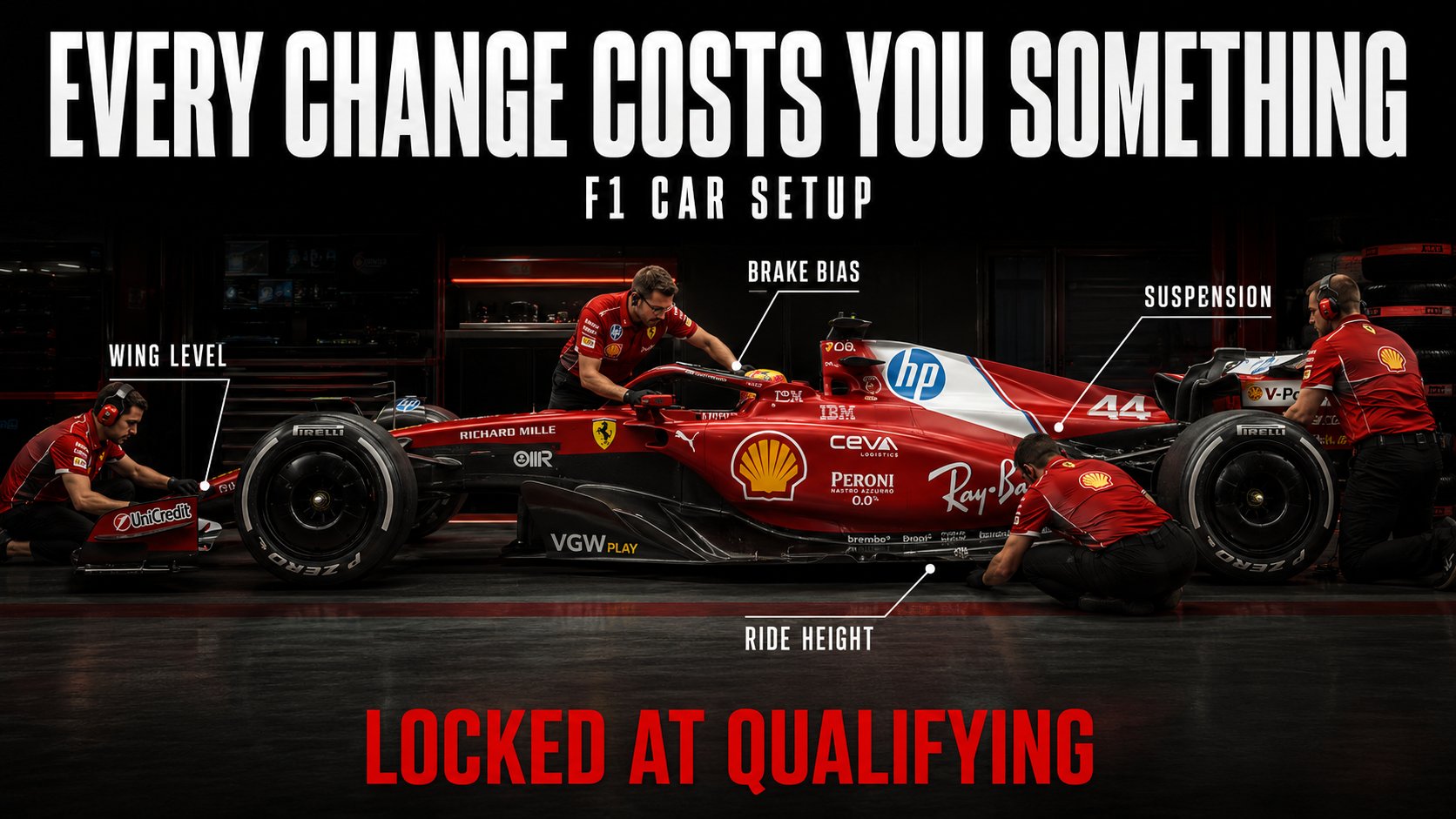
Setup is a set of compromises made before the car is locked. Wing level, ride height, brake bias and tyres, what each one trades away, and when the freedom ends.
Two cars from the same team, built to the same drawings, can be genuinely different machines by Saturday afternoon. That difference is setup: the adjustments a team makes to suit a circuit, a driver and a weekend's conditions.
Almost none of it is a straight improvement. Nearly every setup change trades one thing for another, and the skill is knowing which trade is worth making at a given track.
And there is a deadline. Once qualifying begins, the car is frozen.
The first and largest choice is how much downforce to run.
More wing means more grip in the corners and more drag on the straights. Less wing means the opposite. There is no universally correct answer, only a correct answer for this circuit.
That is why Monza runs the skinniest wings of the season, with a lap that is mostly straights, and Monaco runs the most, where top speed barely matters. It is also why the same car can look quick at one venue and anonymous at the next: the correct trade changed and the team judged it differently. The circuits at each extreme are in the fastest F1 circuits.
Ride height: the setting with a hard floor
Running the car lower generally makes the floor work better, and the floor is where most downforce comes from.
The limit is not aerodynamic, it is a rule. The plank under the car starts at 10mm and, under the 2026 Technical Regulations, must not measure below 8mm around its three measuring holes after the session. Two millimetres of wear across an entire Grand Prix, where until 2025 it was one.
Teams therefore set ride height as low as they dare and model the wear, which depends on fuel load, kerb use, track temperature and surface. Get the model wrong by a fraction of a millimetre and the result is deleted. Lewis Hamilton was disqualified from the 2025 Chinese Grand Prix when his plank measured 8.6mm, under that year's 9mm limit. The full mechanism is in why F1 cars spark.
Ride height is also a live problem, because the car gets lighter as fuel burns off and therefore sits higher. A setup optimal at the start is not optimal at the end.
Brake bias: the one drivers change constantly
Brake bias is the front-to-rear split of braking force, expressed as a front percentage, typically around 55 to 60 per cent front.
Unlike most setup, this one is adjustable from the cockpit. A rotary switch on the steering wheel lets a driver move it in small increments, and they do so constantly, sometimes corner by corner.
Forward stabilises the car under braking but risks locking a front tyre, which flat-spots it and ruins the stint.
Rearward helps the car rotate into a corner, which is faster if controlled, but risks the rear stepping out.
It has to move through a race anyway, because fuel burn shifts the weight distribution and the tyres age at different rates front and rear. The braking side is covered in F1 brakes explained.
Suspension and mechanical balance
Springs, dampers and anti-roll bars determine how the car transfers weight and absorbs bumps and kerbs.
Stiffer suspension keeps the floor at a more consistent height, which the aerodynamics prefer, but it makes the car unforgiving over bumps and kerbs. Softer suspension is kinder to the tyres and better on a rough surface, at the cost of aerodynamic consistency.
This is why street circuits look so different: bumpy surfaces and aggressive kerbs force a softer, higher setup than the aerodynamicists would like, and the whole car is compromised around that.
The balance a driver feels comes out of this, and it produces the two complaints you hear most on the radio, understeer and oversteer.
Tyres: the setup you do not fully control
Compound choice is constrained. Pirelli nominates which compounds are available at each event, and in a dry race a driver must use at least two different dry compounds, which forces a pit stop.
What a team does control is how the setup treats the tyres. Camber, pressures within the permitted range, mechanical balance and driving style all change how quickly rubber degrades, and degradation drives everything about strategy. We measured the soft losing 0.048 seconds per lap of tyre age in 2025 against the hard's 0.011, with that hierarchy collapsing in 2026. The numbers are in how fast F1 tyres degrade.
A car that is quick over one lap and destroys its tyres is a common and expensive setup outcome. It looks fast on Saturday and loses on Sunday.
The deadline: parc fermé
Setup freedom ends when qualifying starts.
From that moment the car enters parc fermé conditions, and the significant setup parameters are locked. Wings cannot be changed, ride height cannot be adjusted, suspension settings are frozen. Break the restriction and the car starts from the pit lane.
This is what makes setup a genuine gamble rather than a continuous optimisation. A team commits to a configuration before it knows what Sunday's weather will do, and a wrong call cannot be undone. It is the single most consequential deadline in the weekend, and it is explained in what parc fermé is.
A sprint weekend compresses this further: one practice session instead of three, and parc fermé arriving much earlier, so teams commit on far less information. That is covered in the F1 sprint format.
Why two team-mates set the car up differently
Given identical machinery, drivers routinely choose different setups, and the difference is rarely small.
Some drivers want a stable rear and accept understeer. Others want the car to rotate and will tolerate a nervous rear end to get it. Neither is wrong, and the faster configuration is whichever one that particular driver can extract from.
It is also why the team-mate comparison is so revealing. Same car, same track, same session, different setup philosophy, and a measurable gap at the end of it. We measured every pairing on the grid, from 20-0 clean sweeps down to 0.035%, in F1 team-mate qualifying head to head.
Watch setup decisions play out
Setup is invisible in the garage and obvious on the timing screen.
The Formula Dream app runs a live Dashboard through every session: every car on the circuit map, and a timing tower with lap times, gaps and intervals, tyre compound and age, plus flag and safety car alerts as race control calls them. Sector times are where a low-drag setup and a high-downforce one separate, and where a car eating its tyres reveals itself. You also get live driver radio as it is broadcast, which is where balance complaints and bias changes are actually communicated, and every FIA document of the weekend as it is published, including parc fermé breaches.
Free, no subscription, no ads, independent. Not affiliated with Formula 1.
The adjustments a team makes to suit a circuit, a driver and the conditions: wing level, ride height, suspension, brake bias and tyre parameters. Almost every change trades one quality for another rather than simply improving the car.
What can drivers change from the cockpit?
Brake bias, differential settings and engine or energy modes, among others. Brake bias is the one drivers adjust most, sometimes corner by corner, using a rotary switch on the steering wheel.
When is F1 car setup locked?
At the start of qualifying, when the car enters parc fermé conditions. Significant setup parameters are frozen from that point until the race, and breaking the restriction means starting from the pit lane.
Why do teams run different wing levels at different tracks?
Because downforce costs drag. Circuits dominated by straights, like Monza, reward low drag. Circuits dominated by corners, like Monaco, reward maximum downforce. The correct trade is different at every venue.
Why can't teams run the car as low as they want?
Because of the plank. It starts at 10mm and, under the 2026 rules, must not wear below 8mm at the FIA's measurement points, so a car run too low is disqualified. Teams set ride height as low as they dare and model the wear.
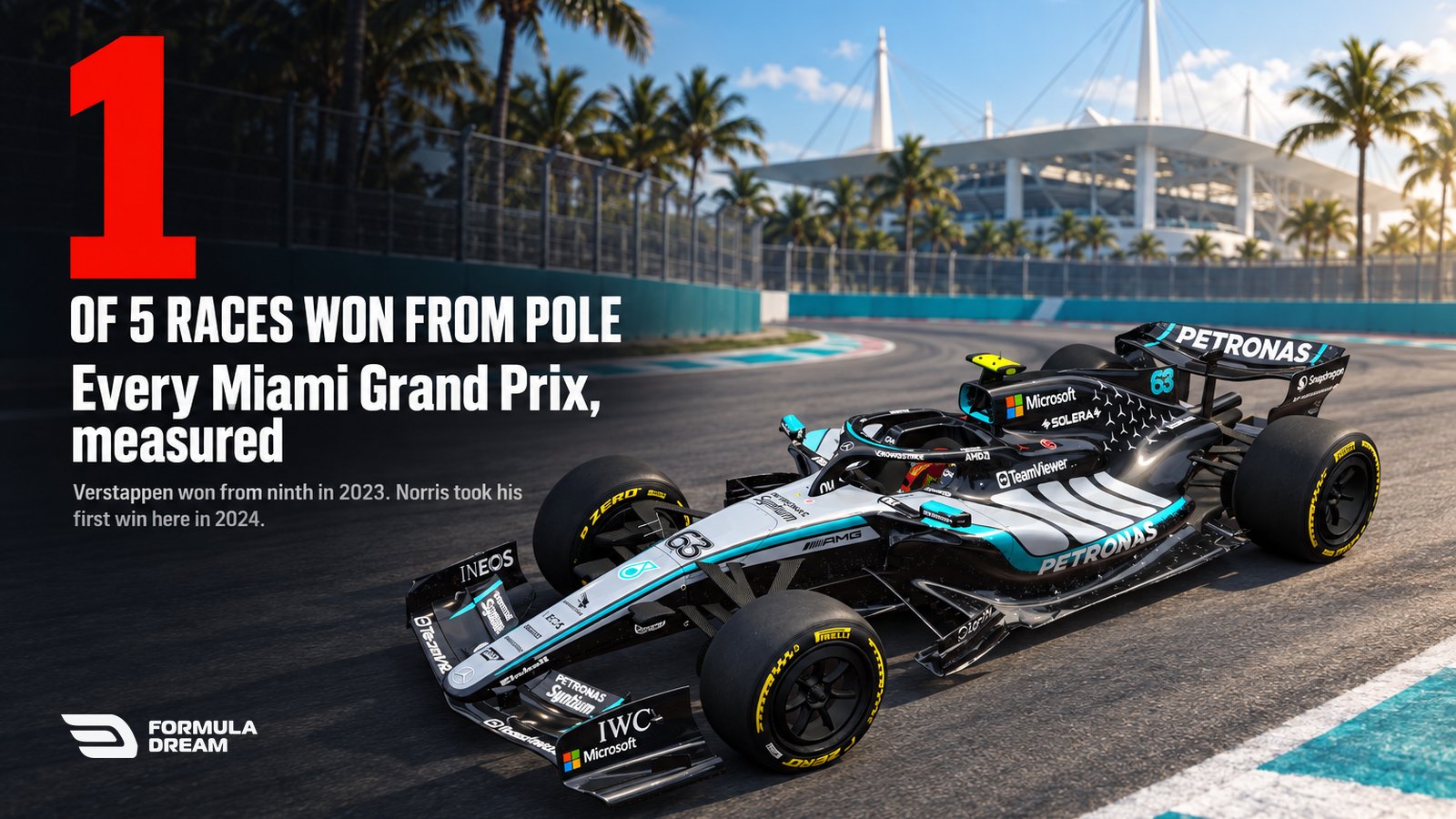
Every Miami Grand Prix winner, measured: five races, and pole has won only one of them
Five Miami Grands Prix have been held since 2022, and only one was won from pole: Kimi Antonelli's in 2026. Max Verstappen won from ninth in 2023, and Lando Norris took his first win there in 2024. Every winner, grid slot and safety car, measured.