F1 Suspension Explained: How It Works | Formula Dream
Guides
F1 Suspension Explained: It Exists to Serve the Floor
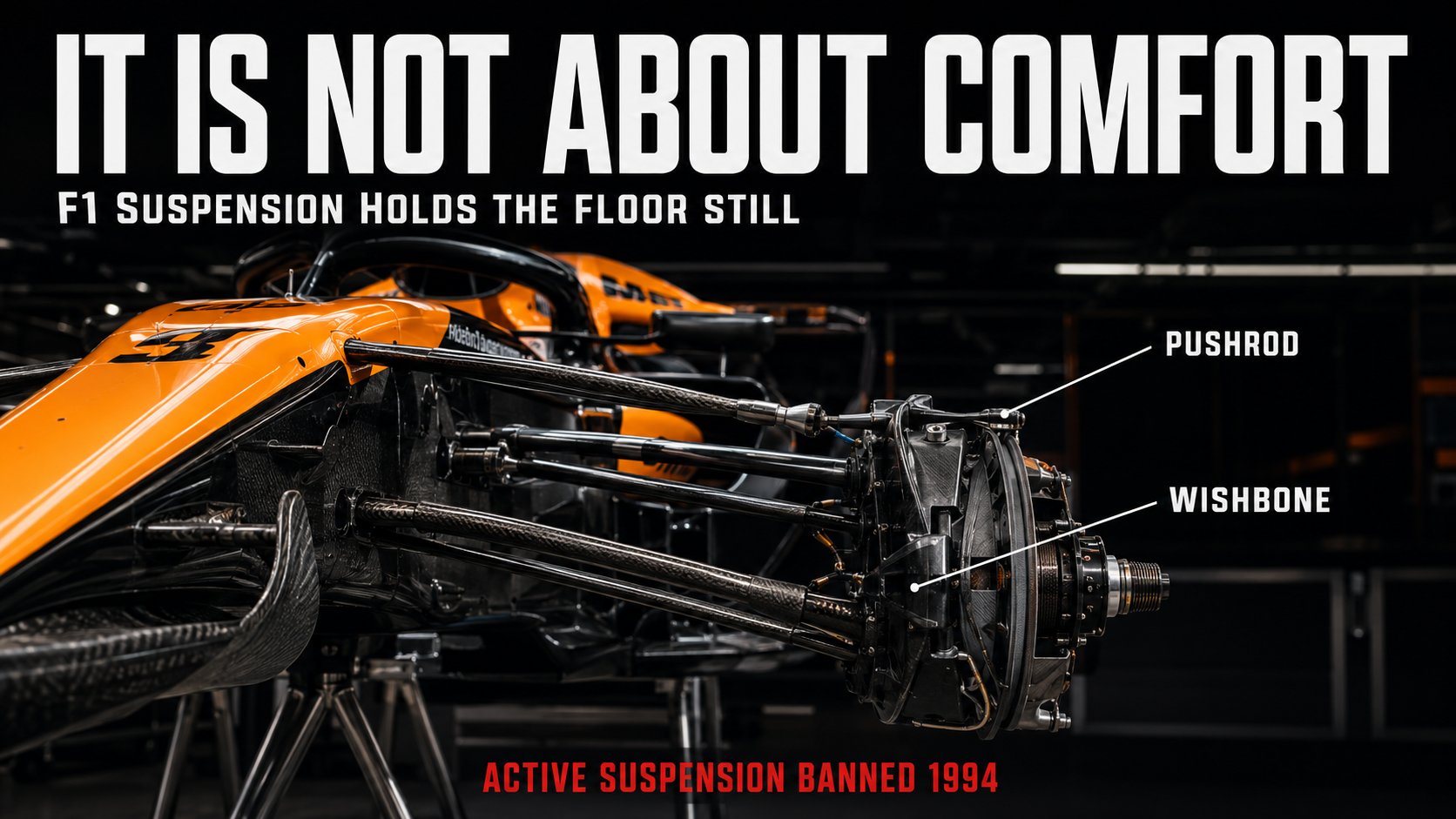
F1 suspension is not really about ride comfort or mechanical grip. Its main job is holding the floor at a constant height so the aerodynamics keep working.
On a road car, suspension exists to keep the tyres on the road and the passengers comfortable.
On a Formula 1 car, comfort is irrelevant and mechanical grip is secondary. The primary job of F1 suspension is to hold the floor at a constant height above the track, because that is what the aerodynamics need to work.
Once you know that, the whole design makes sense, including why it is so brutally stiff and why the sport banned the version that worked best.
The floor is the single biggest source of a modern F1 car's downforce, even after the 2026 rules partly flattened it. Ground effect works by accelerating air underneath the car, and its performance is extremely sensitive to ride height and to the car's attitude, meaning how it pitches nose-down or tail-down.
Move the floor a few millimetres and the aerodynamic load changes measurably. Get it wrong and the car becomes unpredictable, which is not merely slow but genuinely difficult to drive. The mechanism is in the F1 floor explained.
So the suspension's real assignment is: keep the aerodynamic platform stable, whatever the track surface does. Everything else is a compromise made in service of that.
This is why F1 cars are set up so stiff that they look almost rigid over kerbs. A softer car would ride bumps better and treat its tyres more kindly, but the floor would move, and the aerodynamics would come and go.
Pushrod and pullrod
The visible difference between cars, and the one people ask about.
Both layouts do the same thing: transfer wheel movement inboard to springs and dampers mounted inside the bodywork, where they are out of the airflow. They differ in direction.
Pushrod: the rod runs upwards from the bottom of the upright and pushes on the inboard suspension from below.
Pullrod: the rod runs downwards from the top of the upright and pulls on it from above.
Pullrod allows the heavy components to sit lower in the car, which lowers the centre of gravity, and permits a lower nose. Pushrod is easier to package and maintain, and is the more common choice.
Neither is universally correct. It is a packaging decision made around the aerodynamics the team wants, which is why different teams run different layouts front and rear in the same season, and why a team may switch when it changes concept.
Anti-dive and anti-squat
This is where suspension geometry becomes an aerodynamic tool rather than a mechanical one.
Under braking a car wants to dive, pitching nose-down. Under acceleration it wants to squat, sitting on its rear. Both move the floor and disturb the aerodynamic platform at precisely the moments a driver needs the car to be predictable.
Anti-dive and anti-squat geometry angle the suspension pickup points so that braking and acceleration forces partly resist those movements mechanically, before the springs ever get involved. The purpose is to hold the floor at its target height and protect downforce.
The trade is feel. Aggressive anti-dive stabilises the platform but numbs what the driver senses through the car under braking, and drivers notice. It is a recurring source of the balance complaints you hear on the radio, covered in understeer and oversteer.
Why active suspension is banned
Because it worked far too well.
Active suspension uses sensors and actuators to control ride height continuously, holding the car at the perfect attitude through every corner, bump and braking zone. For a ground effect car it is close to an ideal solution: the aerodynamic platform simply never moves.
It was banned for 1994, in the same clear-out that removed traction control, ABS and launch control. The reasoning was the same too: the FIA judged that electronics had gone too far in taking the car out of the driver's hands, and that the spending required favoured the wealthiest teams. That story, including the ban that had to be made twice, is in do F1 cars have traction control.
Teams have spent the thirty years since trying to approximate actively controlled ride height using entirely passive parts. Which is exactly what anti-dive geometry, carefully chosen spring rates and clever damping are for.
The device that got banned for being too clever
One of those attempts is worth knowing about.
From the late 1990s, teams began using inerters, sometimes called J-dampers: a device using a small flywheel that resists changes in the rate of suspension movement by absorbing energy. It gave a meaningful improvement in platform control without any electronics, which is precisely why it was attractive under a rulebook that had banned the electronic version.
Inerters were prohibited from 2022, alongside the return of ground effect floors, because their value would have been enormous exactly when ride height mattered most. The 2026 rules still name them in the list of banned devices.
That is a recurring pattern in F1 regulation. Ban a capability, watch teams reach the same outcome by another route, then close that route too. The same instinct produced the 2026 amendment banning tyre cooling as well as heating.
What the 2026 rules allow, and what they ban
The Technical Regulations are specific about how passive a Formula 1 suspension has to be. Under Article C10.2 of the 2026 rules:
Every car must be fitted with sprung suspension, and each axle's suspension must respond only to the loads on that axle's wheels.
Any powered device that can change the suspension's configuration or performance is forbidden, and nothing may be adjusted while the car is moving.
The suspension may not respond to body accelerations, which rules out inerters, mass dampers and acceleration-sensitive damper valves by name.
It may not be coupled to the brakes or the steering, and there may be no ride height control through self-levelling systems or feedback loops.
It may not store energy for delayed release.
Fixed geometry that uses the tyre forces themselves, such as anti-dive, anti-squat and anti-lift, is written in as explicitly allowed. That single permission is where much of the modern engineering happens.
Why 2026 made it harder
The current cars are lighter and generate roughly 30% less downforce, which changes the suspension problem rather than easing it.
Less aerodynamic load means less force pressing the car down, so the springs have less to work against and the platform behaves differently over bumps. Less downforce also means every remaining bit of it matters more, so losing some to a moving floor is proportionally worse.
The result, measured rather than assumed: 2026 pole laps are a median of 3.05% slower than 2025 at the ten circuits raced in both seasons, 2.93% on average, and the spread from pole to the slowest car more than doubled, from 2.49% to 5.54%. Teams that understood the new platform gained a great deal. The figures are in are F1 cars getting faster and how close is the F1 grid.
Watch it in the sector times
Suspension is invisible, and its consequences are not.
The Formula Dream app runs a live Dashboard through every session: every car on the circuit map, and a timing tower with lap times, gaps and intervals, tyre compound and age, plus flag and safety car alerts as race control calls them. A car whose platform is working shows it in the fast corners and over kerbs; one that is not shows it in a sector that never improves. You also get live driver radio as it is broadcast, which is where balance and ride complaints are actually made, and every FIA document of the weekend as it is published.
Free, no subscription, no ads, independent. Not affiliated with Formula 1.
Yes. The rules require it: under Article C10.2.1 of the 2026 Technical Regulations every car must be fitted with sprung suspension. It is simply far stiffer than a road car's, because its main job is to hold the floor at a steady height rather than to smooth out bumps.
What does F1 suspension actually do?
Primarily it keeps the floor at a constant height and attitude so the aerodynamics work consistently. Mechanical grip and ride quality are secondary, which is why F1 cars are set up far stiffer than any road car.
What is the difference between pushrod and pullrod suspension?
Pushrod runs upwards from the upright and pushes on the inboard springs from below. Pullrod runs downwards and pulls on them from above. Pullrod lowers the centre of gravity and allows a lower nose; pushrod is easier to package and maintain.
Why is active suspension banned in F1?
It was banned for 1994, alongside traction control, ABS and launch control. The FIA judged that electronics were removing too much of the driver's role, and that the spending involved favoured the richest teams. Today Article C10.2 forbids any powered device that can alter the suspension, and any ride height control through feedback loops.
What is anti-dive in F1?
Suspension geometry that resists the car pitching nose-down under braking, using the braking forces themselves rather than the springs. It protects the aerodynamic platform, at the cost of some of the feel a driver gets under braking.
What is an inerter in F1?
A device using a small flywheel to resist changes in suspension movement, used from the late 1990s to improve platform control without electronics. It was prohibited from 2022, when ground effect floors returned.
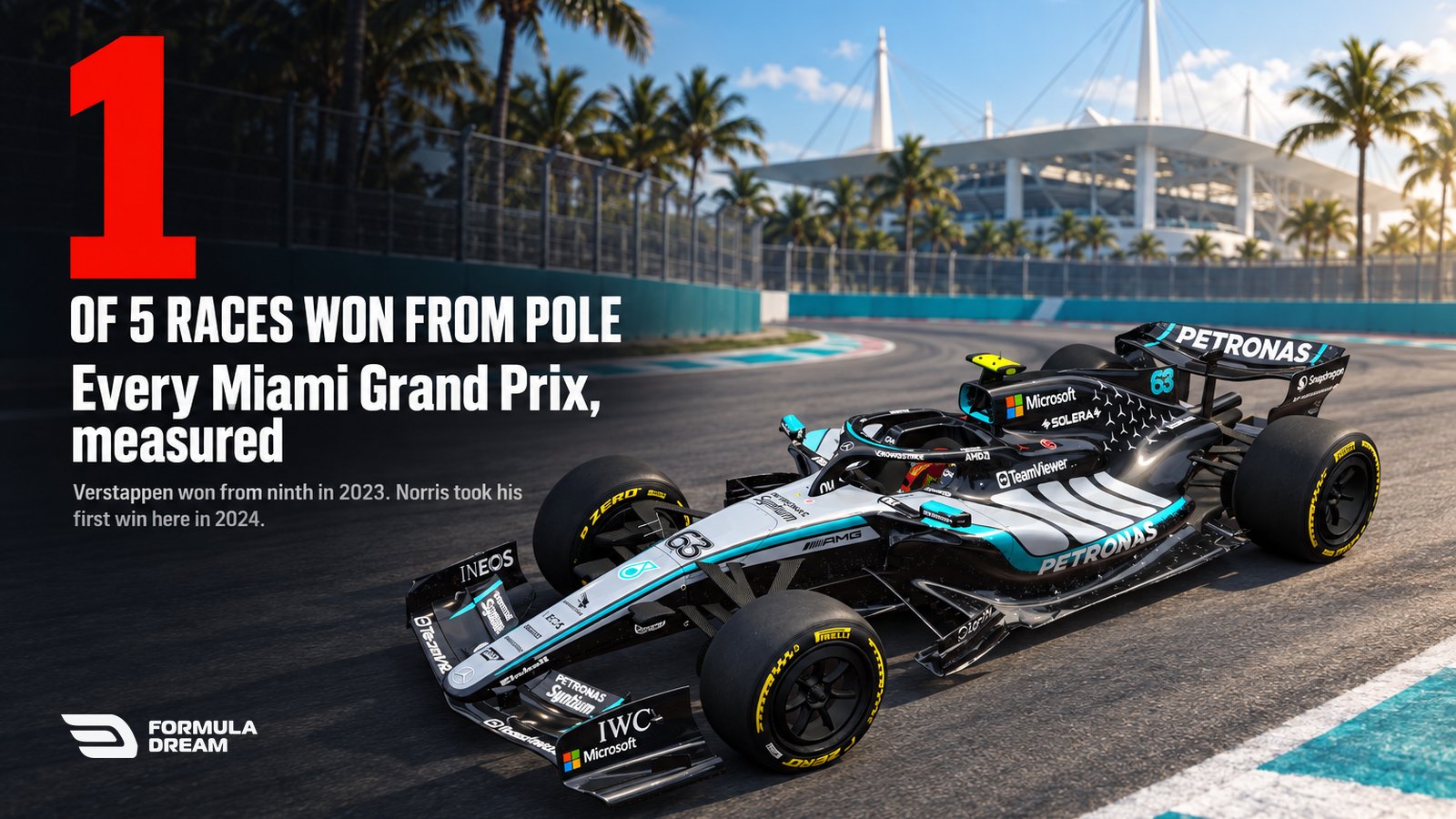
Every Miami Grand Prix winner, measured: five races, and pole has won only one of them
Five Miami Grands Prix have been held since 2022, and only one was won from pole: Kimi Antonelli's in 2026. Max Verstappen won from ninth in 2023, and Lando Norris took his first win there in 2024. Every winner, grid slot and safety car, measured.