F1 Brakes Explained: 1,000°C, and Useless When Cold
F1 carbon brakes stop a car from 300 km/h in under four seconds, and produce almost no bite below 400°C. The narrow window explains most braking mistakes you see.
A Formula 1 car stops from 300 km/h in under four seconds, over roughly 60 to 65 metres, pulling more than 4g and often 5 to 6.
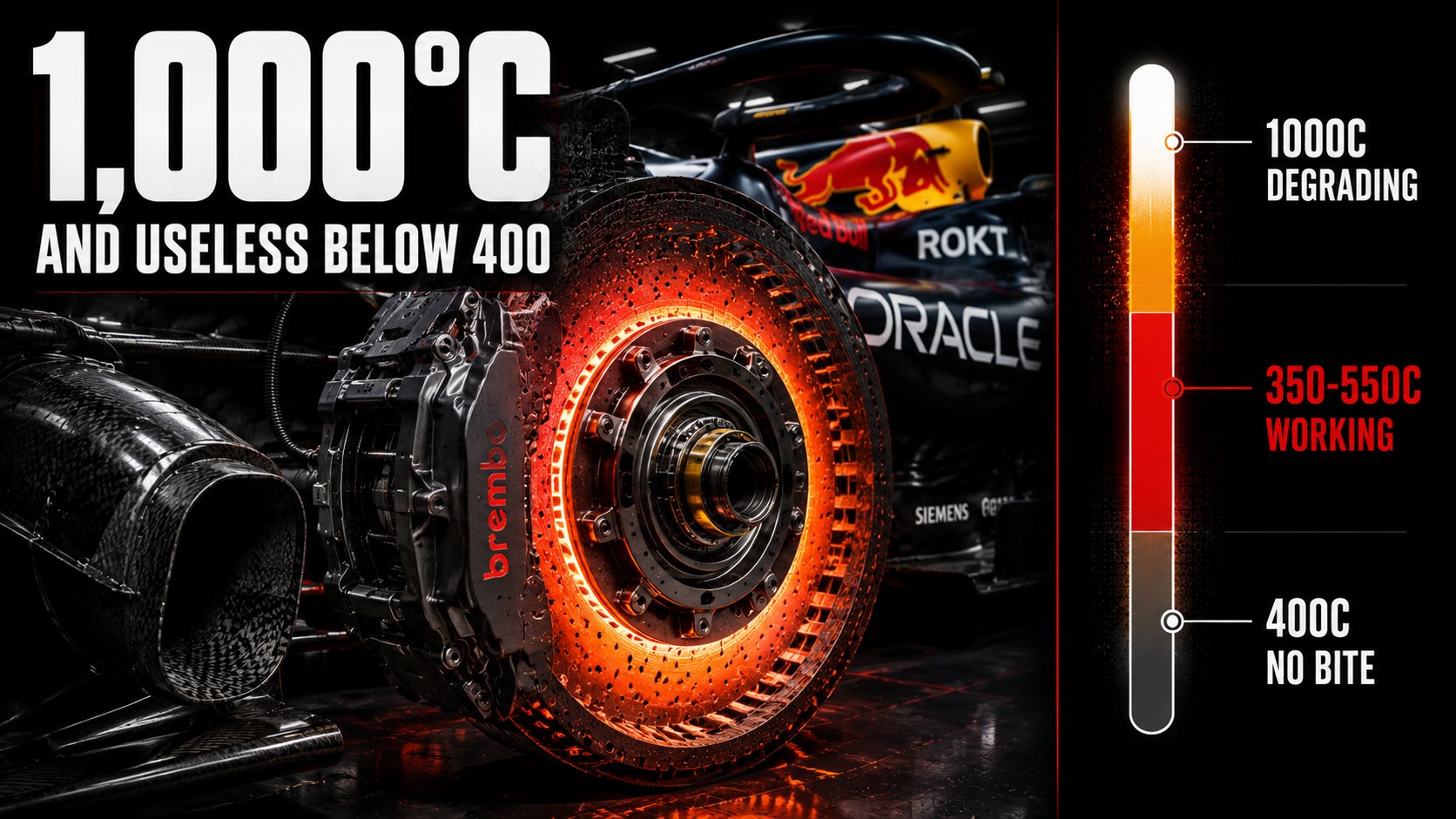
It does that with carbon discs that run beyond 1,000°C under heavy braking. And here is the part that explains most of the braking mistakes you watch: below about 400°C those same brakes produce almost no bite at all.
Carbon brakes are not simply stronger than road brakes. They are a different thing, with a narrow temperature window, and managing that window is a real part of driving an F1 car.
Each corner has a carbon-carbon disc, roughly 278mm in diameter and 28mm thick, gripped by a carbon-composite pad inside a caliper.
Carbon is used for two reasons. It is far lighter than steel, which matters on a car chasing a 768kg minimum weight, and it copes with sustained high temperature far better. A steel disc asked to do this job would fade and eventually fail.
The disc is also drilled with over a thousand holes. They are not decorative and they are not simply for venting: they enormously increase the internal surface area, and air is fed through dedicated ducts and forced along hundreds of radial micro-channels inside the disc, pulling heat out from within rather than just off the face.
The temperature window is the whole story
Carbon brakes work properly in a band of roughly 350°C to 550°C.
Below about 400°C, the friction coefficient falls away sharply. The driver presses the pedal and the car does not slow as expected. This is not a subtle effect, and it is the reason cold brakes are dangerous rather than merely slow.
Above 1,000°C, oxidation accelerates and the disc surface starts degrading. Sustained running that hot wears the brakes out and, in the extreme, destroys them.
So the engineering problem is not "make them strong". It is "keep them inside a 200-degree band while dissipating enough energy to slow 800kg from 300 km/h, repeatedly, for two hours." That is what the ducting and the thousand holes exist to solve, and it is why brake cooling is a setup decision: bigger ducts cool better but cost aerodynamic performance.
Why cold brakes explain so much of what you see
Once you know the window, several recurring moments make sense.
Weaving on out-laps and formation laps. Drivers are not just warming tyres. They are dragging the brakes to get heat into the discs before the first real braking zone.
Safety car restarts. Long periods at low speed pull heat out of both tyres and brakes. The restart happens on equipment below its window, which is why so many incidents cluster there. The same effect is why a safety car period is more dangerous than it looks.
The first lap. Cold brakes, cold tyres and twenty cars converging on one corner. We measured that 38% of drivers finish lap one exactly where they started, but the incidents that do happen are concentrated in exactly this window, covered in what really happens on an F1 first lap.
Lock-ups after a long straight. A driver who has not touched the brakes for fifteen seconds arrives at the corner with cooler discs and, at the same time, a car that has been cooling its tyres. Get the pedal pressure wrong and there is no ABS to save it, because driver aids are banned.
Brake bias: the dial drivers actually use
Brake bias, or brake balance, is the split of braking force between the front and rear axles, expressed as a front percentage. Typical settings sit somewhere around 55 to 60 per cent front.
A driver adjusting to "58 per cent front" is asking the front wheels to do 58% of the work and the rears 42%. There is a rotary switch on the steering wheel to change it in small increments, and drivers change it constantly, sometimes corner by corner.
The trade is simple and unforgiving:
Bias forward stabilises the car under heavy braking, but risks locking a front tyre, which flat-spots it and ruins the stint.
Bias rearward helps the car rotate into the corner, which is faster if you can control it, but risks the rear stepping out.
Bias also has to move through a race for reasons that have nothing to do with driver preference. As fuel burns off the car gets lighter and the weight distribution shifts. As tyres age, grip changes at each axle at different rates. A setting that was perfect on lap five is wrong by lap thirty.
The rear axle is a special case, because on a modern car it is not purely hydraulic. Brake-by-wire blends the friction brakes with the electrical braking from energy recovery, and a computer manages the mix to deliver what the driver asked for.
Why braking is physically punishing
The deceleration figures are why F1 drivers train the way they do.
Braking loads exceed 4g routinely and reach 5 to 6g at the heaviest zones. A driver is thrown forward against the belts at several times their own body weight, dozens of times a lap, for a full race. The braking effort itself is enormous, requiring pedal loads far beyond anything in a road car, and it has to be applied with precision measured in single percentage points.
Braking is where lap time is found and lost, and it is close to invisible on a broadcast.
The Formula Dream app runs a live Dashboard through every session: every car on the circuit map, and a timing tower with lap times, gaps and intervals, tyre compound and age, plus flag and safety car alerts as race control calls them. Sector times are where a driver braking better than another shows up first. You also get live driver radio as it is broadcast, which is where brake temperature and bias instructions actually arrive, and every FIA document of the weekend as it is published.
Free, no subscription, no ads, independent. Not affiliated with Formula 1.
Beyond 1,000°C under heavy braking. Their effective working window is much narrower, roughly 350°C to 550°C, and above 1,000°C oxidation begins degrading the disc surface.
How quickly can an F1 car stop?
From 300 km/h to a standstill in under four seconds, in roughly 60 to 65 metres, with deceleration above 4g and often reaching 5 to 6g.
Why are F1 brakes bad when cold?
Because carbon needs heat to generate friction. Below about 400°C the friction coefficient drops sharply and the driver gets very little bite, which is why drivers weave to warm the brakes and why safety car restarts are hazardous.
What is brake bias in F1?
The front-to-rear split of braking force, expressed as a front percentage and usually around 55 to 60 per cent. Drivers adjust it from a rotary switch on the steering wheel, moving it forward for stability or rearward for rotation.
What are F1 brake discs made of?
Carbon-carbon composite, about 278mm across and 28mm thick, drilled with over a thousand holes that increase internal surface area so cooling air can be forced through the disc.
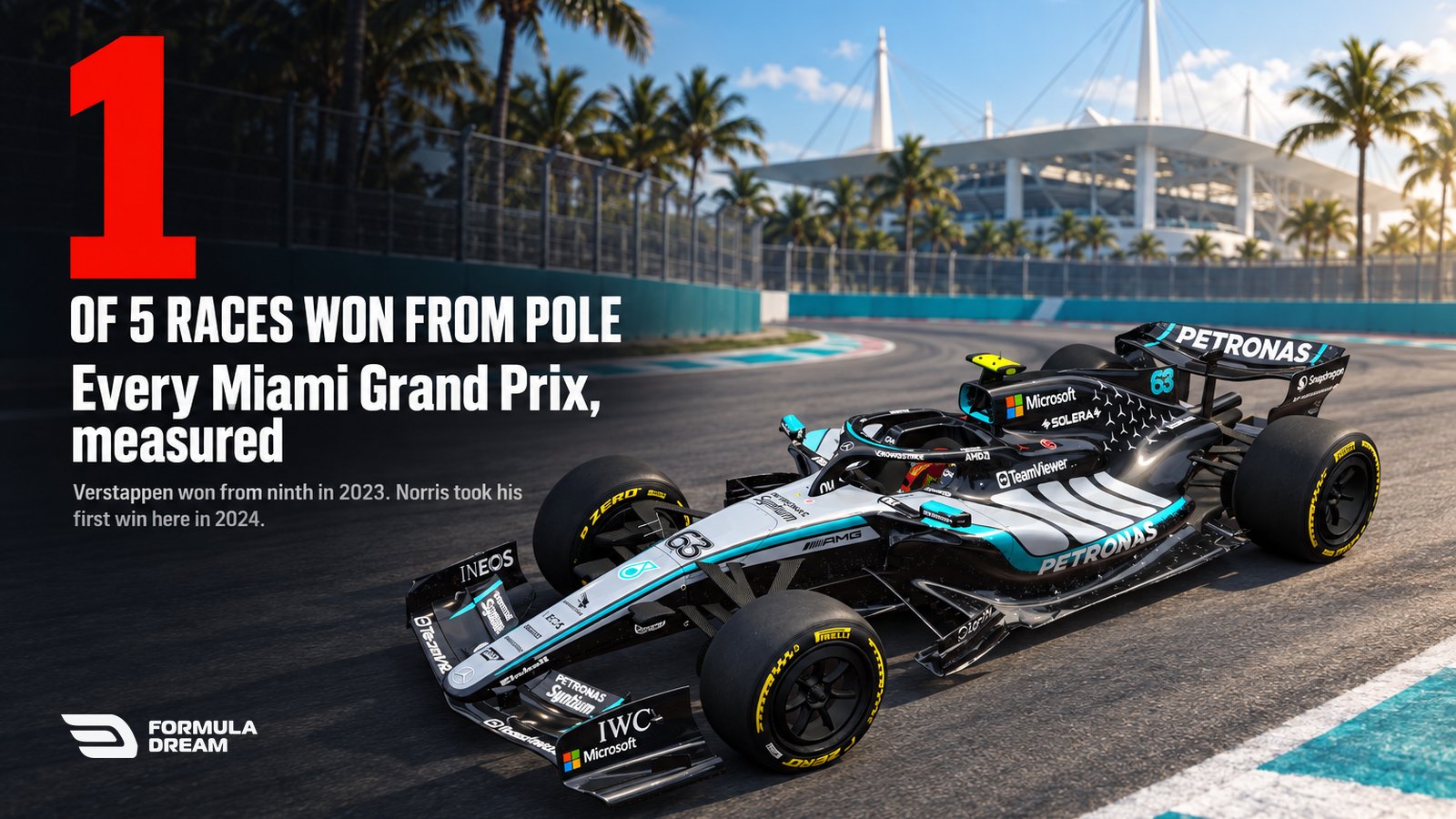
Every Miami Grand Prix winner, measured: five races, and pole has won only one of them
Five Miami Grands Prix have been held since 2022, and only one was won from pole: Kimi Antonelli's in 2026. Max Verstappen won from ninth in 2023, and Lando Norris took his first win there in 2024. Every winner, grid slot and safety car, measured.