What Is Downforce in F1? The Force That Makes Everything Else Possible
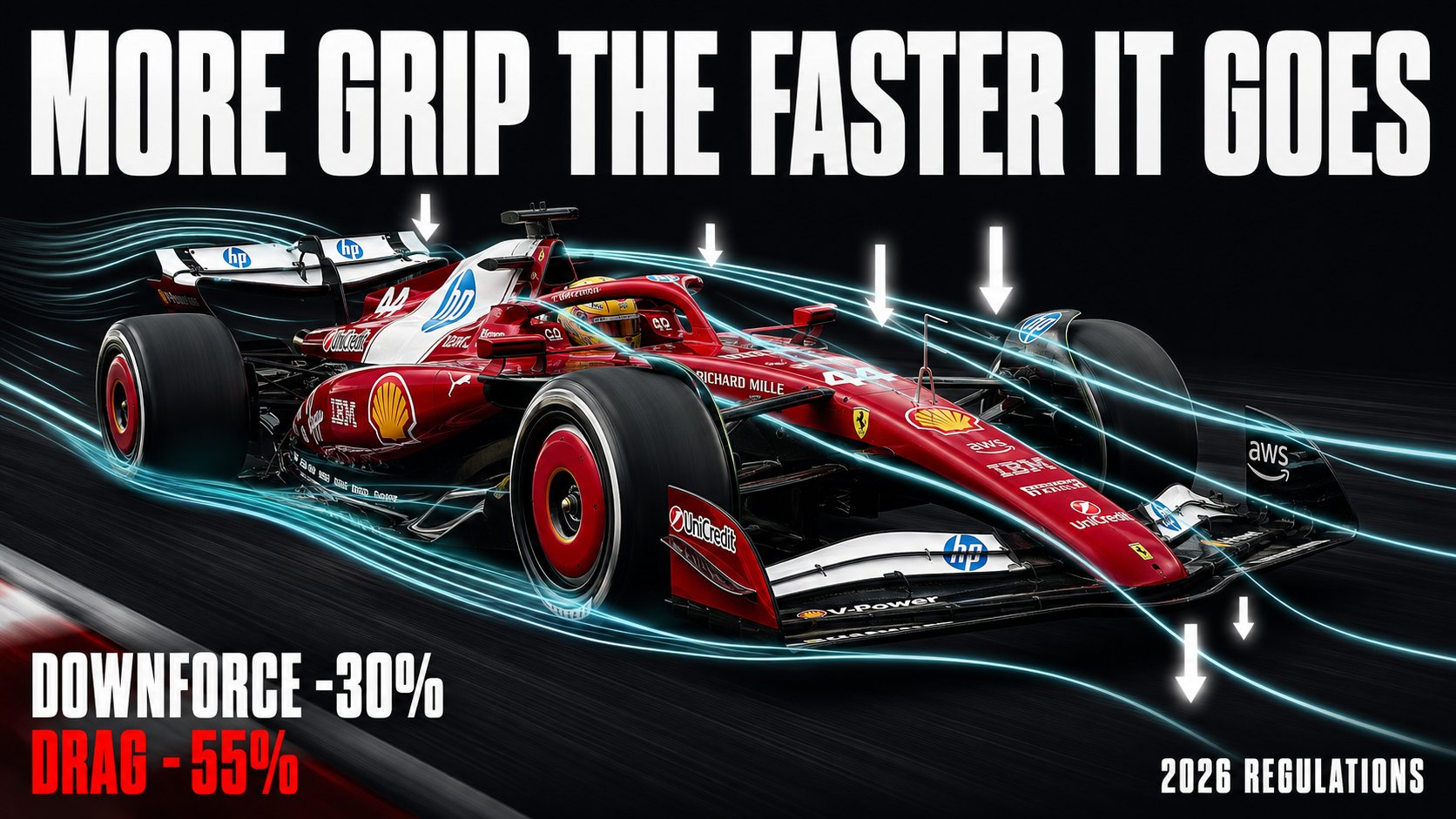
Downforce is aerodynamic grip, and it is where almost all of an F1 car's performance comes from. For 2026 the sport cut it by 30% on purpose. Here is what that does.
Downforce is aerodynamic force pushing the car down onto the track. Wings and the floor turn airflow into vertical load, the tyres press harder into the surface, and the car generates far more grip than its weight alone could produce.
Almost everything impressive about a Formula 1 car traces back to it. The cornering speeds, the braking distances, the acceleration out of a corner: all of it is downforce.
Which is why the most significant thing about the 2026 cars is that Formula 1 deliberately took 30% of it away
Grip depends on how hard a tyre is pressed into the road. You can achieve that with mass, but mass has to be accelerated, stopped and turned, so it costs you everywhere.
Downforce is the trick that escapes the trade. It presses the car down without adding weight to move, and it scales with the square of speed: double the speed and you get roughly four times the load.
That produces the defining characteristic of an F1 car. The faster it goes, the more grip it has. A road car runs out of grip as speed rises. An F1 car gains it, which is why the fast corners are the impressive ones and the slow hairpins are the ones where the car feels ordinary.
It is also why the car is at its most vulnerable when slow: leaving the pits, on a safety car restart, or on a wet formation lap, there is barely any aerodynamic load at all.
Where it comes from
Three sources, in rough order of importance on a modern car.
The floor. The single biggest contributor. Air accelerated underneath the car creates low pressure that effectively sucks it down. This is ground effect, and the details are in the F1 floor explained.
The rear wing. Large, adjustable, and the most visible aerodynamic device. It also generates a great deal of drag, which is the trade at the heart of setup.
The front wing. Balances the car and, just as importantly, sets up the airflow for everything behind it. Get the front wing wrong and the floor never works properly, which is covered in F1 front wings and outwash.
The floor's dominance is why teams guard photographs of it, and why floor damage from a first-lap incident wrecks a race in a way a scraped rear wing endplate does not.
The cost: drag
Downforce is not free. The same surfaces that generate vertical load also generate drag, the resistance holding the car back on the straights.
Every setup decision is that trade. Monza runs the skinniest wings of the season because the lap is mostly straights, so drag hurts more than cornering grip helps. Monaco runs maximum downforce because top speed is nearly irrelevant. The full ranking is in the fastest F1 circuits.
It is also the reason DRS existed for fifteen years: a way to temporarily dump rear downforce, and its drag, to help a chasing car pass.
What 2026 changed, and why
The current regulations cut aerodynamic performance sharply and on purpose:
Downforce reduced by around 30%
Drag reduced by around 55%
Note that drag fell much further than downforce. That is the point. The cars are more efficient aerodynamically, with a better ratio of grip to resistance, even though the absolute grip is lower. The stated aim was to improve efficiency and handling and make the cars more raceable.
The floor is now described by Formula 1 as "partially flat" with a "lower-powered diffuser", so ground effect is reduced rather than removed. And DRS is gone, replaced by active aerodynamics: wings that switch between Straight Mode, a low-drag setting for straights, and Corner Mode, high downforce for corners, several times a lap.
What less downforce actually did
We measured it rather than taking the intention on trust.
Comparing pole laps at the ten circuits raced in both 2025 and 2026, the current cars are 3.046% slower. On a 90 second lap that is about 2.7 seconds, and every one of those ten circuits got slower, with no exceptions. The full method is in are F1 cars getting faster.
So the cars are quicker in a straight line, because of that 55% drag reduction, and meaningfully slower over a lap, because cornering is where most lap time lives. It is a useful demonstration of how little top speed matters: by that measure 2026 looks like progress, and by lap time it is the biggest step backwards since 2022.
The one thing the reduction was supposed to fix has not fully arrived either. Less downforce should mean a smaller wake and easier following, but our measurements still show a clear cost at close range: running within a second of another car costs about 0.49 seconds a lap, as set out in what dirty air actually costs.
The number people always want
The claim you will see everywhere is that an F1 car generates enough downforce to drive upside down in a tunnel.
At sufficient speed the aerodynamic load does exceed the car's weight, so the physics is not absurd. It has never been done, and the practical obstacles are not aerodynamic: the fuel and oil systems are not designed to run inverted, and the engine would stop. Treat it as a way of expressing scale rather than a claim about something anyone has attempted.
Published downforce figures vary widely between sources and between cars, and teams do not release their real numbers, so precise kilogram claims should be treated with caution. What is reliable is the shape of it: at racing speed the aerodynamic load on the car is greater than the car itself.
Watch downforce in the lap times
Downforce is invisible, and its effects are the most visible things on a timing screen.
The Formula Dream app runs a live Dashboard through every session: every car on the circuit map, and a timing tower with lap times, gaps and intervals, tyre compound and age, plus flag and safety car alerts as race control calls them. Sector times are where a car with more downforce separates itself, and where a car that has lost floor damage shows it immediately. You also get live driver radio as it is broadcast, and every FIA document of the weekend as it is published.
Free, no subscription, no ads, independent. Not affiliated with Formula 1.
Aerodynamic force pressing the car down onto the track, generated by the wings and the floor. It increases grip without adding weight, and it scales with the square of speed, so the faster the car goes the more grip it has.
Where does an F1 car's downforce come from?
Mostly the floor, through ground effect, with the rear and front wings contributing the rest. The front wing also conditions the airflow that everything behind it depends on.
How much downforce did F1 lose in 2026?
Around 30%, alongside a roughly 55% reduction in drag. Drag fell further than downforce, so the cars are aerodynamically more efficient despite having less absolute grip.
Can an F1 car drive upside down?
At high enough speed the aerodynamic load exceeds the car's weight, so in principle yes. It has never been attempted, and the obstacle is not aerodynamics but the fuel and oil systems, which are not built to run inverted.
Why are the 2026 cars slower if drag is down?
Because lap time is mostly made in corners, not on straights. We measured 2026 pole laps as 3.046% slower than 2025 across the ten shared circuits, even though less drag makes the cars quicker in a straight line.
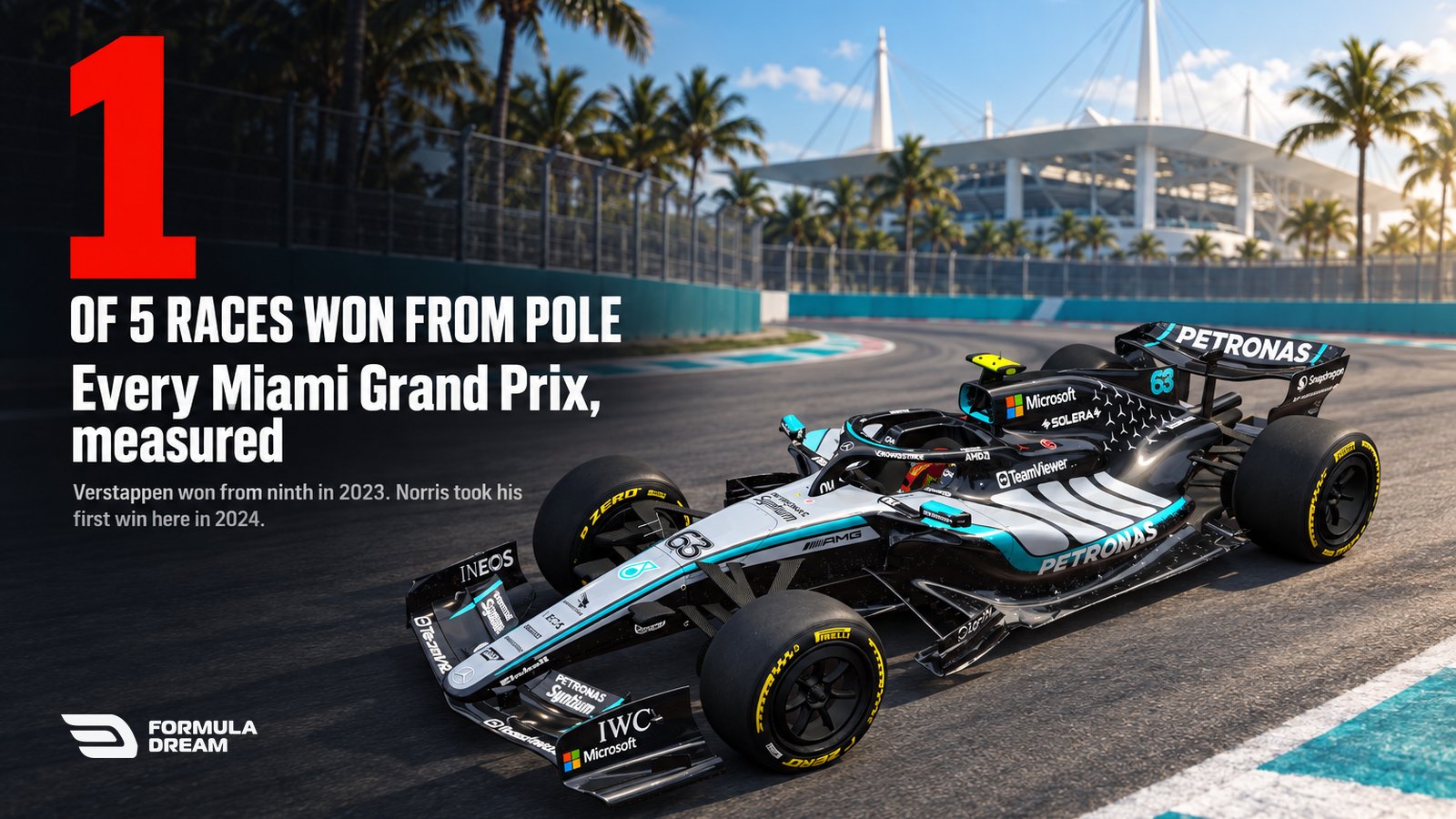
Every Miami Grand Prix winner, measured: five races, and pole has won only one of them
Five Miami Grands Prix have been held since 2022, and only one was won from pole: Kimi Antonelli's in 2026. Max Verstappen won from ninth in 2023, and Lando Norris took his first win there in 2024. Every winner, grid slot and safety car, measured.