Parts of an F1 Car Explained, With Diagram | Formula Dream
Guides
Anatomy of an F1 Car: Every Main Part, and What It Really Does
A full tour of the anatomy of an F1 car, the front wing, floor, sidepods, halo, power unit, rear wing, brakes and tyres, what each part does, and why the whole car works as one connected aerodynamic system.
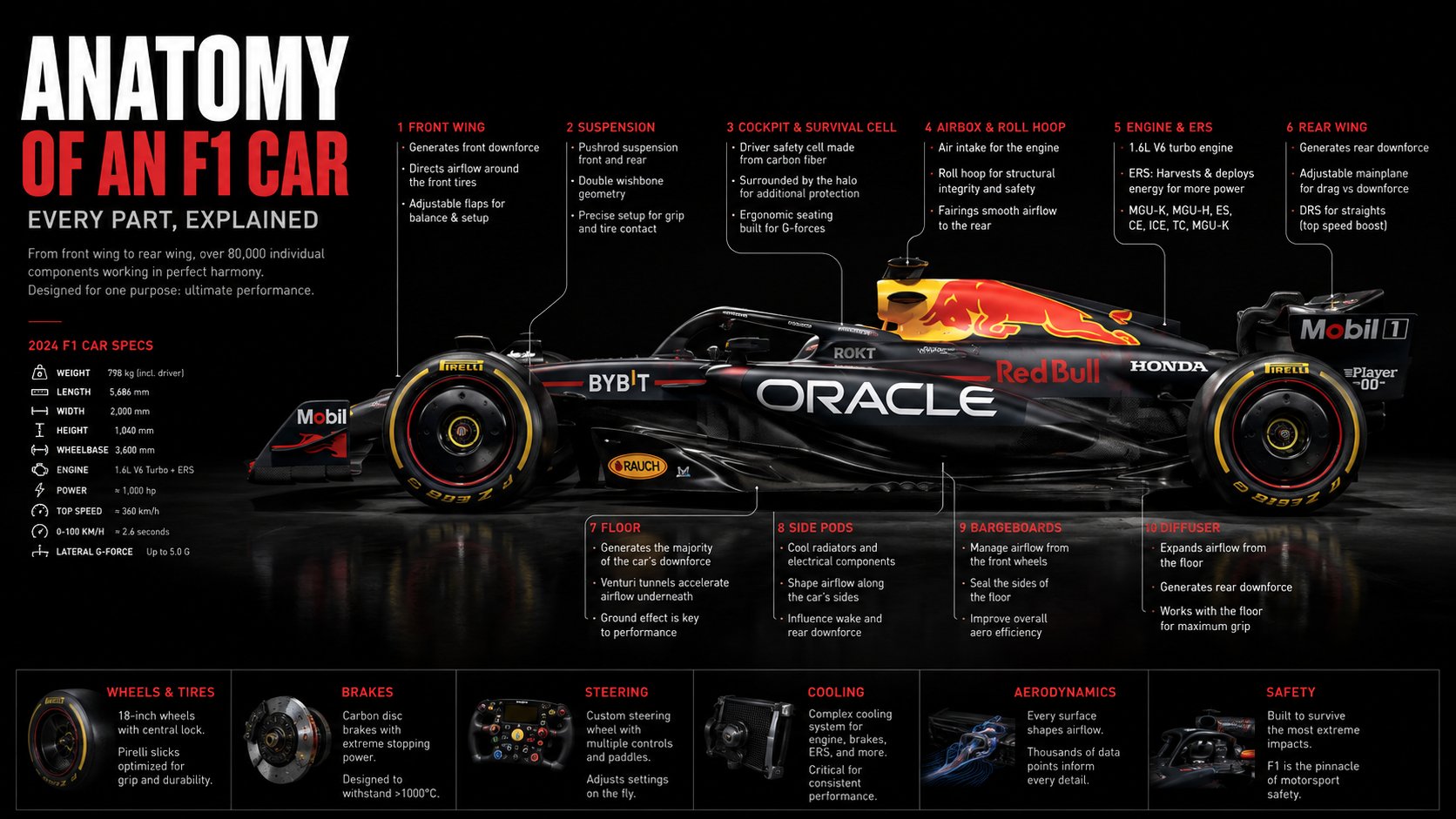
An F1 car can look like a chaos of carbon fibre and winglets, but there is a logic to all of it. Almost every part is doing one of two jobs: making the car go faster, or keeping the driver safe. And the parts that chase speed are almost all chasing the same thing, grip, because grip is what lets an F1 car corner, brake and accelerate far harder than anything else on wheels. Once you understand what each major component is for, and how they all feed into one another, the whole machine starts to make sense. Here is the tour, from the nose to the rear wing.
Every part on this list is discussed over the radio during a race, usually in shorthand. You can hear it: every message from the last Grand Prix is in our
, with the audio and a transcript that colours itself by who is speaking.
What are the parts of an F1 car?
The short answer, before the detail. An F1 car is built from these main parts:
Front wing and nose, which generate downforce and set up the airflow for everything behind
Survival cell (the monocoque), the carbon tub the driver sits in
Halo, the titanium structure protecting the driver's head
Floor and diffuser, which produce most of the car's downforce
Sidepods and cooling inlets, feeding the radiators
Power unit, the turbo-hybrid engine and its energy recovery systems
Gearbox and rear suspension
Rear wing, which balances the car and switches between Corner Mode and Straight Mode
Brakes, carbon discs running at around 1,000°C
Tyres, the only part touching the road
Almost every one of them is doing one of two jobs: making the car go faster, or keeping the driver alive. And the parts chasing speed are nearly all chasing the same thing, which is downforce.
Here is what each one actually does.
Specification
2026 rule
Minimum weight
768 kg, including the driver but not fuel
Maximum wheelbase
3,400 mm
Maximum width
1,900 mm
Engine
1.6-litre turbocharged V6
Electric motor (MGU-K)
Up to 350 kW
Forward gears
8
Wheel rims
Magnesium alloy
Rear lights
3
Key 2026 F1 car dimensions and specifications, from the FIA Technical Regulations.
Every main part of an F1 car, in one view. The bodywork is shown transparent so the survival cell, power unit and gearbox are visible in their real positions.
The front wing
The first thing to meet the air, and the most important aerodynamic surface on the car after the floor. The front wing does two jobs at once. It makes downforce over the front tyres, giving the car its ability to turn in. And it acts as the car's air traffic controller, taking the oncoming air and directing it precisely around the front wheels and down the body, setting up the airflow for every part behind it. Teams adjust its flap angle between sessions to move the car's balance toward or away from understeer, and because it is so sensitive, it is the very first thing to lose performance when a car runs in another's dirty air. That is why following closely makes a car push wide. Since 2026 the front wing also moves on track: its flaps switch between a high-downforce Corner Mode and a low-drag Straight Mode on the straights.
The nose and the survival cell
Behind the front wing, the nose connects to the heart of the car: the survival cell, or monocoque. This is a single moulded tub of carbon fibre that houses the driver, the fuel and the front of the car, and it is astonishingly strong. It is the reason drivers walk away from enormous accidents with the car destroyed around an intact cockpit. Everything else, engine, wings, suspension, bolts onto this central safety structure, and each design has to pass a series of FIA impact and load tests before it is allowed to race.
The floor and diffuser
If you could only understand one part of a modern F1 car, make it this one. The floor is the single biggest source of the car's downforce. Shaped channels underneath, called Venturi tunnels, accelerate the air passing beneath the car to create a zone of low pressure that literally sucks the car down onto the track. This is ground effect, and it is both powerful and efficient. At the very back, the floor sweeps upward into the diffuser, which manages how that fast underfloor air expands and exits, sealing the whole system. Get the floor right and you have the fastest car; get it wrong and, as 2022 showed, you get a car that bounces. The 2026 rules reined this in: Formula 1 describes the new floor as partially flat with a lower-powered diffuser, part of a cut of around 30% in downforce.
The sidepods and cooling
The bodywork along the car's flanks, the sidepods, hides the radiators that stop the power unit and its battery from cooking themselves. Their shape is a permanent tug-of-war: cooling wants big openings to let air in, while aerodynamics wants the bodywork wrapped as tightly as possible to feed clean air to the floor and rear wing. This is one of the areas where teams differ most visibly, and where clever packaging can be worth real lap time.
Floor edges, and why bargeboards are gone
The turbulent wake thrown up by the spinning front tyres is one of aerodynamics' nastiest problems, because it wants to spill straight into the floor. Until 2021 teams attacked it with bargeboards, intricate carbon vanes at the front of the sidepods that pushed the air as far outboard as possible. That worked for the car using them and wrecked the air for anyone following, so the 2022 rules outlawed them. Today the job falls to the detailed edges and fences of the floor, which shepherd the messy air away from the underfloor within far stricter geometric limits. They look like afterthoughts. They are some of the most heavily developed parts on the car.
The halo
The curved titanium hoop over the cockpit does nothing for speed, its only job is safety. It deflects wheels, debris and other cars away from the driver's exposed head, is made from several kilograms of titanium, and must withstand a load of 125 kilonewtons, about 12.7 tonnes. In the rulebook it is called the Secondary Roll Structure. It was controversial when it arrived in 2018 and is unquestioned now, because it has saved lives. The full story is in our guide to the halo.
The power unit
Behind the driver sits the power unit, and "engine" undersells it. It is a 1.6-litre turbocharged V6 combined with an energy recovery system that harvests and redeploys electrical power, together producing around 1,000 horsepower while sipping fuel by racing standards. It breathes through the airbox, the intake above the driver's head, and since 2026 its power has been split roughly 50/50 between the combustion engine, about 400 kW, and the electric motor, up to 350 kW.
The rear wing
At the back, the rear wing makes downforce over the rear tyres to balance the front, and it is a major source of drag. Until 2025 it also housed DRS, the flap that opened on straights to shed drag and help overtaking. From 2026 that job became part of active aerodynamics: both the front and rear wings switch between Corner Mode, for downforce in braking zones and corners, and Straight Mode, a low-drag setting on the straights.
The back of an F1 car
Look at an F1 car from behind and you are seeing several parts stacked together. At the top is the rear wing. Low down is the exit of the diffuser, the upswept tail of the floor. In the middle sits the rear impact structure, a crash structure the rules require behind the gearbox to absorb a rear-end hit, and around it the single exhaust tailpipe and the rear lights. There must be three of them, switchable from the cockpit, and they are what you see flashing through the spray in a wet race. Hidden under the bodywork are the gearbox and the rear suspension.
The brakes and tyres
These are the unsung heroes of an F1 car's staggering pace. The brakes use carbon-fibre discs that only work properly when glowing red hot, around 1,000 degrees Celsius, and Brembo puts an F1 car's stop from 300 km/h to a standstill at under four seconds. And the tyres are the whole point of everything else: four small contact patches are the only thing connecting all that power and downforce to the road. Every other part on the car is ultimately trying to help those four patches of rubber grip.
How it all works as one system
Here is the idea that ties the whole car together, and it is the thing that makes F1 engineering so hard. An F1 car is not a collection of independent parts. It is a single, deeply connected aerodynamic system. The front wing conditions the air for the floor. The floor and diffuser generate the downforce that loads the tyres. The floor edges keep the tyre wake from ruining the floor. The suspension controls the car's ride height, which changes how the floor works. Touch any one part and you change the behaviour of all the others, often in ways that are hard to predict.
The journey of the air: the front wing splits and directs it, the floor accelerates it underneath to suck the car down, and the diffuser and rear wing manage its exit. Every part feeds the next.
That is why teams spend hundreds of millions chasing tiny gains, and why a change that looks like an improvement in isolation can make the whole car slower. Understanding the anatomy of an F1 car is not just about naming the parts. It is about seeing how they conspire, all together, to press four small patches of rubber into the track.
You can hear that interconnection failing in real time. When a floor is damaged or a front wing endplate is lost, a driver almost never reports the part. They report the symptom: understeer, the rear stepping out, no front end. Team radio is full of drivers describing an aerodynamic problem through its consequences, and the engineer's job is to work backwards from the symptom to the component that caused it.
See every part up close
Reading about the parts is one thing, seeing them is another. Our 3D Showroom lets you walk around the current F1 cars and study the front wing, sidepods, floor and rear wing from every angle.
See the car working, live
A diagram shows you the parts. A session shows you what they are doing.
The Formula Dream app runs a live Dashboard through every session: every car on the circuit map, and a timing tower with lap times, gaps, intervals, tyre compound and age, plus flag and safety car alerts as race control calls them. You also get live driver radio as it is broadcast, which is where you hear a driver describe what the floor or the front wing is actually doing, and every FIA document of the weekend as it is published, including the technical and scrutineering reports on these parts.
Free, no subscription, no ads, independent. Not affiliated with Formula 1.
Two parts deserve their own explanation. The gearbox is in F1 gearboxes explained, and the helmet, which is not part of the car but is the most tested object a driver owns, is in the F1 helmet explained.
Frequently asked questions
What are the main parts of an F1 car?
The front wing, nose and survival cell, floor and diffuser, sidepods, halo, power unit, gearbox, rear wing, brakes and tyres. Most exist to make downforce, cut drag, or protect the driver.
What part of an F1 car makes the most downforce?
The floor and diffuser, through ground effect, with the front and rear wings making the rest. The 2026 floor is partially flat, with a lower-powered diffuser than the 2022 to 2025 cars had.
What is the survival cell?
The carbon-fibre monocoque tub at the centre of the car that houses the driver and fuel. It is extremely strong and is the main reason drivers survive huge crashes with the car destroyed around them.
Why is the front wing so important?
It makes downforce over the front tyres and directs the airflow for the entire rest of the car, so its performance affects every part behind it. It is also the first thing to lose downforce in dirty air.
Why is an F1 car described as one system?
Because the parts feed into each other, the front wing sets up the floor, the floor loads the tyres, the suspension controls the floor's ride height, and so on. Changing one part affects all the others, which is what makes car development so difficult.
What is the back of an F1 car called?
There is no single name. From top to bottom it is the rear wing, the rear impact structure carrying the rear lights and exhaust, and the diffuser, the upswept end of the floor. The gearbox and rear suspension sit under the bodywork.
Do F1 cars still have bargeboards?
No. Bargeboards were outlawed from 2022 because they threw disrupted air at following cars. The edges and fences of the floor now manage the front tyre wake instead.
How much does an F1 car weigh?
The 2026 minimum is 768 kg, including the driver but not fuel, down from 800 kg in 2025. The full breakdown is in how much an F1 car weighs.
---
Sources
Dimensions, minimum weight, wheel rims, halo, rear impact structure, rear lights and the wing modes: FIA 2026 Formula 1 Technical Regulations, Issue 18, Articles C2.3, C3, C4.1, C10.7, C12.4.2, C13.7 and C14.3
Nineteen Chinese Grands Prix have been held in Shanghai since 2004. Lewis Hamilton won six, pole won twelve, and in 2026 Kimi Antonelli took the first win of his career there, at 19, with Hamilton on the podium for Ferrari for the first time. Every winner, grid slot and safety car, measured.